Updates

  1. Person pages list letters, writing, profiles and links as sortable tables with filters, and show each person's companies as links; Fund letters show each letter's description in its own column.
  2. Experts show a checked job title and a short description of each person; 30 more people have photographs.
  3. Every company, fund, university and publication the experts work for has a page listing the people there.
  4. Fund letters show each letter's thesis and filter by it; 225 person pages list the essays, columns and newsletter issues the person wrote.
  5. Person pages list every essay and newsletter issue a person wrote, and their own books as a table in List view.
  6. Recommends shows the five largest kinds of book and the rest under More; browse pictures load sooner.
  7. Podcasts and talks link the original episode, filter by Audio and video or Press, and list each publisher once.
  8. Pages are wider, Recommends has List and Grid, and a filter clicked again turns off.
  9. Book cards sit in a ruled grid with Open Library and Goodreads links and each book's one-line note.
  10. Funds is now Investors; each investor's styles are buttons that filter the table.
  11. Podcasts and talks on a person's page filter by year and publisher and show as a list or a grid of pictures.
  12. Quotes show only people's own words: 472 summaries written by list sites are gone.
  13. Country pages open from Browse again, and every link on the shelf lands on a page.
  14. Subject and person pages show their sections as tabs, and each book appears once on a person's page.
  15. Book cards show the quote, who said it and the source; grids show five cards to a row.
  16. On a phone, a menu holds the sections, search, Updates, Feedback and dark mode.
  17. Feedback takes a screenshot of the page with no browser prompt, opens a screenshot full size when you click it, and clears itself once sent.
  18. Book cards are centred, search names the topic each book sits in, and any text cut short shows whole on hover.
  19. Search groups its results by kind: people, companies, geographies, subjects, topics, books, funds, fund letters and papers.
  20. The Books table lists who recommended each book by name, and the browser tab names the section you are in.
  21. Feedback can take a screenshot of the page, or one you paste or choose, and opens in the corner beside Updates.
  22. Each rail button reopens its section where you left it, and Browse, Table and People show on every book and subject page.
  23. Filters grey out choices that hold nothing instead of hiding them, and Books › People filters by authors or recommenders.
  24. Feedback takes a subject line and up to three screenshots.
  25. Biographies are grouped by the person they are about: 41 new pages, from Abraham Lincoln to Lee Kuan Yew.
  26. Sport splits into 23 sports, and Religion into one topic per faith.
  27. Book lists show as cards: the cover, one recommendation quote and every recommender by name.
  28. Seventeen subjects that had two or three pages under different names now have one page each.
  29. Every page lists its Experts as authors and recommenders, with a link to them on the Experts tab.
  30. Economics, Financial history, Financial panics and Accounting are subjects of their own, with one page per financial crisis.
  31. Book, person and subject pages open inside the app, so the tabs stay in view.
  32. 996 more book covers, and photographs or logos for 227 more people and companies.
  33. Books › Browse shows every subject as cards, and the rail holds Fund letters, Papers, Experts, Books and Funds.
  34. Every topic over 150 books splits into narrower topics, each with a page of its own.

Send feedback

What is it?
Screenshots, up to 3 (optional)
or paste one with Ctrl+V

We use your email only to reply to you.

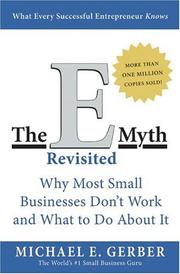
The E-Myth Revisited

The E-Myth Revisited

Michael E. Gerber
1995
T2 268 pages · about 4h 28m to read Open Librarygoodreads

Build the business as a replicable prototype; the franchise mindset generalised.

Summary

Gerber argues that most small businesses fail because they are started by technicians who are good at the work and who assume that being good at the work qualifies them to run a business. His central distinction separates three roles: the entrepreneur, who works on the business and sets direction; the manager, who creates order and systems; and the technician, who does the work. He argues that most owners are almost entirely technician and end up owning a job rather than a business.

His prescription is to build the business as if it were the prototype for a franchise, which forces every process to be documented, systemised and executable by someone with ordinary skill. He uses McDonald's as the reference case, arguing that Ray Kroc's real product was the business system rather than the food. The turnkey approach requires an operations manual, defined roles with position contracts, and standards that produce a consistent customer result independent of who performs the work.

The book includes a business development process covering innovation, quantification and orchestration, and it argues that an owner should define their primary aim in life before defining the business's strategic objective, so that the business serves the life rather than the reverse.

The narrative device, a series of conversations with a pie shop owner named Sarah, is repetitive and the book is padded to length. The advice fits service businesses and small operations with repeatable processes, and fits poorly with businesses whose value comes from judgment, creativity or specialised expertise. The systemisation argument is sound and widely applied. The franchise prototype framing is the reason people remember it.

Key takeaways 8

  1. Most small businesses are started by technicians who assume that skill at the work qualifies them to run a business, which is the source of the failure rate.
  2. An owner who works only inside the business owns a job rather than a business, and the difference is whether it can operate without them.
  3. A business should be built as if it were the prototype for a franchise, which forces documentation of every process before it is needed.
  4. Systems should be designed so that people with ordinary skill produce consistent results, rather than relying on hiring exceptional people.
  5. The owner should define what they want from their life first, and then design a business that produces it.
  6. Every role should have a written position contract stating the result it produces, the work involved and the standards, including roles the owner currently fills.
  7. Business development runs on innovation, quantification and orchestration, and quantification is the step most owners skip.
  8. Working on the business rather than in it requires scheduled time that must be protected, because operational demands will consume it otherwise.

Who should read it

Owners of small service businesses who are the bottleneck in their own operation and need to document and delegate before they can grow.

Who recommended it 9

Ali Abdaalreported
Derek Siversreported
Nick Huberreported
Simon Sinekreported
Tim Ferrissreported
Tom Bilyeureported

Similar books 6

Chosen by shared topics, the entries that hold them, and the people who recommended both.
David Heinemeier Hansson · 2010
Paul Jarvis · 2019

Why a business can stay small on purpose instead of chasing growth.

Alan Weiss · 1992

Value pricing for solo and boutique consultancies.

Recommended by: Nat Eliason, Noah Kagan

Where it sits in the reference 3

Business models
Business themes
Business themes

Topics

Entrepreneurship and StartupsBusiness and ManagementSmall Business and Bootstrapping