Updates

  1. Person pages list letters, writing, profiles and links as sortable tables with filters, and show each person's companies as links; Fund letters show each letter's description in its own column.
  2. Experts show a checked job title and a short description of each person; 30 more people have photographs.
  3. Every company, fund, university and publication the experts work for has a page listing the people there.
  4. Fund letters show each letter's thesis and filter by it; 225 person pages list the essays, columns and newsletter issues the person wrote.
  5. Person pages list every essay and newsletter issue a person wrote, and their own books as a table in List view.
  6. Recommends shows the five largest kinds of book and the rest under More; browse pictures load sooner.
  7. Podcasts and talks link the original episode, filter by Audio and video or Press, and list each publisher once.
  8. Pages are wider, Recommends has List and Grid, and a filter clicked again turns off.
  9. Book cards sit in a ruled grid with Open Library and Goodreads links and each book's one-line note.
  10. Funds is now Investors; each investor's styles are buttons that filter the table.
  11. Podcasts and talks on a person's page filter by year and publisher and show as a list or a grid of pictures.
  12. Quotes show only people's own words: 472 summaries written by list sites are gone.
  13. Country pages open from Browse again, and every link on the shelf lands on a page.
  14. Subject and person pages show their sections as tabs, and each book appears once on a person's page.
  15. Book cards show the quote, who said it and the source; grids show five cards to a row.
  16. On a phone, a menu holds the sections, search, Updates, Feedback and dark mode.
  17. Feedback takes a screenshot of the page with no browser prompt, opens a screenshot full size when you click it, and clears itself once sent.
  18. Book cards are centred, search names the topic each book sits in, and any text cut short shows whole on hover.
  19. Search groups its results by kind: people, companies, geographies, subjects, topics, books, funds, fund letters and papers.
  20. The Books table lists who recommended each book by name, and the browser tab names the section you are in.
  21. Feedback can take a screenshot of the page, or one you paste or choose, and opens in the corner beside Updates.
  22. Each rail button reopens its section where you left it, and Browse, Table and People show on every book and subject page.
  23. Filters grey out choices that hold nothing instead of hiding them, and Books › People filters by authors or recommenders.
  24. Feedback takes a subject line and up to three screenshots.
  25. Biographies are grouped by the person they are about: 41 new pages, from Abraham Lincoln to Lee Kuan Yew.
  26. Sport splits into 23 sports, and Religion into one topic per faith.
  27. Book lists show as cards: the cover, one recommendation quote and every recommender by name.
  28. Seventeen subjects that had two or three pages under different names now have one page each.
  29. Every page lists its Experts as authors and recommenders, with a link to them on the Experts tab.
  30. Economics, Financial history, Financial panics and Accounting are subjects of their own, with one page per financial crisis.
  31. Book, person and subject pages open inside the app, so the tabs stay in view.
  32. 996 more book covers, and photographs or logos for 227 more people and companies.
  33. Books › Browse shows every subject as cards, and the rail holds Fund letters, Papers, Experts, Books and Funds.
  34. Every topic over 150 books splits into narrower topics, each with a page of its own.

Send feedback

What is it?
Screenshots, up to 3 (optional)
or paste one with Ctrl+V

We use your email only to reply to you.

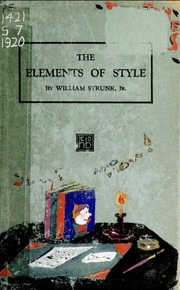
The Elements of Style

The Elements of Style

William Strunk, E.B. White
1920
76 pages · about 1h 16m to read Open Librarygoodreads

Summary

Strunk wrote the original for his Cornell students in 1918 and E. B. White, who had been one of them, revised and expanded it in 1959. It is under a hundred pages and consists of numbered rules with examples. The sections cover elementary rules of usage, principles of composition, matters of form, commonly misused words and expressions, and White's chapter on style. The most cited instructions include omit needless words, use the active voice, put statements in positive form, use definite and concrete language, keep related words together, and place the emphatic words of a sentence at the end.

White's final chapter argues that style cannot be taught directly, that it emerges from the writer rather than being applied to the writing, and that a writer should place themselves in the background and write in a way that comes naturally.

The book has been criticised seriously by linguists. Geoffrey Pullum's essay identifies rules that are factually wrong about English grammar, including the treatment of the passive voice where several of Strunk's own examples are not passive, and argues that the prescriptions have made generations of writers anxious about constructions that are perfectly standard. The usage section reflects mid-century American preferences presented as rules.

It remains useful as a discipline rather than as a description of English. The instruction to remove unnecessary words and to prefer concrete language improves nearly all writing. The rules should be treated as defaults to depart from deliberately rather than as grammar.

Key takeaways 8

  1. Omitting needless words is the single instruction that improves most writing, and it requires deciding what each word is doing.
  2. The active voice identifies who performed an action, which the passive conceals, and this usually makes the sentence shorter as well.
  3. Statements should be put in positive form, since telling a reader what is not the case leaves them without information.
  4. Definite and concrete language is understood and remembered while abstraction is not.
  5. The emphatic position in a sentence is the end, so the most important word should be placed there.
  6. Related words should be kept together, since separation forces the reader to reassemble the meaning.
  7. Style emerges from the writer rather than being applied to the writing, which is White's argument in the final chapter.
  8. Linguists have identified rules in the book that are factually wrong about English, including several of its passive voice examples.

Who should read it

Anyone who writes professionally and wants a very short set of defaults, treated as discipline rather than as grammar.

Who recommended it 6 · 2 direct

Ann Handleyreported
Kara Swisherreported
Tobi Lütkereported

Similar books 6

Chosen by shared topics, the entries that hold them, and the people who recommended both.

Mortimer J. Adler, Charles van Doren · 1940

A method for reading hard books for understanding, not just information.

Where it sits in the reference 0

No entry holds this book yet. It reached the reference because someone recommended it.

Topics

Writing and CommunicationReference WorksGeneral knowledge and practical guides