
The Gorilla Game
Technology growth investing framed around platform winners; a period piece worth reading as one.
Summary
Geoffrey Moore, Paul Johnson and Tom Kippola applied the technology adoption framework from Moore's Crossing the Chasm and Inside the Tornado to public market investing in technology stocks.
Their framework identifies a market structure that emerges in discontinuous technology categories with high switching costs and strong network effects. When such a category enters mass adoption, which Moore calls the tornado, one company typically becomes the gorilla, capturing the majority of the market and the great majority of the profits, while others become chimpanzees, holding defensible niches, or monkeys, selling clones at low margin. Their investment prescription follows: identify a category entering the tornado, buy a basket of all plausible gorilla candidates, hold through the volatility, and consolidate the position into the winner as it becomes clear, selling the others.
They are explicit about when the method does not apply: categories without proprietary architecture and high switching costs produce no gorilla, and the strategy fails there. The book was published in 1998, at the height of the technology bubble, and its examples date badly; several of the companies it identifies as gorillas were displaced or destroyed. The framework's underlying observation, that winner-take-most dynamics appear in categories with switching costs and network effects, is sound and the strategy of buying the category rather than the company is a defensible response to uncertainty about which firm wins.
Key takeaways 7
- Technology categories with proprietary architecture and high switching costs produce one dominant firm capturing most of the profit.
- An investor should buy a basket of all plausible winners during the adoption phase rather than attempting to pick one.
- The position should be consolidated into the emerging winner as the market resolves, selling the others.
- Categories without proprietary architecture and switching costs produce no dominant firm, and the strategy does not apply to them.
- Value accrues to the owner of the architecture that others must build against rather than to the best product.
- The authors distinguish gorillas, chimpanzees and monkeys by whether they own the architecture, hold a niche, or sell clones.
- The book's specific examples date badly, and several identified winners were subsequently displaced.
Who should read it
Technology investors who want a framework for handling uncertainty about which firm wins a category with winner-take-most dynamics.
About Geoffrey A. Moore
American technology-marketing consultant and venture partner at Mohr Davidow Ventures who wrote Crossing the Chasm.
Crossing the Chasm identifies the gap between early adopters and the pragmatic majority and prescribes the beachhead answer: dominate one narrow segment with a complete product before widening. Inside the Tornado and Living on the Fault Line carry the model into hypergrowth and into managing businesses at different stages of maturity at once.
Similar books 6
Chosen by shared topics, the entries that hold them, and the people who recommended both.

Run a tech company for shareholder value by funding its core advantage.
“Moore's forthcoming book, Living on the Fault Line... is terrific and highly recommended.” — Michael Mauboussin
Source: Network to Net Worth: Exploring Network Dynamics (CS First Boston)
Recommended by: Michael Mauboussin

Subtitled Stocks That Return 100-to-1 and How to Find Them; expanded edition 2025.
Recommended by: Mohnish Pabrai

The 1972 original that Mayer updated; buy right and hold on.
Recommended by: Mohnish Pabrai
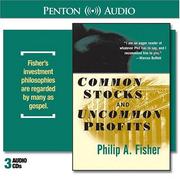
Buy a few outstanding growth companies, research them by scuttlebutt, and hold.
“The late Philip Fisher wrote several books that are very good [including] Common Stocks and Uncommon Profits.” — Arnold Van Den Berg
Source: Van Den Berg on Fisher's books
Recommended by: Arnold Van Den Berg, Bill Stewart and 10 others

The amateur's edge argument from the Magellan record.
“One book that probably made the biggest impact on my career in those early formidable years back in the day was Peter Lynch's 'One Up on Wall Street.'” — David Rolfe
Source: Rolfe on the book that most shaped his early career
Recommended by: David Rolfe, Francisco Garcia Parames and 9 others
Biography of the man who named and institutionalised growth investing.
Where it sits in the reference 2
Topics