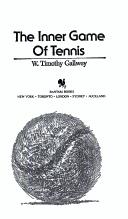
The Inner Game of Tennis
Performing under pressure by quieting the self-interference that spoils play.
Performance under pressure; the self-interference problem investors recognise
Summary
Gallwey argues that a player's main opponent is inside the mind: self-doubt, nervousness and lapses in concentration. He calls this contest the inner game. The key to good play, in his account, is not the exact grip or footwork but an uncluttered mind, which he describes as a state of relaxed concentration.
Gallwey teaches players to trust the intuitive knowledge of their bodies instead of directing every stroke with conscious instruction, and he gives chapters to trusting oneself and to changing habits. The method has spread beyond tennis. Billie Jean King called the book her tennis bible, Al Gore used it with his campaign staff, Itzhak Perlman recommended it to young violinists, and Bill Gates named it one of his five favourite books. The series it started has sold more than one million copies, and Gallwey applies the same approach to music, writing and work.
Key takeaways 4
- Performance suffers most from interference inside the mind: doubt, nerves and lost focus.
- Relaxed concentration produces better results than conscious, step-by-step self-instruction.
- The body often knows how to perform a skill if the mind stops interfering.
- The same method applies to music, writing and work as well as to sport.
Who should read it
Anyone who performs under pressure, investors included, and wants a method for quieting the self-interference that spoils judgement.
Who recommended it 4 · 4 direct
“When I played tennis as a teenager, I remember reading The Inner Game of Tennis: The Classic Guide to the Mental Side of Peak Performance by Tim Gallwey. Near the end of my recent sabbatical + birthday vacation, after almost seven weeks of tennis where I played at least five days a week, I decided to read it again.”
“There's a really good book that I very highly recommend called The Inner Game of Tennis.”
Similar books 6
Chosen by shared topics, the entries that hold them, and the people who recommended both.
Why people mistake luck for skill, above all in markets.
“Fooled By Randomness was unquestionably the best non-fiction book I read in 2005.” — Brad Feld
Source: Book Review: Fooled By Randomness — Feld Thoughts
Recommended by: Barton Biggs, Brad Feld, Derek Sivers and 15 others

Speeches making the case for a latticework of mental models from many fields.
“…books I've recommended, highlighted to death, or forced on friends.” — Andrew Wilkinson
Source: Andrew Wilkinson's Bookshelf, neverenough.com
Recommended by: Andrew Wilkinson, Charlie Munger and 26 others
How cognitive dissonance drives people to justify their mistakes, not admit them.
“We are wired for self-justification. We create fictions that absolve us of responsibility, restoring our belief that we are smart, moral, and right — a belief that often keeps us on a course that is dumb, immoral, and wrong.” — Derek Sivers
Source: Derek Sivers book notes (primary, rated list) · Rating: 3/10
Recommended by: Derek Sivers, Howard Marks, Mohnish Pabrai and 3 others
Rare, unforeseen, high-impact events drive history, explained only after the fact.
“The Black Swan U The best-known bird around today is The Black Swan, the second book from Nassim Nicolas Taleb.” — Howard Marks
Source: The Complete Collection, page 530
Recommended by: David Perell, Howard Marks, Marc Andreessen and 20 others
How people hide their real motives from themselves in order to hide them from others.
“You have hidden motives and subconscious incentives. Two reasons for doing anything: a good reason and the real reason. Instititutions do this too: wasteful because they’re serving hidden purposes no one acknowledges. Great insights throughout.” — Derek Sivers
Source: Derek Sivers book notes (primary, rated list) · Rating: 8/10
Recommended by: Derek Sivers, Nat Eliason, Tyler Cowen and 4 others
Beyond a point, more options make people less likely to choose and less satisfied.
“Faced with many options or decisions in your life? This will change the way you look at them. We feel worse when we have too many options.” — Derek Sivers
Source: Derek Sivers book notes (primary, rated list) · Rating: 9/10
Recommended by: Derek Sivers, Nat Eliason, Nick Sleep and 1 other
Where it sits in the reference 1
Topics 4
As an Amazon Associate I earn from qualifying purchases.