Updates

  1. Fund letters lists 118 more letters, each with its own page: 44 weekly commentaries by Jeremy Siegel from 2026, 31 issues of Van Tharp's newsletter from 2018, 23 Pabrai Investment Funds letters from 2021 to Q3 2026, 13 Efficient Frontier essays by William Bernstein, Oakmark's three 3Q 2026 commentaries, two Lindsell Train reports, a John Hussman comment and Third Point's Q3 2026 letter.
  2. 2,027 more books carry a one-line description in the Books table and on their pages; 7,067 of 7,715 have one, every tier 1, 2 and 3 book among them.
  3. Fund letters lists 187 more letters from 19 firms, among them Permanent Equity, Social Capital, Lux Capital, Square Peg, Bestinver, Cobas, Sequoia Fund, Marketfield and EquityCompass; each shows on its investor's page and has a page of its own.
  4. 2,928 more books carry a one-line description in the Books table and on their pages, so every tier 1, 2 and 3 book has one; 5,040 in all.
  5. Every publication on Newsletters has its own page: its writing, its writers, its staff and who recommends it. Investor pages have a Management tab; a company's Experts tab now leaves out its own people, who list under Management. Tabs on a phone move sideways only.
  6. Every fund letter and research paper has its own page: the thesis, the PDF, the companies and books it names, and for 176 letters and 24 papers so far a summary, key insights and quotes with their page.
  7. 99 books that no page listed now sit under their topics in Books, among them Caste, American Prometheus and Pale Blue Dot.
  8. Newsletters lists every newspaper, magazine, investment newsletter, journal and blog the reference holds, 442 in all, with the people who write there. The search box keeps your last 20 searches. You can create an account.
  9. 283 books that fund managers recommend in their letters are on the shelf, each with the letter's own words and page; investor pages have a Recommends tab.
  10. Person, company, investor and show pages link their own accounts on X, Threads, Instagram, LinkedIn, YouTube and Substack: 275 people, 552 companies and organisations, 88 investors and 478 shows.
  11. 716 more book recommendations name their source: the person's own reading list, letter, blog post, speech or interview, or an article that reports it. 232 of them quote the person's own words about the book, on the book card and on the book's page.
  12. Every US-listed company has a page with its SEC filings. Company pages list their experts and their management, past and present. Fund managers sit under Investors. Each show has a page of its episodes, and an episode page names its guests and hosts. Biographies lists groups, then people. Breadcrumbs show where a page sits.
  13. Media lists every podcast episode, video, interview and talk, over 10,000, by person, company, publisher and event; each filter searches its own choices. Books opens on its table, then Browse, then Authors and Recommenders. A filter's count no longer covers its arrow.
  14. A book that no company, country or subject page lists shows its topics under Where it sits in the reference. On a phone, a page's tabs scroll sideways only. Descriptions read the same on every page. See them in the Experts tab lists every expert the page names.
  15. Every podcast episode, video and interview has its own page with a video or audio player and a link to the source. Investor pages show each company's sector and market cap; firms such as Berkshire Hathaway have one page that holds their letters and their company tabs. Letters tabs filter by company and search the theses. Companies filter by Public, Private and Defunct and link each company's website.
  16. Every tab, view and search has its own address, such as /books/table/asset or /letters/companies, so Back works and a link opens the same place. Page addresses no longer end in .html. Fund letters, Investors, Companies and Papers load about a fifth of the data they did.
  17. Fund letters has a Companies tab: every company the letters name, with its market cap, sector, country, and how many letters and investors name it. Investor pages link each investor's website. Lists in table cells end with “… and N more” at every width.
  18. 1,120 more book summaries; descriptions for 373 papers; pages for 137 more companies, each with the fund letters that discuss it; 215 official photographs; search has its own page.
  19. 411 more books have a summary; person pages list 930 more of the books they wrote; 147 people show their official photograph.
  20. Every investor has a page with its letters and the companies they discuss; company pages list the investors whose letters name them.
  21. A Companies section at the top of the rail lists every company the books, experts and fund letters name.
  22. Person pages list letters, writing, profiles and links as sortable tables with filters, and show each person's companies as links; Fund letters show each letter's description in its own column.
  23. Experts show a checked job title and a short description of each person; 30 more people have photographs.
  24. Every company, fund, university and publication the experts work for has a page listing the people there.
  25. Fund letters show each letter's thesis and filter by it; 225 person pages list the essays, columns and newsletter issues the person wrote.
  26. Person pages list every essay and newsletter issue a person wrote, and their own books as a table in List view.
  27. Recommends shows the five largest kinds of book and the rest under More; browse pictures load sooner.
  28. Podcasts and talks link the original episode, filter by Audio and video or Press, and list each publisher once.
  29. Pages are wider, Recommends has List and Grid, and a filter clicked again turns off.
  30. Book cards sit in a ruled grid with Open Library and Goodreads links and each book's one-line note.
  31. Funds is now Investors; each investor's styles are buttons that filter the table.
  32. Podcasts and talks on a person's page filter by year and publisher and show as a list or a grid of pictures.
  33. Quotes show only people's own words: 472 summaries written by list sites are gone.
  34. Country pages open from Browse again, and every link on the shelf lands on a page.
  35. Subject and person pages show their sections as tabs, and each book appears once on a person's page.
  36. Book cards show the quote, who said it and the source; grids show five cards to a row.
  37. On a phone, a menu holds the sections, search, Updates, Feedback and dark mode.
  38. Feedback takes a screenshot of the page with no browser prompt, opens a screenshot full size when you click it, and clears itself once sent.
  39. Book cards are centred, search names the topic each book sits in, and any text cut short shows whole on hover.
  40. Search groups its results by kind: people, companies, geographies, subjects, topics, books, funds, fund letters and papers.
  41. The Books table lists who recommended each book by name, and the browser tab names the section you are in.
  42. Feedback can take a screenshot of the page, or one you paste or choose, and opens in the corner beside Updates.
  43. Each rail button reopens its section where you left it, and Browse, Table and People show on every book and subject page.
  44. Filters grey out choices that hold nothing instead of hiding them, and Books › People filters by authors or recommenders.
  45. Feedback takes a subject line and up to three screenshots.
  46. Biographies are grouped by the person they are about: 41 new pages, from Abraham Lincoln to Lee Kuan Yew.
  47. Sport splits into 23 sports, and Religion into one topic per faith.
  48. Book lists show as cards: the cover, one recommendation quote and every recommender by name.
  49. Seventeen subjects that had two or three pages under different names now have one page each.
  50. Every page lists its Experts as authors and recommenders, with a link to them on the Experts tab.
  51. Economics, Financial history, Financial panics and Accounting are subjects of their own, with one page per financial crisis.
  52. Book, person and subject pages open inside the app, so the tabs stay in view.
  53. 996 more book covers, and photographs or logos for 227 more people and companies.
  54. Books › Browse shows every subject as cards, and the rail holds Fund letters, Papers, Experts, Books and Funds.
  55. Every topic over 150 books splits into narrower topics, each with a page of its own.

Send feedback

What is it?
Screenshots, up to 3 (optional)
or paste one with Ctrl+V

We use your email only to reply to you.

The Most Important Thing Illuminated

The Most Important Thing Illuminated

Second-level thinking on risk and cycles, with notes by Klarman and Greenblatt.

Annotated edition of the 2011 book with four commentators.

Summary

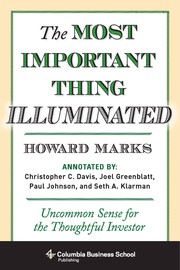
This edition adds commentary from four investors to Marks' original text: Christopher Davis, Joel Greenblatt, Paul Johnson and Seth Klarman. Their annotations appear alongside the chapters, sometimes agreeing, sometimes qualifying and occasionally disagreeing with Marks.

The underlying book is unchanged. Marks argues for second-level thinking, meaning holding a view that differs from consensus and turns out to be right; for defining risk as the probability of permanent loss rather than as volatility; for recognising that the riskiest moments are those when investors believe risk is absent; for assessing where a cycle currently stands rather than attempting to predict its turning points; and for defensive investing, where avoiding losses matters more than finding winners.

The commentary adds practical texture. Klarman's notes are the most substantive, particularly on the difficulty of holding a contrarian position when clients are withdrawing capital, and on the institutional constraints that prevent professionals from acting on what they know. Greenblatt adds material on special situations and on the discipline of doing nothing. Davis and Johnson contribute perspective from long-only management and from teaching.

The value over the original edition depends on whether a reader wants those interjections. Some find they break the flow of Marks' argument, others find they show how experienced investors disagree at the margins. Neither version contains a valuation method or a specific procedure, which is deliberate. Both are collections of judgment rather than technique, drawn from Marks' Oaktree memos, which are available free and which some readers prefer in the original form.

Key takeaways 8

  1. Outperformance requires second-level thinking, meaning a view different from consensus that turns out to be correct.
  2. Risk means the probability of permanent capital loss and is not captured by any measure of volatility.
  3. The riskiest environment is the one in which investors believe risk has been eliminated, because that belief creates the pricing and the behaviour that produce danger.
  4. Where a market sits in its cycle can be assessed from investor behaviour and pricing even though the timing of the turn cannot be predicted.
  5. Avoiding losses produces long-run returns more reliably than identifying winners, because a record without disasters compounds.
  6. Institutional constraints, including client withdrawals and benchmark measurement, prevent professionals from acting on views they hold correctly.
  7. Almost no asset is so good that it cannot be overpriced, and almost none so bad that it cannot become cheap enough to buy.
  8. Doing nothing is frequently the correct action, and the pressure to act destroys more capital than incorrect analysis does.

Who should read it

Investors who want Marks' framework with four experienced practitioners annotating where they agree and where they qualify it.

About Howard Marks

Co-founder and Co-Chairman, Oaktree Capital Management

His client memos, written continuously since 1990, are a primary source on risk, cycles and market psychology that other investors quote directly.

Who recommended it 5 · 2 direct

“…books I've recommended, highlighted to death, or forced on friends.”

Nat Eliasonreported
Peter Attiareported

Similar books 6

Chosen by shared topics, the entries that hold them, and the people who recommended both.
Howard Marks · 2018

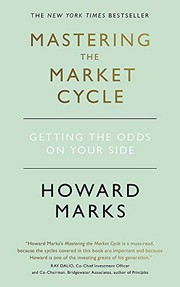
Cycles can't be timed, but knowing where you stand in one lets you adjust risk.

Howard Marks · 2011

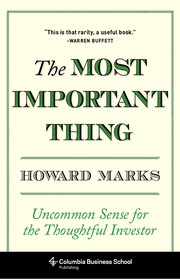
Second-level thinking, risk and market cycles, drawn from Oaktree's client memos.

Guy Spier · 2014

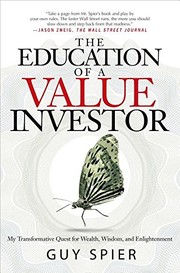
One investor's change from a brokerage job to value investing, after Buffett.

“…books I've recommended, highlighted to death, or forced on friends.” — Andrew Wilkinson

Source: Andrew Wilkinson's Bookshelf, neverenough.com

Recommended by: Andrew Wilkinson, Christopher Bloomstran and 1 other
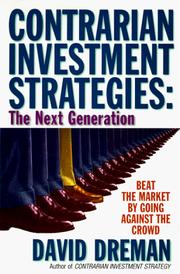
David Dreman · 1999

Data showing that low-expectation stocks beat popular ones over the long run.

“all these people really were helpful in forming and getting me involved in investing” — Joel Greenblatt

Source: Masters in Business transcript: Joel Greenblatt (2018)

Recommended by: Joel Greenblatt, Michael Mauboussin and 2 others
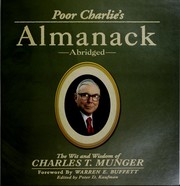
Charlie Munger · 2005

Speeches making the case for a latticework of mental models from many fields.

“…books I've recommended, highlighted to death, or forced on friends.” — Andrew Wilkinson

Source: Andrew Wilkinson's Bookshelf, neverenough.com

Recommended by: Andrew Wilkinson, Charlie Munger and 26 others

Vitaliy N. Katsenelson · 2010

How to make money in long range-bound markets with active value investing.

Recommended by: Mohnish Pabrai

Where it sits in the reference 4

Investors
Investment philosophy
Investment styles
Mental models

Topics 1

Investing

As an Amazon Associate I earn from qualifying purchases.