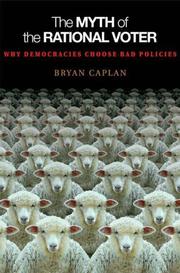
The Myth of the Rational Voter
Voters hold systematic biases about economics, so democracies choose bad policies.
Systematic voter bias about economics, and why democracies choose badly
Summary
Caplan argues that democracy produces bad economic policy not because voters are ignorant, which the standard rational ignorance literature already accepts, but because they hold systematically mistaken beliefs that they prefer to hold. He calls this rational irrationality: since an individual vote has essentially zero probability of changing an outcome, the private cost of holding a comfortable false belief is nearly zero, so people indulge beliefs they would abandon if they bore the consequences.
His evidence is the Survey of Americans and Economists on the Economy, which asked the same economic questions of the general public and of professional economists. He identifies four systematic biases where the public differs from economists in a consistent direction: anti-market bias, underestimating the benefits of market mechanisms; anti-foreign bias, underestimating the benefits of trade with foreigners; make-work bias, treating employment rather than production as the goal; and pessimistic bias, systematically believing conditions are worse and worsening. He controls for income, education, ideology and other factors and finds the gaps persist.
His conclusions are uncomfortable and he states them plainly: more democracy is not the remedy for bad policy, and insulating economic decisions from voter preference, through independent central banks, trade agreements or judicial constraint, produces better outcomes.
The main objection is that Caplan treats the economics profession's consensus as the standard of truth, which is defensible on some questions and not on others, and the 2008 crisis complicated that assumption. The empirical finding that public and expert opinion diverge systematically has held up.
Key takeaways 7
- Voters hold systematically mistaken economic beliefs rather than randomly distributed errors, so the errors do not cancel out in aggregate.
- Because an individual vote has essentially no chance of changing an outcome, the private cost of holding a comfortable false belief is nearly zero.
- The public differs from economists in four consistent directions: against markets, against trade with foreigners, treating jobs rather than output as the goal, and toward pessimism.
- These gaps persist after controlling for income, education and ideology, which rules out the explanation that they reflect different interests.
- More democratic participation does not improve economic policy, since the problem is the content of preferences rather than their transmission.
- Insulating economic decisions from direct voter preference, through independent institutions or binding agreements, produces better outcomes than responsiveness does.
- Political ignorance is rational in the standard account, and Caplan's addition is that irrationality is rational too under the same incentive structure.
Who should read it
Investors and policy readers who want the public choice account of why democratic economic policy is systematically distorted.
Who recommended it 3 · 3 direct
“A critical look at democracy. I love the way he thinks so it’s fun to hear his thought process even though I’m not that interested in this subject.”
“The median American is a moderate national socialist – statist to the core on both economic and social policy.”
Similar books 6
Chosen by shared topics, the entries that hold them, and the people who recommended both.
Economic freedom as a condition of political freedom, applied to policy questions.
“During the quarter, I reread three volumes authored by great economists: The General Theory of Employment, Interest and Money by John Maynard Keynes, The Road to Serfdom by F. A. Hayek, and Capitalism and Freedom by Milton Friedman.” — Martin J. Whitman
Source: Third Avenue Funds Q4 2005 Shareholder Letters (Chairman's letter by Martin J. Whitman)
Recommended by: Martin J. Whitman, Marc Andreessen
The case for free markets and limited government, policy area by policy area.
Recommended by: Brian Armstrong, Jim Collins, Mohnish Pabrai and 2 others

How communities manage shared resources without either the state or the market.
Recommended by: Patrick Collison, Stewart Brand
How leaders of dictatorships and democracies gain and keep power.
Recommended by: Nat Eliason, Andrew Chen, Marc Andreessen

An inquiry into the nature of freedom and the uses of power.
Recommended by: Marc Andreessen
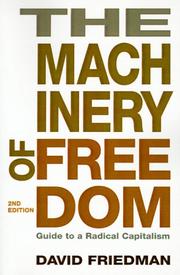
The case for anarcho-capitalism, a society run on markets without a state.
Recommended by: Marc Andreessen
Where it sits in the reference 3
Topics 3
As an Amazon Associate I earn from qualifying purchases.