Updates

  1. Person pages list letters, writing, profiles and links as sortable tables with filters, and show each person's companies as links; Fund letters show each letter's description in its own column.
  2. Experts show a checked job title and a short description of each person; 30 more people have photographs.
  3. Every company, fund, university and publication the experts work for has a page listing the people there.
  4. Fund letters show each letter's thesis and filter by it; 225 person pages list the essays, columns and newsletter issues the person wrote.
  5. Person pages list every essay and newsletter issue a person wrote, and their own books as a table in List view.
  6. Recommends shows the five largest kinds of book and the rest under More; browse pictures load sooner.
  7. Podcasts and talks link the original episode, filter by Audio and video or Press, and list each publisher once.
  8. Pages are wider, Recommends has List and Grid, and a filter clicked again turns off.
  9. Book cards sit in a ruled grid with Open Library and Goodreads links and each book's one-line note.
  10. Funds is now Investors; each investor's styles are buttons that filter the table.
  11. Podcasts and talks on a person's page filter by year and publisher and show as a list or a grid of pictures.
  12. Quotes show only people's own words: 472 summaries written by list sites are gone.
  13. Country pages open from Browse again, and every link on the shelf lands on a page.
  14. Subject and person pages show their sections as tabs, and each book appears once on a person's page.
  15. Book cards show the quote, who said it and the source; grids show five cards to a row.
  16. On a phone, a menu holds the sections, search, Updates, Feedback and dark mode.
  17. Feedback takes a screenshot of the page with no browser prompt, opens a screenshot full size when you click it, and clears itself once sent.
  18. Book cards are centred, search names the topic each book sits in, and any text cut short shows whole on hover.
  19. Search groups its results by kind: people, companies, geographies, subjects, topics, books, funds, fund letters and papers.
  20. The Books table lists who recommended each book by name, and the browser tab names the section you are in.
  21. Feedback can take a screenshot of the page, or one you paste or choose, and opens in the corner beside Updates.
  22. Each rail button reopens its section where you left it, and Browse, Table and People show on every book and subject page.
  23. Filters grey out choices that hold nothing instead of hiding them, and Books › People filters by authors or recommenders.
  24. Feedback takes a subject line and up to three screenshots.
  25. Biographies are grouped by the person they are about: 41 new pages, from Abraham Lincoln to Lee Kuan Yew.
  26. Sport splits into 23 sports, and Religion into one topic per faith.
  27. Book lists show as cards: the cover, one recommendation quote and every recommender by name.
  28. Seventeen subjects that had two or three pages under different names now have one page each.
  29. Every page lists its Experts as authors and recommenders, with a link to them on the Experts tab.
  30. Economics, Financial history, Financial panics and Accounting are subjects of their own, with one page per financial crisis.
  31. Book, person and subject pages open inside the app, so the tabs stay in view.
  32. 996 more book covers, and photographs or logos for 227 more people and companies.
  33. Books › Browse shows every subject as cards, and the rail holds Fund letters, Papers, Experts, Books and Funds.
  34. Every topic over 150 books splits into narrower topics, each with a page of its own.

Send feedback

What is it?
Screenshots, up to 3 (optional)
or paste one with Ctrl+V

We use your email only to reply to you.

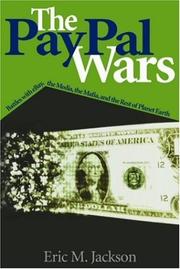
The PayPal Wars

The PayPal Wars

Eric M. Jackson
2004
T3 303 pages · about 5h 3m to read Open Librarygoodreads

Insider account by an early PayPal marketing hire; partisan but first-hand.

Summary

Jackson was an early PayPal marketing employee and wrote this account of the company from 1999 through the eBay acquisition in 2002. It covers the merger of Confinity and X.com, the competition with eBay's Billpoint, the fraud problem, the regulatory attacks, and the internal conflicts.

The operational material is the useful part. Jackson documents the viral growth mechanism, in which PayPal paid ten dollars to new users and ten dollars for referrals, which acquired users at a cost the company could not sustain but which built the network faster than any competitor could respond. He covers the discovery that eBay auctions were the actual use case, which was not the founders' plan, and the decision to build for that market specifically. The fraud chapters are the most substantive: organised criminal groups, particularly from Eastern Europe, attacked the payment system at scale, and PayPal's survival depended on building detection systems that identified fraudulent patterns, which is the work that produced the company's core capability and several later companies.

He also covers the regulatory pressure from state banking authorities and from lawsuits, and the internal fight between the Confinity and X.com factions that ended with Musk's removal as chief executive.

The book is written by a participant with a strong point of view, including political framing that some readers find intrusive. It gives Thiel's faction the better of every dispute. It is nonetheless the most detailed available account of the company's operating problems, and the fraud material is genuinely instructive.

Key takeaways 7

  1. PayPal acquired users through direct cash payments for signups and referrals, which was unsustainable per user and built the network faster than competitors could respond.
  2. The eBay auction use case was discovered rather than planned, and building specifically for it against the founders' original intent was the decisive product decision.
  3. Organised fraud at scale nearly destroyed the company, and building automated detection of fraudulent patterns became its core technical capability.
  4. Competing against eBay's own payment product while depending on eBay's platform required growing fast enough that eBay's users would resist the alternative.
  5. Regulatory attacks came from state banking authorities questioning whether the company was operating as an unlicensed bank, which is a risk any payment startup inherits.
  6. Network effects in payments are two-sided and local to a specific transaction context, which is why winning eBay was equivalent to winning the market.
  7. Merging two competitors produced a prolonged internal conflict over product direction and leadership that consumed the company's attention during its critical period.

Who should read it

Founders in payments and marketplaces who want a participant's account of viral acquisition economics, fraud at scale and platform dependency.

Who recommended it 1

Similar books 6

Chosen by shared topics, the entries that hold them, and the people who recommended both.

Adam Fisher · 2018

Oral history; Thiel and the PayPal cohort speak in their own words.

Dan McCrum · 2022

A reporter's six-year investigation of Wirecard until its missing cash sank it.

Tonny K. Omwansa, Nicholas P. Sullivan · 2012

How Safaricom built the world's reference mobile-money business.

Where it sits in the reference 3

Companies
Biographies
Industries

Topics

Company HistoriesEntrepreneurship and StartupsFounder Profiles and Startup Stories