Updates

  1. Person pages list letters, writing, profiles and links as sortable tables with filters, and show each person's companies as links; Fund letters show each letter's description in its own column.
  2. Experts show a checked job title and a short description of each person; 30 more people have photographs.
  3. Every company, fund, university and publication the experts work for has a page listing the people there.
  4. Fund letters show each letter's thesis and filter by it; 225 person pages list the essays, columns and newsletter issues the person wrote.
  5. Person pages list every essay and newsletter issue a person wrote, and their own books as a table in List view.
  6. Recommends shows the five largest kinds of book and the rest under More; browse pictures load sooner.
  7. Podcasts and talks link the original episode, filter by Audio and video or Press, and list each publisher once.
  8. Pages are wider, Recommends has List and Grid, and a filter clicked again turns off.
  9. Book cards sit in a ruled grid with Open Library and Goodreads links and each book's one-line note.
  10. Funds is now Investors; each investor's styles are buttons that filter the table.
  11. Podcasts and talks on a person's page filter by year and publisher and show as a list or a grid of pictures.
  12. Quotes show only people's own words: 472 summaries written by list sites are gone.
  13. Country pages open from Browse again, and every link on the shelf lands on a page.
  14. Subject and person pages show their sections as tabs, and each book appears once on a person's page.
  15. Book cards show the quote, who said it and the source; grids show five cards to a row.
  16. On a phone, a menu holds the sections, search, Updates, Feedback and dark mode.
  17. Feedback takes a screenshot of the page with no browser prompt, opens a screenshot full size when you click it, and clears itself once sent.
  18. Book cards are centred, search names the topic each book sits in, and any text cut short shows whole on hover.
  19. Search groups its results by kind: people, companies, geographies, subjects, topics, books, funds, fund letters and papers.
  20. The Books table lists who recommended each book by name, and the browser tab names the section you are in.
  21. Feedback can take a screenshot of the page, or one you paste or choose, and opens in the corner beside Updates.
  22. Each rail button reopens its section where you left it, and Browse, Table and People show on every book and subject page.
  23. Filters grey out choices that hold nothing instead of hiding them, and Books › People filters by authors or recommenders.
  24. Feedback takes a subject line and up to three screenshots.
  25. Biographies are grouped by the person they are about: 41 new pages, from Abraham Lincoln to Lee Kuan Yew.
  26. Sport splits into 23 sports, and Religion into one topic per faith.
  27. Book lists show as cards: the cover, one recommendation quote and every recommender by name.
  28. Seventeen subjects that had two or three pages under different names now have one page each.
  29. Every page lists its Experts as authors and recommenders, with a link to them on the Experts tab.
  30. Economics, Financial history, Financial panics and Accounting are subjects of their own, with one page per financial crisis.
  31. Book, person and subject pages open inside the app, so the tabs stay in view.
  32. 996 more book covers, and photographs or logos for 227 more people and companies.
  33. Books › Browse shows every subject as cards, and the rail holds Fund letters, Papers, Experts, Books and Funds.
  34. Every topic over 150 books splits into narrower topics, each with a page of its own.

Send feedback

What is it?
Screenshots, up to 3 (optional)
or paste one with Ctrl+V

We use your email only to reply to you.

The Power and Independence of the Federal Re

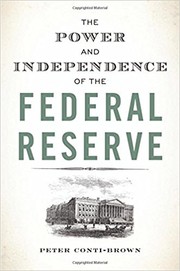
The Power and Independence of the Federal Reserve

Peter Conti-Brown
2016
T2 347 pages · about 5h 47m to read Open Librarygoodreads

What Fed independence legally is, versus what people assume.

Summary

Peter Conti-Brown, a legal scholar, argues that central bank independence is not a single property that an institution either has or lacks, and that treating it as one has prevented clear thinking about the Federal Reserve.

His historical and legal analysis shows how the institution's actual structure developed. The 1913 Act created a decentralised system whose power was distributed between Washington and the reserve banks; the 1935 reforms concentrated it in the Board of Governors; the 1951 Accord with the Treasury established the Federal Reserve's authority over monetary policy after wartime rate pegging; and the practice since has been shaped as much by personalities and by relationships as by statute. He shows that the fourteen-year governor terms, cited as a guarantee of independence, are rarely served in full, so that presidents appoint governors far more frequently than the statute implies.

His analytical contribution is to break independence into components: independence from whom, over what, and through what mechanism. He examines the personnel dimension, the budgetary independence that comes from the Federal Reserve funding itself from its own operations, the legal ambiguity of the reserve banks' private ownership, and the accountability mechanisms that exist. He is critical of the reserve bank structure and of the role of member banks in selecting their directors. The book is legal and institutional rather than economic and is the best available analysis of what the Federal Reserve actually is as an institution.

Key takeaways 7

  1. Central bank independence is not a single property but a set of separate relationships, each of which must be specified.
  2. Fourteen-year governor terms are rarely served in full, so presidents appoint governors far more frequently than the statute suggests.
  3. The Federal Reserve funds itself from its own operations, which gives it budgetary independence that most agencies lack.
  4. The 1951 Accord with the Treasury, not the founding statute, established the Federal Reserve's authority over monetary policy.
  5. Reserve banks are formally private institutions whose directors are selected partly by the banks they supervise.
  6. Conti-Brown argues that personalities and relationships have shaped the institution's actual independence more than statutory provisions have.
  7. Accountability and independence are not opposites, and the useful question is which mechanisms hold the institution to account for what.

Who should read it

Investors and policy readers who want a rigorous legal and institutional account of what the Federal Reserve is and where its independence actually comes from.

Similar books 6

Chosen by shared topics, the entries that hold them, and the people who recommended both.

Anat Admati, Martin Hellwig · 2013

Why banks should fund themselves with far more equity, and why their objections fail.

Ben S. Bernanke · 2022

Insider account of the Fed from Burns through the QE era.

Allan H. Meltzer · 2003

The Fed from 1913 to 1951, told from its own minutes and internal memos.
Roger Lowenstein · 2015

How the Federal Reserve was argued into existence, from the 1907 panic to 1913.

Recommended by: Seth Klarman

Where it sits in the reference 1

Financial history

Topics

Finance and MarketsPolitics and GovernmentRegulation, central banks and public policy