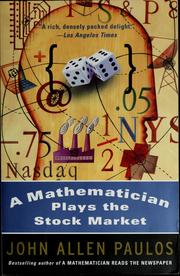
A Mathematician Plays the Stock Market
A mathematician's own losses used to explain market probability errors
Summary
Paulos, a mathematics professor who writes about innumeracy, lost a substantial amount of money on WorldCom shares during the technology bubble, and this book combines an account of that experience with an examination of what mathematics can and cannot say about markets.
The technical content covers the efficient market hypothesis in its three forms and the evidence for each, random walks and why price series that look patterned are consistent with randomness, the mathematics of expected value and why it misleads when applied to sequences, regression to the mean, the difference between the arithmetic and geometric mean of returns and why volatility reduces compound growth, portfolio theory and correlation, options pricing, power law distributions in market returns, and the Kelly criterion. He also covers technical analysis, chaos theory applications and the mathematics of stock scams including the mail-based prediction fraud.
The personal thread is what makes it useful. Paulos knew everything the book explains and lost money anyway, and he examines why: he averaged down repeatedly, he sought out confirming information, he treated his loss as recoverable only through the same stock, and he applied his knowledge to justify his position rather than to test it. His conclusion is that mathematical understanding provides no protection against the behaviour that destroys returns.
The book is a collection of connected essays rather than an argument, and the technical treatment is introductory. Its value is the honest account of an expert failing in exactly the way experts fail, and the clear explanations of concepts investors misuse.
Key takeaways 7
- Mathematical understanding of markets provides no protection against the behavioural errors that destroy returns, and Paulos demonstrates this on himself.
- Price series that appear to contain patterns are consistent with randomness, and human pattern detection generates the appearance regardless.
- Volatility reduces compound growth, so the arithmetic average of returns systematically overstates what an investor actually earns.
- Averaging down converts a bad decision into a larger bad decision and feels like conviction while doing it.
- The efficient market hypothesis is neither straightforwardly true nor false, and the useful question is which form applies to which information.
- Market return distributions have fatter tails than the normal distribution, which invalidates risk measures built on standard deviation.
- Attention to a single position produces information seeking that confirms rather than tests it, and expertise makes the confirming arguments better rather than the position sounder.
Who should read it
Investors who want clear explanations of misused mathematical concepts alongside an honest account of an expert making standard behavioural errors.
Who recommended it 1
Similar books 6
Chosen by shared topics, the entries that hold them, and the people who recommended both.
Why standard finance models understate market risk, from fractal geometry's creator.
Recommended by: Mohnish Pabrai, Nassim Nicholas Taleb and 1 other
Data showing that low-expectation stocks beat popular ones over the long run.
“all these people really were helpful in forming and getting me involved in investing” — Joel Greenblatt
Source: Masters in Business transcript: Joel Greenblatt (2018)
Recommended by: Joel Greenblatt, Mohnish Pabrai and 1 other

How biased samples, chosen averages and cut-off chart axes make numbers mislead.
Recommended by: Bill Gates, Mohnish Pabrai, Morgan Housel and 6 others

Life as speculation, with lessons on markets, games, careers and relationships.
Recommended by: Mohnish Pabrai
Spier on the psychology and habits behind durable value investing.
“…books I've recommended, highlighted to death, or forced on friends.” — Andrew Wilkinson
Source: Andrew Wilkinson's Bookshelf, neverenough.com
Recommended by: Andrew Wilkinson, Christopher Bloomstran and 1 other
Practical countermeasures rather than a catalogue of biases.
Recommended by: Mohnish Pabrai
Where it sits in the reference 2
Topics