Updates

  1. Person pages list letters, writing, profiles and links as sortable tables with filters, and show each person's companies as links; Fund letters show each letter's description in its own column.
  2. Experts show a checked job title and a short description of each person; 30 more people have photographs.
  3. Every company, fund, university and publication the experts work for has a page listing the people there.
  4. Fund letters show each letter's thesis and filter by it; 225 person pages list the essays, columns and newsletter issues the person wrote.
  5. Person pages list every essay and newsletter issue a person wrote, and their own books as a table in List view.
  6. Recommends shows the five largest kinds of book and the rest under More; browse pictures load sooner.
  7. Podcasts and talks link the original episode, filter by Audio and video or Press, and list each publisher once.
  8. Pages are wider, Recommends has List and Grid, and a filter clicked again turns off.
  9. Book cards sit in a ruled grid with Open Library and Goodreads links and each book's one-line note.
  10. Funds is now Investors; each investor's styles are buttons that filter the table.
  11. Podcasts and talks on a person's page filter by year and publisher and show as a list or a grid of pictures.
  12. Quotes show only people's own words: 472 summaries written by list sites are gone.
  13. Country pages open from Browse again, and every link on the shelf lands on a page.
  14. Subject and person pages show their sections as tabs, and each book appears once on a person's page.
  15. Book cards show the quote, who said it and the source; grids show five cards to a row.
  16. On a phone, a menu holds the sections, search, Updates, Feedback and dark mode.
  17. Feedback takes a screenshot of the page with no browser prompt, opens a screenshot full size when you click it, and clears itself once sent.
  18. Book cards are centred, search names the topic each book sits in, and any text cut short shows whole on hover.
  19. Search groups its results by kind: people, companies, geographies, subjects, topics, books, funds, fund letters and papers.
  20. The Books table lists who recommended each book by name, and the browser tab names the section you are in.
  21. Feedback can take a screenshot of the page, or one you paste or choose, and opens in the corner beside Updates.
  22. Each rail button reopens its section where you left it, and Browse, Table and People show on every book and subject page.
  23. Filters grey out choices that hold nothing instead of hiding them, and Books › People filters by authors or recommenders.
  24. Feedback takes a subject line and up to three screenshots.
  25. Biographies are grouped by the person they are about: 41 new pages, from Abraham Lincoln to Lee Kuan Yew.
  26. Sport splits into 23 sports, and Religion into one topic per faith.
  27. Book lists show as cards: the cover, one recommendation quote and every recommender by name.
  28. Seventeen subjects that had two or three pages under different names now have one page each.
  29. Every page lists its Experts as authors and recommenders, with a link to them on the Experts tab.
  30. Economics, Financial history, Financial panics and Accounting are subjects of their own, with one page per financial crisis.
  31. Book, person and subject pages open inside the app, so the tabs stay in view.
  32. 996 more book covers, and photographs or logos for 227 more people and companies.
  33. Books › Browse shows every subject as cards, and the rail holds Fund letters, Papers, Experts, Books and Funds.
  34. Every topic over 150 books splits into narrower topics, each with a page of its own.

Send feedback

What is it?
Screenshots, up to 3 (optional)
or paste one with Ctrl+V

We use your email only to reply to you.

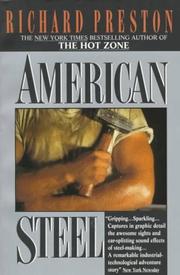
American Steel

American Steel

Richard Preston
1991
T3 278 pages · about 4h 38m to read Open Librarygoodreads

Nucor building a mini-mill at the bottom of the steel cycle.

Summary

Preston followed Nucor's construction of the Crawfordsville, Indiana plant in the late 1980s, the first commercial mill to cast thin slabs of steel continuously and roll them directly into sheet. He had access to the engineers, the operators and the company's leadership during construction and start-up.

The technical claim is the centre of the book. Integrated steelmakers made flat-rolled sheet by casting thick slabs, letting them cool, reheating them and rolling them down through a long mill, a process requiring enormous capital and scale. Nucor bought an unproven German design from SMS Schloemann-Siemag that cast a slab about two inches thick and fed it directly into rolling while still hot. If it worked, an electric arc furnace mini-mill melting scrap could make sheet steel, which had previously been the exclusive product of integrated producers using iron ore and coke. Preston documents the start-up in detail, including the near-failures, the breakouts of molten steel and the improvisation by the operating crews.

The organisational material is equally specific. Nucor under Ken Iverson ran with four management layers, no corporate staff to speak of, production bonuses that could double a worker's pay and were paid weekly, no separate executive dining rooms or reserved parking, and plant managers with wide autonomy. Preston connects the willingness to bet the company on unproven technology to that structure.

The book is reportage rather than industry analysis, and it stops at start-up. What followed, the widespread adoption of thin-slab casting, the resulting collapse of the integrated producers' position in sheet, and Nucor's growth into the largest American steelmaker, is outside it. The book is also the standard example of how a low-cost entrant moves upmarket into a segment incumbents believed was protected.

Key takeaways 7

  1. Thin-slab continuous casting let mini-mills make flat-rolled sheet, which had previously required integrated mills using ore and coke.
  2. Nucor bet a large share of its net worth on an unproven German casting design that no one had operated commercially.
  3. Electric arc furnaces melting scrap have far lower capital cost per ton than integrated steelmaking, which is the source of the cost advantage.
  4. Nucor operated with four management layers and almost no corporate staff, which is what allowed a fast decision on unproven technology.
  5. Weekly production bonuses paid to operating crews, capable of doubling base pay, produced the start-up improvisation the plant required.
  6. Incumbent integrated producers assumed sheet steel was protected by capital intensity and did not respond until the technology worked.
  7. Start-up of genuinely new process technology depends on operators solving unanticipated problems, not on the design being correct.

Who should read it

Operators and investors who want a documented case of a low-cost entrant moving into a segment incumbents believed was defended by capital intensity.

Similar books 6

Chosen by shared topics, the entries that hold them, and the people who recommended both.
Ken Iverson · 1997

Nucor's chief executive on flat structure, incentive pay and minimills

“Another great builder of our time was Kenneth Iverson. In just a few decades, Iverson transformed a small, nearly bankrupt company into the largest and most profitable steel company in the U.S…” — Francois Rochon

Source: Rochon on Ken Iverson and the building of Nucor

Recommended by: Francois Rochon
Bryce G. Hoffman · 2012

The 2006-2010 turnaround told with close management access.

Recommended by: Mohnish Pabrai

Tim Bouquet, Byron Ousey · 2009

Mittal Steel's 2006 hostile takeover of Arcelor, creating the largest steelmaker.

Recommended by: Mohnish Pabrai

Verrier Elwin · 1958

Commissioned history of Jamshedpur and the steel works.

Where it sits in the reference 3

Companies
Investment styles
Industries

Topics

Company HistoriesTechnology and ComputingInvention, engineering and energy