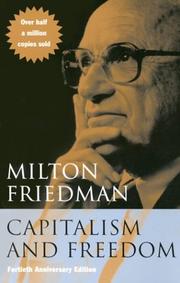
Capitalism and Freedom
Friedman's most systematic statement of the classical-liberal case: that economic and political freedom are inseparable, and that government intervention, however well-intentioned, typically produces worse outcomes than markets. Controversial on education vouchers and monetary policy; influential on both.
Summary
Friedman's 1962 book sets out the case that economic freedom is a necessary condition for political freedom, and applies that position to a series of specific policy questions.
The foundational argument is that a market economy disperses power, so that a person who dissents can still find employment, publish and organise, while a system in which the state controls economic life gives it the ability to suppress dissent without any explicit repression. He treats economic and political freedom as connected rather than separate.
The policy chapters propose: a monetary rule requiring steady growth in the money supply rather than discretionary central banking; floating exchange rates rather than fixed, which was heterodox at the time and became standard; the negative income tax as a replacement for the entire apparatus of welfare programmes; school vouchers allowing parents to direct public education funding to any school; the abolition of occupational licensing, including for physicians; the elimination of agricultural subsidies, tariffs, rent control, minimum wages, conscription and public housing; and the removal of corporate social responsibility as a legitimate objective for company management.
Several proposals were adopted, including floating exchange rates and the end of conscription. Others, particularly vouchers and the negative income tax, remain contested. The empirical basis in the book is thin, since Friedman argues mostly from principle and illustration, and the intervening sixty years have produced substantial evidence on several of the questions that cuts in both directions. It remains the clearest statement of the position.
Key takeaways 7
- Economic freedom is a necessary condition for political freedom, because a state controlling economic life can suppress dissent without explicit repression.
- A market economy disperses power so that dissenters can still find employment, funding and publication.
- Monetary policy should follow a rule requiring steady money supply growth rather than discretionary decisions, because the lags make discretion counterproductive.
- Floating exchange rates are preferable to fixed rates because they allow adjustment without requiring domestic deflation.
- A negative income tax would replace the entire welfare apparatus with a single cash transfer, removing both administrative cost and the incentive distortions of specific programmes.
- Occupational licensing restricts entry to benefit incumbent practitioners rather than to protect consumers, and this applies to medicine as much as to other trades.
- Corporate management has no legitimate objective other than earning returns for shareholders within the rules, since any other objective spends money belonging to others.
Who should read it
Readers who want the foundational statement of the market-liberal policy position from its most influential twentieth-century advocate.
About Milton Friedman
Economist at the University of Chicago and the Hoover Institution who led the monetarist school and won the 1976 Nobel prize.
A Monetary History of the United States, written with Anna Schwartz, established that the Federal Reserve's contraction of the money supply turned the 1929 downturn into the Depression, and it set the terms of monetary policy argument ever since. Capitalism and Freedom and Free to Choose make the political case for markets and supply the standard arguments on floating rates, schooling and regulation.
Who recommended it 1
Similar books 6
Chosen by shared topics, the entries that hold them, and the people who recommended both.
The case for free markets and limited government, policy area by policy area.
Recommended by: Brian Armstrong, Mohnish Pabrai and 2 others

An inquiry into the nature of freedom and the uses of power.
Recommended by: Marc Andreessen

The case for anarcho-capitalism, a society run on markets without a state.
Recommended by: Marc Andreessen

Why managers and technocrats would replace capitalists as society's ruling class.
Recommended by: Marc Andreessen
Voters hold systematic biases about economics, so democracies choose bad policies.
“The median American is a moderate national socialist – statist to the core on both economic and social policy.” — Marc Andreessen
Source: @pmarca, 'Thread: Books I've recently read and recommend'
Recommended by: Marc Andreessen, Patrick Collison

How communities manage shared resources without either the state or the market.
Recommended by: Patrick Collison, Stewart Brand
Where it sits in the reference 2
Topics