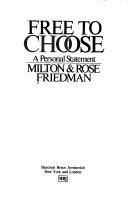
Free to Choose: A Personal Statement
The popular companion to Capitalism and Freedom, written with Rose Friedman. More accessible and more polemical. Best read as a rhetorical document as much as an economic one — it shows how free-market ideas get translated into public argument, for better and worse.
Summary
Friedman and Rose Friedman wrote this to accompany their 1980 television series, stating the case for free markets and limited government for a general audience. It is more accessible and more political than Friedman's academic work.
The argument runs through specific policy areas. The price system coordinates activity without central direction, which the Friedmans illustrate through Leonard Read's account of the pencil, whose production involves people worldwide who share no common purpose. They argue that the Great Depression was caused by Federal Reserve policy failure rather than by any inherent market instability, which draws on Friedman and Schwartz's Monetary History. They oppose tariffs and argue for unilateral free trade. They attack occupational licensing, minimum wages, rent control and consumer protection agencies as measures that benefit incumbents at the expense of the people they claim to protect.
On education they propose vouchers, arguing that public funding does not require public provision. On welfare they propose a negative income tax replacing the entire apparatus of targeted programmes. On inflation they argue that it is always and everywhere a monetary phenomenon. Their general claim is that regulatory agencies are captured by the industries they regulate, and that concentrated benefits and diffuse costs explain why bad policies persist.
The book is advocacy and treats contested empirical questions as settled. The monetary explanation of the Depression, the school voucher evidence and the minimum wage claims have all been substantially contested since. Friedman received the Nobel Prize and his academic work is more careful than this. Read it as the clearest statement of one position rather than as analysis.
Key takeaways 8
- The price system coordinates the activity of people worldwide who share no common purpose and no knowledge of each other.
- Voluntary exchange benefits both parties, which is why transactions occur at all, and this is what makes coordination without direction possible.
- The Great Depression resulted from Federal Reserve policy failure in allowing the money supply to contract rather than from market instability.
- Inflation is always and everywhere a monetary phenomenon, produced by increases in money supply exceeding output growth.
- Regulatory agencies become captured by the industries they regulate, because concentrated interests have more at stake than diffuse ones.
- Occupational licensing restricts entry and raises prices while providing minimal protection to the consumers it is justified by.
- Public funding of education does not require public provision, and vouchers would separate the two.
- A negative income tax would replace the entire targeted welfare apparatus with a single mechanism and remove the perverse incentives of means testing.
Who should read it
Readers who want the clearest popular statement of the case for markets and limited government, read as advocacy rather than as settled analysis.
About Milton Friedman
Economist at the University of Chicago and the Hoover Institution who led the monetarist school and won the 1976 Nobel prize.
A Monetary History of the United States, written with Anna Schwartz, established that the Federal Reserve's contraction of the money supply turned the 1929 downturn into the Depression, and it set the terms of monetary policy argument ever since. Capitalism and Freedom and Free to Choose make the political case for markets and supply the standard arguments on floating rates, schooling and regulation.
Who recommended it 4 · 2 direct
Similar books 6
Chosen by shared topics, the entries that hold them, and the people who recommended both.
Economic freedom as a condition of political freedom, applied to policy questions.
Recommended by: Marc Andreessen

An inquiry into the nature of freedom and the uses of power.
Recommended by: Marc Andreessen

The case for anarcho-capitalism, a society run on markets without a state.
Recommended by: Marc Andreessen

Why managers and technocrats would replace capitalists as society's ruling class.
Recommended by: Marc Andreessen
Voters hold systematic biases about economics, so democracies choose bad policies.
“The median American is a moderate national socialist – statist to the core on both economic and social policy.” — Marc Andreessen
Source: @pmarca, 'Thread: Books I've recently read and recommend'
Recommended by: Marc Andreessen, Patrick Collison

How communities manage shared resources without either the state or the market.
Recommended by: Patrick Collison, Stewart Brand
Where it sits in the reference 2
Topics