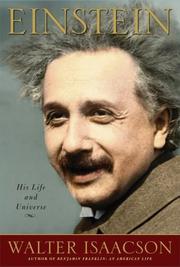
Einstein: His Life and Universe
Isaacson on Einstein's thought experiments and reasoning from principles
Summary
Isaacson wrote the biography after Einstein's personal papers were released in 2006, which gave access to correspondence previously restricted. The book covers the childhood and schooling in Germany and Switzerland, the patent office years in Bern, the 1905 papers, general relativity, the Nobel Prize, the emigration to Princeton, the letter to Roosevelt, and the unsuccessful decades pursuing a unified field theory.
The scientific explanation is at a general reader's level and Isaacson had physicists review it. He explains the 1905 papers on the photoelectric effect, Brownian motion and special relativity, and works through the ten-year path to general relativity including the equivalence principle and the 1919 eclipse observations that confirmed the light-bending prediction.
The recurring argument is that Einstein's results came from questioning assumptions others treated as given, particularly the absolute nature of simultaneity, and that his later resistance to quantum mechanics came from the same disposition applied to a case where he was wrong. Isaacson connects the scientific rebellion to the personal one, showing a man who rejected authority in schooling, in politics and in physics with equal consistency.
The personal material is unsparing. Einstein's first marriage to Mileva Maric, the daughter born before the marriage whose fate is unknown, the written conditions he imposed on Mileva, his distance from his sons and the second marriage to his cousin Elsa are all documented from the letters. The physics will be too simple for readers with technical backgrounds and too dense for those without. Isaacson's framing of Einstein as a model of creative nonconformity is repeated more often than it is demonstrated. The last thirty years of Einstein's scientific work produced nothing, and the book handles that period honestly.
Key takeaways 8
- Einstein's central move was rejecting an assumption everyone else treated as given, in this case that simultaneity is absolute.
- He produced his most important work while employed as a patent examiner, outside academic physics and without access to laboratories or colleagues.
- Thought experiments, conducted entirely without apparatus, generated the results that later observation confirmed.
- The 1919 eclipse observations confirmed general relativity's prediction of light bending and made Einstein internationally famous within days.
- His Nobel Prize was awarded for the photoelectric effect rather than for relativity, which the committee considered insufficiently established.
- He rejected quantum mechanics because he could not accept an irreducibly probabilistic reality, and on this he was wrong for the last thirty years of his life.
- He signed the letter to Roosevelt that initiated American atomic research and later described it as his greatest mistake.
- His resistance to authority was consistent across schooling, politics and physics, and it produced both his best work and his final unproductive decades.
Who should read it
Readers interested in how questioning a universally accepted assumption produces results, with the personal record included rather than sanitised.
About Walter Isaacson
American biographer and professor of history at Tulane University; formerly editor of Time and chief executive of CNN and the Aspen Institute.
The biographies are built on long direct access - years of interviews with Jobs, then with Musk - and reconstruct how each subject decided, hired and treated the people around them. The Innovators does the same for computing, presenting it as a chain of collaborations rather than a sequence of lone inventions.
Tulane University, Amanpour & Company, Aspen Institute, CNN, Time
Who recommended it 9 · 1 direct
Similar books 6
Chosen by shared topics, the entries that hold them, and the people who recommended both.

Leonardo's life read through his notebooks, where art and science were one pursuit.
Recommended by: Bill Gates, Austen Allred, Daniel Petre and 7 others
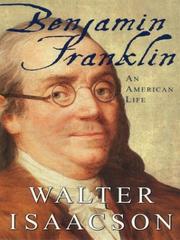
Franklin's life as printer, scientist, diplomat and founder.
“…books I've recommended, highlighted to death, or forced on friends.” — Andrew Wilkinson
Source: Andrew Wilkinson's Bookshelf, neverenough.com
Recommended by: Alfred Lin, Andrew Wilkinson, Mohnish Pabrai and 7 others
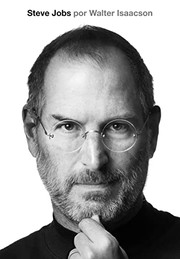
Steve Jobs's life and Apple's products, from forty interviews with him and many more.
Recommended by: Mohnish Pabrai, Patrick Collison and 17 others
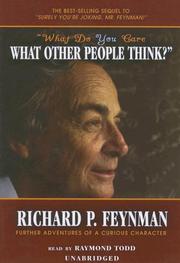
Stories of a physicist's first marriage and his inquiry into the Challenger disaster.
“Richard Feynman's books are awesome. Very bright physicist. Must-read!” — Mohnish Pabrai
Source: Mohnish's Bookshelf — Unorganized, yet Interesting, entry 169
Recommended by: Mohnish Pabrai, Naval Ravikant, Larry Page
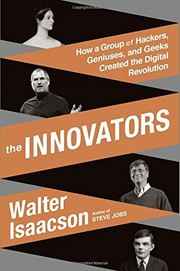
Computing as a run of collaborations, from Ada Lovelace and Babbage to Google.
Recommended by: Mohnish Pabrai, Bill Gates, Chris Fussell and 2 others

How shared fictions such as money, nations and gods let humans cooperate at scale.
“…books I've recommended, highlighted to death, or forced on friends.” — Andrew Wilkinson
Source: Andrew Wilkinson's Bookshelf, neverenough.com
Recommended by: Andrew Wilkinson, Bill Gates, Mohnish Pabrai and 38 others
Where it sits in the reference 2
Topics