Updates

  1. Person pages list letters, writing, profiles and links as sortable tables with filters, and show each person's companies as links; Fund letters show each letter's description in its own column.
  2. Experts show a checked job title and a short description of each person; 30 more people have photographs.
  3. Every company, fund, university and publication the experts work for has a page listing the people there.
  4. Fund letters show each letter's thesis and filter by it; 225 person pages list the essays, columns and newsletter issues the person wrote.
  5. Person pages list every essay and newsletter issue a person wrote, and their own books as a table in List view.
  6. Recommends shows the five largest kinds of book and the rest under More; browse pictures load sooner.
  7. Podcasts and talks link the original episode, filter by Audio and video or Press, and list each publisher once.
  8. Pages are wider, Recommends has List and Grid, and a filter clicked again turns off.
  9. Book cards sit in a ruled grid with Open Library and Goodreads links and each book's one-line note.
  10. Funds is now Investors; each investor's styles are buttons that filter the table.
  11. Podcasts and talks on a person's page filter by year and publisher and show as a list or a grid of pictures.
  12. Quotes show only people's own words: 472 summaries written by list sites are gone.
  13. Country pages open from Browse again, and every link on the shelf lands on a page.
  14. Subject and person pages show their sections as tabs, and each book appears once on a person's page.
  15. Book cards show the quote, who said it and the source; grids show five cards to a row.
  16. On a phone, a menu holds the sections, search, Updates, Feedback and dark mode.
  17. Feedback takes a screenshot of the page with no browser prompt, opens a screenshot full size when you click it, and clears itself once sent.
  18. Book cards are centred, search names the topic each book sits in, and any text cut short shows whole on hover.
  19. Search groups its results by kind: people, companies, geographies, subjects, topics, books, funds, fund letters and papers.
  20. The Books table lists who recommended each book by name, and the browser tab names the section you are in.
  21. Feedback can take a screenshot of the page, or one you paste or choose, and opens in the corner beside Updates.
  22. Each rail button reopens its section where you left it, and Browse, Table and People show on every book and subject page.
  23. Filters grey out choices that hold nothing instead of hiding them, and Books › People filters by authors or recommenders.
  24. Feedback takes a subject line and up to three screenshots.
  25. Biographies are grouped by the person they are about: 41 new pages, from Abraham Lincoln to Lee Kuan Yew.
  26. Sport splits into 23 sports, and Religion into one topic per faith.
  27. Book lists show as cards: the cover, one recommendation quote and every recommender by name.
  28. Seventeen subjects that had two or three pages under different names now have one page each.
  29. Every page lists its Experts as authors and recommenders, with a link to them on the Experts tab.
  30. Economics, Financial history, Financial panics and Accounting are subjects of their own, with one page per financial crisis.
  31. Book, person and subject pages open inside the app, so the tabs stay in view.
  32. 996 more book covers, and photographs or logos for 227 more people and companies.
  33. Books › Browse shows every subject as cards, and the rail holds Fund letters, Papers, Experts, Books and Funds.
  34. Every topic over 150 books splits into narrower topics, each with a page of its own.

Send feedback

What is it?
Screenshots, up to 3 (optional)
or paste one with Ctrl+V

We use your email only to reply to you.

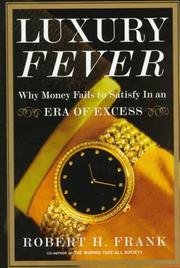
Luxury Fever

Luxury Fever

Robert H. Frank
1999
T3 326 pages · about 5h 26m to read Open Librarygoodreads

The economics of positional goods and status competition.

Summary

Robert Frank, a Cornell economist, argues that a large share of American consumption is positional, meaning that its value depends on comparison with what others have rather than on absolute quantity. He uses this to explain why rising incomes over decades did not raise reported wellbeing, and why spending on housing, cars, weddings and similar visible goods escalated faster than income.

The mechanism is a spending arms race. If the value of a house depends partly on its position relative to other houses in the school district, then everyone buying larger houses leaves everyone in the same relative position while consuming more resources. Frank contrasts positional goods with non-positional ones, principally free time, commuting, job security, and health and safety, whose value does not depend on comparison. He argues that individuals rationally overinvest in the first category and underinvest in the second, and that the aggregate result makes everyone worse off.

His policy proposal is a progressive consumption tax: tax income minus savings, at steeply progressive rates, so that the tax falls on what people spend rather than on what they earn. He argues this would slow the positional arms race without reducing anyone's relative position, and would raise savings and public investment. Critics dispute both the empirical claim that wellbeing has not risen with income and the practicality of the tax, and the happiness research Frank relies on has been contested since, particularly by Stevenson and Wolfers. The positional goods argument itself is now standard in economics.

Key takeaways 7

  1. A large share of consumption is positional, so its value depends on comparison with others rather than on absolute quantity.
  2. Spending on positional goods produces an arms race in which everyone consumes more and nobody improves their relative position.
  3. People systematically underinvest in non-positional goods such as free time, shorter commutes and workplace safety.
  4. Frank proposes taxing consumption rather than income, at steeply progressive rates, to slow positional spending without changing relative rankings.
  5. Rising inequality raises positional spending down the income distribution, because reference standards are set by those above.
  6. Commuting time is the clearest case of a non-positional cost that people accept in exchange for a positional gain in housing.
  7. Frank argues that the case for redistribution can be made on efficiency grounds alone, without appealing to fairness.

Who should read it

Investors and operators in consumer categories, and anyone thinking about how status competition drives demand, who want the economic argument stated rigorously.

Similar books 6

Chosen by shared topics, the entries that hold them, and the people who recommended both.

Robert J. Shiller, George A. Akerlof · 2009

Recommended by: Mohnish Pabrai

Robert J. Shiller · 2019

How popular stories spread like epidemics and drive economic events.

Recommended by: Jackie Vullinghs

Robert J. Shiller, George A. Akerlof · 2015
William Poundstone · 2010

People have no fixed sense of value, so context and anchors set the prices they pay.

Robert H Frank · 2016

Chance shapes success more than people think; what that means for fairer economies.

Recommended by: Mohnish Pabrai

Where it sits in the reference 2

Industries
Economics

Topics

EconomicsSociology and CulturePsychology and BehaviourBehavioural finance and the psychology of moneyConsumer culture and cultural criticism