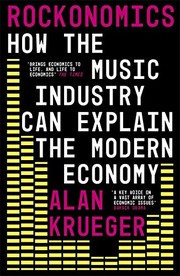
Rockonomics
An economist on superstar effects and the economics of the music industry.
Summary
Krueger, a labour economist who chaired the Council of Economic Advisers, applied economics to the music industry, using it as a setting where the mechanisms shaping the wider economy are visible in concentrated form. He worked from industry data, from a survey of musicians and from interviews with artists and executives.
The central mechanism is superstar economics, drawn from Sherwin Rosen. When a performance can be reproduced at near-zero cost and consumers prefer the best available performer to a slightly worse one, a tiny difference in quality produces an enormous difference in income. Krueger documents the resulting concentration: a very small share of artists earns most of the industry's income, and the concentration has increased as reproduction and distribution costs fell. He argues that the same mechanism now operates across the economy as technology extends the reach of top performers in many fields.
The pricing material is the most practical. Concert tickets have historically been priced below the market-clearing level, which transfers value to scalpers and to the secondary market, and Krueger examines why artists accept this, including the effect on fan goodwill and on merchandise and future tour sales. He covers bundling, price discrimination through tiered seating and packages, and the Bowie theory, named after David Bowie's observation that recorded music would become a loss leader for live performance, which is what happened.
Other chapters cover the economics of streaming and how royalties are divided, the role of luck and cumulative advantage in which songs succeed, and Krueger's estimates of what musicians actually earn.
The book was completed before Krueger's death in 2019 and is written for general readers, so the economics is presented without formal apparatus. The industry data on artist income is inherently incomplete, and the streaming economics have continued to shift since publication.
Key takeaways 7
- Small differences in perceived quality produce enormous differences in income when performance can be reproduced at near-zero cost.
- Income concentration in music increased as reproduction and distribution costs fell, which is the opposite of what democratisation predicted.
- Concert tickets are priced below market-clearing levels, which transfers value to the secondary market rather than to the artist.
- Recorded music became a promotional loss leader for live performance, reversing the industry's historical revenue structure.
- Luck and cumulative advantage determine which songs succeed, as demonstrated by experiments where identical songs performed differently in different social conditions.
- Bundling and tiered pricing let sellers extract more from customers with different willingness to pay than a single price can.
- The distribution of musician income is extremely skewed, and the median working musician earns very little.
Who should read it
Founders and operators in content, media and marketplace businesses who want the economics of superstar markets and below-market pricing explained through a concrete industry.
Similar books 6
Chosen by shared topics, the entries that hold them, and the people who recommended both.

How the music business works in contracts and money, from a music lawyer.

How intermediaries capture creative-work rents; the bear case for creators.
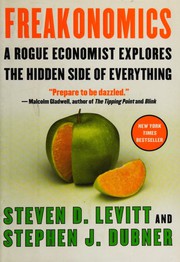
Incentives and data applied to cheating teachers, sumo wrestlers and other puzzles.
Recommended by: Mohnish Pabrai, Andrew Lokenauth and 6 others
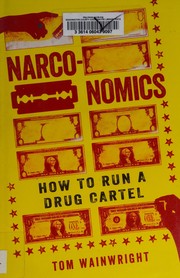
The drug trade as a business: how cartels handle supply chains, staff and branding.

Sequel applying incentive analysis to climate, crime and altruism
“I recommend this book to anyone who reads nonfiction. It is very well written and full of great insights.” — Bill Gates
Source: Gates Notes review of SuperFreakonomics
Recommended by: Bill Gates, Mohnish Pabrai
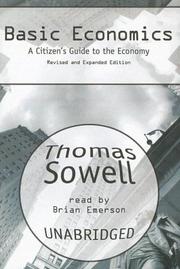
Thomas Sowell's deliberately introductory survey of how prices, incentives, and tradeoffs work across housing, labor, international trade, and discrimination. Dense with empirical examples. Its main contribution to this list is showing the gap between policy intentions and policy consequences.
Where it sits in the reference 3
Topics