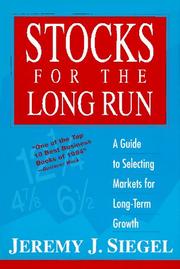
Stocks for the Long Run
Now in its sixth edition (2022)
Summary
Siegel assembled United States equity return data back to 1802 and argues that stocks have produced a real return of around six point five to seven percent annually over that period, that this return has been remarkably stable across very different economic regimes, and that stocks have outperformed bonds and cash over every sufficiently long holding period.
His central claim is that equities are less risky than bonds over long horizons, because equity returns mean-revert while bond returns do not, so the standard deviation of annualised real returns falls faster for stocks than for bonds as the holding period lengthens. He uses this to argue that long-horizon investors should hold substantially more equity than conventional allocation advice recommends.
He also covers the effect of inflation, showing that equities preserve purchasing power over long periods while nominal bonds do not, the analysis of market valuations, the historical behaviour of stocks around economic and political events, and the case for indexation supplemented by tilts toward value and dividend-paying shares in later editions.
The data has been challenged. The nineteenth-century series relies on a small number of surviving securities and the reconstruction methods are contested, particularly by Edward McQuarrie whose recent work revises the early returns downward substantially. The survivorship problem is real, since the United States was the most successful equity market of the twentieth century and the data does not include markets that were destroyed. Mean reversion over long horizons is statistically difficult to establish with the number of independent long periods available. The book remains the standard reference for long-run equity return data.
Key takeaways 8
- United States equities produced a real return of roughly six point five to seven percent annually across two centuries of very different economic regimes.
- Equity returns mean-revert while bond returns do not, which reduces the variability of annualised stock returns faster as the holding period lengthens.
- Over sufficiently long horizons equities have been less risky than bonds when risk is measured as variability of real annualised return.
- Equities preserve purchasing power against inflation over long periods while nominal bonds systematically fail to.
- Long-horizon investors should hold substantially more equity than conventional allocation advice recommends, which follows directly from the mean reversion claim.
- Valuation at the point of purchase predicts long-run subsequent returns, which qualifies the general case for equities at any price.
- The nineteenth-century data rests on a small number of surviving securities and has been revised downward by more recent research.
- The United States was the most successful equity market of the twentieth century, which means the data excludes the markets that were destroyed.
Who should read it
Investors deciding long-horizon allocation who want the long-run return data, with the survivorship and data reconstruction problems in view.
About Jeremy Siegel
Russell E. Palmer Professor Emeritus of Finance, The Wharton School; senior economist / investment strategy adviser to WisdomTree
Stocks for the Long Run assembled the long-run US return series that later writers reuse, though its equity-premium conclusions remain contested.
Who recommended it 1 · 1 direct
“his book "Stocks for the Long Run" contributed greatly to the bull market's middle years”
Similar books 6
Chosen by shared topics, the entries that hold them, and the people who recommended both.
Twenty short essays on why behaviour matters more than knowledge with money.
“…books I've recommended, highlighted to death, or forced on friends.” — Andrew Wilkinson
Source: Andrew Wilkinson's Bookshelf, neverenough.com
Recommended by: Andrew Wilkinson, Nat Eliason, Ali Abdaal and 10 others
How speculation displaced long-term investment in markets, shown in turnover data.
“I also recommend The Clash of the Cultures by Jack Bogle” — Warren Buffett
Source: 2012 Berkshire Hathaway Shareholder Letter, p. 21
Recommended by: Mohnish Pabrai, Warren Buffett and 1 other
What markets looked like at the US stock bottoms of 1921, 1932, 1949 and 1982.
Recommended by: Warren Buffett
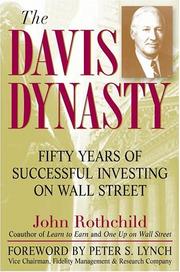
Three generations compounding a fortune through insurance stocks
“When John Rothchild combines history and biography with investing in one package, history illuminates the biography and investing. This is a sparkling book on each level, but even more so as an…” — Peter Bernstein
Source: Bernstein on Rothchild mixing history, biography and investing
Recommended by: Mohnish Pabrai, Peter Bernstein and 1 other
History of indexing; Bogle and Vanguard are its central thread.
Where it sits in the reference 6
Topics