Updates

  1. Person pages list letters, writing, profiles and links as sortable tables with filters, and show each person's companies as links; Fund letters show each letter's description in its own column.
  2. Experts show a checked job title and a short description of each person; 30 more people have photographs.
  3. Every company, fund, university and publication the experts work for has a page listing the people there.
  4. Fund letters show each letter's thesis and filter by it; 225 person pages list the essays, columns and newsletter issues the person wrote.
  5. Person pages list every essay and newsletter issue a person wrote, and their own books as a table in List view.
  6. Recommends shows the five largest kinds of book and the rest under More; browse pictures load sooner.
  7. Podcasts and talks link the original episode, filter by Audio and video or Press, and list each publisher once.
  8. Pages are wider, Recommends has List and Grid, and a filter clicked again turns off.
  9. Book cards sit in a ruled grid with Open Library and Goodreads links and each book's one-line note.
  10. Funds is now Investors; each investor's styles are buttons that filter the table.
  11. Podcasts and talks on a person's page filter by year and publisher and show as a list or a grid of pictures.
  12. Quotes show only people's own words: 472 summaries written by list sites are gone.
  13. Country pages open from Browse again, and every link on the shelf lands on a page.
  14. Subject and person pages show their sections as tabs, and each book appears once on a person's page.
  15. Book cards show the quote, who said it and the source; grids show five cards to a row.
  16. On a phone, a menu holds the sections, search, Updates, Feedback and dark mode.
  17. Feedback takes a screenshot of the page with no browser prompt, opens a screenshot full size when you click it, and clears itself once sent.
  18. Book cards are centred, search names the topic each book sits in, and any text cut short shows whole on hover.
  19. Search groups its results by kind: people, companies, geographies, subjects, topics, books, funds, fund letters and papers.
  20. The Books table lists who recommended each book by name, and the browser tab names the section you are in.
  21. Feedback can take a screenshot of the page, or one you paste or choose, and opens in the corner beside Updates.
  22. Each rail button reopens its section where you left it, and Browse, Table and People show on every book and subject page.
  23. Filters grey out choices that hold nothing instead of hiding them, and Books › People filters by authors or recommenders.
  24. Feedback takes a subject line and up to three screenshots.
  25. Biographies are grouped by the person they are about: 41 new pages, from Abraham Lincoln to Lee Kuan Yew.
  26. Sport splits into 23 sports, and Religion into one topic per faith.
  27. Book lists show as cards: the cover, one recommendation quote and every recommender by name.
  28. Seventeen subjects that had two or three pages under different names now have one page each.
  29. Every page lists its Experts as authors and recommenders, with a link to them on the Experts tab.
  30. Economics, Financial history, Financial panics and Accounting are subjects of their own, with one page per financial crisis.
  31. Book, person and subject pages open inside the app, so the tabs stay in view.
  32. 996 more book covers, and photographs or logos for 227 more people and companies.
  33. Books › Browse shows every subject as cards, and the rail holds Fund letters, Papers, Experts, Books and Funds.
  34. Every topic over 150 books splits into narrower topics, each with a page of its own.

Send feedback

What is it?
Screenshots, up to 3 (optional)
or paste one with Ctrl+V

We use your email only to reply to you.

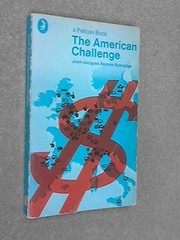
The American Challenge

The American Challenge

Jean-Jacques Servan-Schreiber
1968
T3 224 pages · about 3h 44m to read Open Librarygoodreads

1968 warning that American corporations would come to dominate Europe

Summary

Servan-Schreiber, a French journalist and politician, wrote in 1967 that American corporations were taking over European industry, and that within fifteen years the third industrial power in the world, after the United States and the Soviet Union, would be American industry in Europe. The book sold enormously and shaped European industrial policy debate for a generation.

His diagnosis was that the American advantage was not capital, technology or natural resources but organisation and management. He pointed to American investment in higher education, to the size and integration of the American market, to management practice that promoted on merit and delegated decisions, to the willingness to fund research over long horizons, and to the connection between government spending, universities and industry that produced computing and aerospace. He argued that Europe's fragmentation into national markets, its state-protected national champions, its rigid educational hierarchies and its family firm governance made it structurally unable to compete.

His prescription was European integration, large-scale investment in education and research, and the creation of genuinely European companies. He was largely right about the diagnosis of the moment and wrong about the trajectory, since the American corporate advance stalled in the 1970s, Japanese firms became the competitive threat, and European integration proceeded on a different basis than he proposed. The book is worth reading now as an example of a confident structural forecast that failed on timing and identity while being accurate about the underlying mechanism, and because the same argument about organisational and educational advantage recurs in every subsequent technology competition debate.

Key takeaways 7

  1. American industrial advantage in the 1960s came from management practice, organisation and education rather than from capital or technology.
  2. Market fragmentation into national units prevented European firms from reaching the scale that research spending requires.
  3. State-protected national champions perform worse than firms exposed to competition, because protection removes the pressure that produces organisational improvement.
  4. Investment in mass higher education is the precondition for the management depth that large modern corporations require.
  5. Government research spending routed through universities and into industry created the American advantage in computing and aerospace.
  6. European family firm governance and rigid educational hierarchies restricted management talent to a narrow class and limited competitiveness.
  7. Direct foreign investment transfers control of an economy's most advanced sectors more effectively than trade does.

Who should read it

Readers interested in industrial policy debate and in how confident structural forecasts about technology competition succeed and fail.

Who recommended it 2 · 1 direct

Similar books 6

Chosen by shared topics, the entries that hold them, and the people who recommended both.

Norman Angell · 1909

Conquest no longer pays, since modern prosperity rests on trade and credit.

Recommended by: Peter Thiel

Peter F. Drucker · 1969

Four breaks with the postwar world, from a global economy to knowledge as capital.

Recommended by: Patrick Collison
William W. Lewis · 2004

Sector-level explanation of why productivity differs so much between countries

“on how technology-driven productivity growth improves human welfare and creates more jobs and higher wages” — Marc Andreessen

Source: @pmarca, companion thread to 'It's Time to Build'

Recommended by: Marc Andreessen, Patrick Collison
James Dale Davidson, William Rees-Mogg · 1997

1997 forecast of digital money weakening the nation state

Where it sits in the reference 2

Business themes
Economics

Topics

EconomicsBusiness and Management