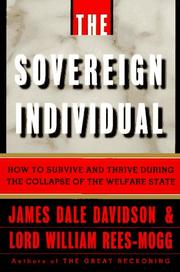
The Sovereign Individual
1997 forecast of digital money weakening the nation state
Summary
Davidson and Rees-Mogg argue that information technology will dissolve the nation state's ability to tax, because the most productive people and their capital will become mobile and encryptable while governments remain territorial. They predict the emergence of a class they call sovereign individuals, who select jurisdictions the way consumers select services, and a corresponding decline in mass democracy and in the welfare state.
The historical framework runs through what they call megapolitical transitions, arguing that the dominant costs and returns of violence determine the political structure of an age. They cover the shift from hunter-gatherer bands to agriculture, from feudalism to the nation state driven by gunpowder and by the printing press, and then to what they call the information age. Their reading of the medieval church as a business, and of the Reformation as a competitive disruption of that business, is the clearest application of the framework.
The predictions are specific and some have proved accurate. They forecast digital cash outside government control, jurisdictional competition for wealthy residents, the erosion of the middle class in developed economies, increasing political anger from those who cannot move, and the growth of private security. The cryptocurrency community treats the book as foundational for this reason.
Other predictions failed. Governments have proved considerably better at taxing and surveilling digital activity than the authors expected, and the FATCA regime, common reporting standards and global minimum tax agreements run the opposite way. The tone toward those left behind is contemptuous, and the authors' political preferences shape the analysis throughout. Read it as an argument about jurisdictional competition, checked against the last decade of tax enforcement.
Key takeaways 8
- The dominant technology and economics of violence determine the political structures of each era, so a change in either forces institutional change.
- Information technology makes the highest earners and their capital mobile, which erodes the tax base that funds the modern state.
- Encryption allows value to be held and transferred outside any government's reach, which the authors described before digital currency existed.
- Governments will respond to a shrinking tax base by increasing enforcement against those who cannot move rather than by reducing spending.
- Jurisdictions will compete for productive residents by offering favourable terms, which turns citizenship into a purchasable service.
- Mass democracy was a product of industrial-era economics and will weaken as those economics change.
- Political anger will rise among people whose economic position depends on national arrangements that are being dissolved.
- The authors treat the resulting inequality as an inevitable consequence rather than as a problem requiring a response.
Who should read it
Investors and founders thinking about jurisdictional arbitrage, digital assets and the long-run fiscal position of states, read against the actual record of tax enforcement since 1997.
Who recommended it 13 · 4 direct
Similar books 6
Chosen by shared topics, the entries that hold them, and the people who recommended both.

Argument that online communities can become sovereign; crypto-native politics
Recommended by: Balaji S. Srinivasan, Brian Armstrong and 4 others

Why the US-guarded trading order is ending, and what that means for supply chains.
Recommended by: Andrew Wilkinson

Conquest no longer pays, since modern prosperity rests on trade and credit.
Recommended by: Peter Thiel

Sound money must hold value over time, and Bitcoin's fixed supply makes it such.
Recommended by: Balaji S. Srinivasan, Alex Lieberman and 1 other
An attack on the IMF's one-size-fits-all policies in the crises of the 1990s.
Recommended by: Patrick Collison
The 1997 warning that the political backlash was coming.
Recommended by: Patrick Collison
Where it sits in the reference 3
Topics