Updates

  1. Person pages list letters, writing, profiles and links as sortable tables with filters, and show each person's companies as links; Fund letters show each letter's description in its own column.
  2. Experts show a checked job title and a short description of each person; 30 more people have photographs.
  3. Every company, fund, university and publication the experts work for has a page listing the people there.
  4. Fund letters show each letter's thesis and filter by it; 225 person pages list the essays, columns and newsletter issues the person wrote.
  5. Person pages list every essay and newsletter issue a person wrote, and their own books as a table in List view.
  6. Recommends shows the five largest kinds of book and the rest under More; browse pictures load sooner.
  7. Podcasts and talks link the original episode, filter by Audio and video or Press, and list each publisher once.
  8. Pages are wider, Recommends has List and Grid, and a filter clicked again turns off.
  9. Book cards sit in a ruled grid with Open Library and Goodreads links and each book's one-line note.
  10. Funds is now Investors; each investor's styles are buttons that filter the table.
  11. Podcasts and talks on a person's page filter by year and publisher and show as a list or a grid of pictures.
  12. Quotes show only people's own words: 472 summaries written by list sites are gone.
  13. Country pages open from Browse again, and every link on the shelf lands on a page.
  14. Subject and person pages show their sections as tabs, and each book appears once on a person's page.
  15. Book cards show the quote, who said it and the source; grids show five cards to a row.
  16. On a phone, a menu holds the sections, search, Updates, Feedback and dark mode.
  17. Feedback takes a screenshot of the page with no browser prompt, opens a screenshot full size when you click it, and clears itself once sent.
  18. Book cards are centred, search names the topic each book sits in, and any text cut short shows whole on hover.
  19. Search groups its results by kind: people, companies, geographies, subjects, topics, books, funds, fund letters and papers.
  20. The Books table lists who recommended each book by name, and the browser tab names the section you are in.
  21. Feedback can take a screenshot of the page, or one you paste or choose, and opens in the corner beside Updates.
  22. Each rail button reopens its section where you left it, and Browse, Table and People show on every book and subject page.
  23. Filters grey out choices that hold nothing instead of hiding them, and Books › People filters by authors or recommenders.
  24. Feedback takes a subject line and up to three screenshots.
  25. Biographies are grouped by the person they are about: 41 new pages, from Abraham Lincoln to Lee Kuan Yew.
  26. Sport splits into 23 sports, and Religion into one topic per faith.
  27. Book lists show as cards: the cover, one recommendation quote and every recommender by name.
  28. Seventeen subjects that had two or three pages under different names now have one page each.
  29. Every page lists its Experts as authors and recommenders, with a link to them on the Experts tab.
  30. Economics, Financial history, Financial panics and Accounting are subjects of their own, with one page per financial crisis.
  31. Book, person and subject pages open inside the app, so the tabs stay in view.
  32. 996 more book covers, and photographs or logos for 227 more people and companies.
  33. Books › Browse shows every subject as cards, and the rail holds Fund letters, Papers, Experts, Books and Funds.
  34. Every topic over 150 books splits into narrower topics, each with a page of its own.

Send feedback

What is it?
Screenshots, up to 3 (optional)
or paste one with Ctrl+V

We use your email only to reply to you.

The Clash of Civilizations and the Remaking

The Clash of Civilizations and the Remaking of World Order

Samuel P. Huntington
1996
T2 404 pages · about 6h 44m to read Open Librarygoodreads

Cultural blocs as the organising frame of post-Cold War conflict

Summary

Huntington argues that after the Cold War the principal source of international conflict would be cultural and religious rather than ideological or economic, and that world politics would be organised around a small number of civilisations rather than around nation states or blocs.

He identifies major civilisations including Western, Orthodox, Islamic, Sinic, Hindu, Japanese, Latin American and African, each defined by religion, language, history and institutions. His argument is that conflict concentrates along the boundaries between them, which he calls fault lines, and that states within a civilisation align with its core state.

His specific claims include that Western universalism is not universal and is perceived elsewhere as imperialism; that modernisation does not produce Westernisation and frequently produces a return to indigenous culture as societies become wealthier and more confident; that the West's relative power is declining as Asian economies grow and as demographic weight shifts; and that the most dangerous conflicts would involve Islamic and Sinic civilisations against the West and against each other. The book was written against Fukuyama's argument that liberal democracy had won permanently.

The criticisms are extensive. Edward Said and others argued that the civilisational categories are crude and internally contradictory, since more conflict occurs within these blocs than between them. The framework was used after 2001 to justify policy in ways that some argue made the thesis self-confirming. Amartya Sen argued that reducing people to a single civilisational identity is both wrong and dangerous. The observation that modernisation does not produce Westernisation has held up better than the civilisational blocs.

Key takeaways 8

  1. Cultural and religious identity rather than ideology or economics would organise international conflict after the Cold War.
  2. World politics would be structured around a small number of civilisations, with states aligning to the core state of their own.
  3. Modernisation does not produce Westernisation, and societies frequently return to indigenous culture as they become wealthier and more confident.
  4. Western universalism is not universal and is perceived elsewhere as a demand for cultural submission.
  5. The West's relative power is declining as Asian economies grow and as demographic weight shifts away from it.
  6. Conflict concentrates along the boundaries between civilisations rather than within them, which is the fault line claim.
  7. Countries divided internally between civilisations face particular instability, which Huntington calls torn countries.
  8. More conflict has occurred within these civilisational blocs than between them, which is the central empirical objection to the thesis.

Who should read it

Readers wanting the influential post-Cold War framework in its original form, aware that its categories are heavily contested and were used to justify policy.

Who recommended it 5 · 3 direct

Ray Dalioreported

Similar books 6

Chosen by shared topics, the entries that hold them, and the people who recommended both.

Henry Kissinger · 2014

Competing regional ideas of legitimate order and the balance of power.

Peter Zeihan · 2022

Why the US-guarded trading order is ending, and what that means for supply chains.

Recommended by: Andrew Wilkinson
Niall Ferguson · 2011

Six advantages, from competition to the work ethic, that let the West pull ahead.

Recommended by: Mohnish Pabrai
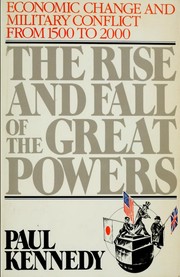
Paul Kennedy · 1987

Military spending measured against the economy that has to carry it.

“The River Out of Eden by Richard Dawkins, The Rise and Fall of the Great Powers by Paul Kennedy” — Ray Dalio

Source: Ray Dalio Reddit AMA, r/IAmA (u/RayTDalio)

Recommended by: Ray Dalio, Michael Wong

Where it sits in the reference 1

Secular themes

Topics

Politics and GovernmentGeneral HistorySociology and CultureWorld and Big HistoryGeopolitics and international relationsGlobalisation and national societies