Updates

  1. Person pages list letters, writing, profiles and links as sortable tables with filters, and show each person's companies as links; Fund letters show each letter's description in its own column.
  2. Experts show a checked job title and a short description of each person; 30 more people have photographs.
  3. Every company, fund, university and publication the experts work for has a page listing the people there.
  4. Fund letters show each letter's thesis and filter by it; 225 person pages list the essays, columns and newsletter issues the person wrote.
  5. Person pages list every essay and newsletter issue a person wrote, and their own books as a table in List view.
  6. Recommends shows the five largest kinds of book and the rest under More; browse pictures load sooner.
  7. Podcasts and talks link the original episode, filter by Audio and video or Press, and list each publisher once.
  8. Pages are wider, Recommends has List and Grid, and a filter clicked again turns off.
  9. Book cards sit in a ruled grid with Open Library and Goodreads links and each book's one-line note.
  10. Funds is now Investors; each investor's styles are buttons that filter the table.
  11. Podcasts and talks on a person's page filter by year and publisher and show as a list or a grid of pictures.
  12. Quotes show only people's own words: 472 summaries written by list sites are gone.
  13. Country pages open from Browse again, and every link on the shelf lands on a page.
  14. Subject and person pages show their sections as tabs, and each book appears once on a person's page.
  15. Book cards show the quote, who said it and the source; grids show five cards to a row.
  16. On a phone, a menu holds the sections, search, Updates, Feedback and dark mode.
  17. Feedback takes a screenshot of the page with no browser prompt, opens a screenshot full size when you click it, and clears itself once sent.
  18. Book cards are centred, search names the topic each book sits in, and any text cut short shows whole on hover.
  19. Search groups its results by kind: people, companies, geographies, subjects, topics, books, funds, fund letters and papers.
  20. The Books table lists who recommended each book by name, and the browser tab names the section you are in.
  21. Feedback can take a screenshot of the page, or one you paste or choose, and opens in the corner beside Updates.
  22. Each rail button reopens its section where you left it, and Browse, Table and People show on every book and subject page.
  23. Filters grey out choices that hold nothing instead of hiding them, and Books › People filters by authors or recommenders.
  24. Feedback takes a subject line and up to three screenshots.
  25. Biographies are grouped by the person they are about: 41 new pages, from Abraham Lincoln to Lee Kuan Yew.
  26. Sport splits into 23 sports, and Religion into one topic per faith.
  27. Book lists show as cards: the cover, one recommendation quote and every recommender by name.
  28. Seventeen subjects that had two or three pages under different names now have one page each.
  29. Every page lists its Experts as authors and recommenders, with a link to them on the Experts tab.
  30. Economics, Financial history, Financial panics and Accounting are subjects of their own, with one page per financial crisis.
  31. Book, person and subject pages open inside the app, so the tabs stay in view.
  32. 996 more book covers, and photographs or logos for 227 more people and companies.
  33. Books › Browse shows every subject as cards, and the rail holds Fund letters, Papers, Experts, Books and Funds.
  34. Every topic over 150 books splits into narrower topics, each with a page of its own.

Send feedback

What is it?
Screenshots, up to 3 (optional)
or paste one with Ctrl+V

We use your email only to reply to you.

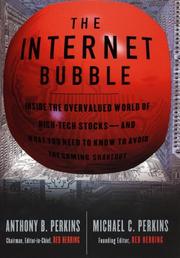
The Internet Bubble

The Internet Bubble

Anthony B. Perkins, Michael C. Perkins
1999
T3 283 pages · about 4h 43m to read Open Librarygoodreads

Written before the crash, naming Yahoo among the overvalued.

Summary

Anthony and Michael Perkins founded Red Herring, the magazine covering technology venture investing, and published this in 1999 arguing that internet stock valuations were unsustainable.

Their analysis was straightforward and correct. They computed what revenue and profit growth would be required to justify the market capitalisations of the leading internet companies, showed that the required numbers were implausible for most of them, and identified the specific mechanisms producing the valuations: the small share of stock actually floated, which allowed a high price to be set on marginal trading; the lock-up structures that concentrated selling pressure at predictable dates; the incentives of investment banks whose research analysts were compensated on banking revenue; the venture capital model, which requires exits and therefore requires public market appetite; and the retail investor participation drawn in by media coverage.

They published a list of companies they considered overvalued and were substantially vindicated within eighteen months. The book is a period document and its interest now is as an example of a correct contemporaneous call made by people inside the industry, and of the specific structural mechanisms that sustained the valuations. The authors were themselves participants in the ecosystem they criticised, which they acknowledge. The analysis of analyst conflicts contributed to the regulatory settlement that followed in 2003.

Key takeaways 7

  1. The revenue and profit growth required to justify 1999 internet valuations was implausible for almost every company examined.
  2. Floating a small share of a company's stock allows a high price to be set on marginal trading volume.
  3. Lock-up expiry dates concentrate insider selling pressure at predictable moments after an offering.
  4. Investment bank research analysts were compensated from banking revenue, which made their recommendations advertising.
  5. The venture capital model requires exits, which creates a structural interest in maintaining public market appetite.
  6. The authors published specific overvaluation calls that were substantially vindicated within eighteen months.
  7. The authors were participants in the ecosystem they criticised, which they acknowledge and readers should weigh.

Who should read it

Investors who want a documented example of a correct contemporaneous bubble call and of the structural mechanisms that sustain inflated valuations.

Similar books 6

Chosen by shared topics, the entries that hold them, and the people who recommended both.

John Cassidy · 2002

The internet stock bubble from Netscape's 1995 listing to the crash.

Robert H. Reid · 1997

Contemporary profiles including Yahoo's founding by Yang and Filo.

Recommended by: Keith Rabois
Maggie Mahar · 2003

The US bull market from August 1982 to its 1999 peak, and what changed in it.

Recommended by: Warren Buffett

Robert J. Shiller · 2000

How psychology, not fundamentals, drove the stock and housing booms of 2000 and 2005.

Nicholas Carlson · 2015

Marissa Mayer's arrival at Yahoo in 2012 and her struggle to turn it around.
John Battelle · 2005

The search industry from early engines to Google, and how paid search was invented.

Recommended by: Gary Vaynerchuk, Keith Rabois

Where it sits in the reference 2

Companies
Financial panics

Topics

Financial HistoryTechnology and ComputingTech strategy and platform economics