Updates

  1. Person pages list letters, writing, profiles and links as sortable tables with filters, and show each person's companies as links; Fund letters show each letter's description in its own column.
  2. Experts show a checked job title and a short description of each person; 30 more people have photographs.
  3. Every company, fund, university and publication the experts work for has a page listing the people there.
  4. Fund letters show each letter's thesis and filter by it; 225 person pages list the essays, columns and newsletter issues the person wrote.
  5. Person pages list every essay and newsletter issue a person wrote, and their own books as a table in List view.
  6. Recommends shows the five largest kinds of book and the rest under More; browse pictures load sooner.
  7. Podcasts and talks link the original episode, filter by Audio and video or Press, and list each publisher once.
  8. Pages are wider, Recommends has List and Grid, and a filter clicked again turns off.
  9. Book cards sit in a ruled grid with Open Library and Goodreads links and each book's one-line note.
  10. Funds is now Investors; each investor's styles are buttons that filter the table.
  11. Podcasts and talks on a person's page filter by year and publisher and show as a list or a grid of pictures.
  12. Quotes show only people's own words: 472 summaries written by list sites are gone.
  13. Country pages open from Browse again, and every link on the shelf lands on a page.
  14. Subject and person pages show their sections as tabs, and each book appears once on a person's page.
  15. Book cards show the quote, who said it and the source; grids show five cards to a row.
  16. On a phone, a menu holds the sections, search, Updates, Feedback and dark mode.
  17. Feedback takes a screenshot of the page with no browser prompt, opens a screenshot full size when you click it, and clears itself once sent.
  18. Book cards are centred, search names the topic each book sits in, and any text cut short shows whole on hover.
  19. Search groups its results by kind: people, companies, geographies, subjects, topics, books, funds, fund letters and papers.
  20. The Books table lists who recommended each book by name, and the browser tab names the section you are in.
  21. Feedback can take a screenshot of the page, or one you paste or choose, and opens in the corner beside Updates.
  22. Each rail button reopens its section where you left it, and Browse, Table and People show on every book and subject page.
  23. Filters grey out choices that hold nothing instead of hiding them, and Books › People filters by authors or recommenders.
  24. Feedback takes a subject line and up to three screenshots.
  25. Biographies are grouped by the person they are about: 41 new pages, from Abraham Lincoln to Lee Kuan Yew.
  26. Sport splits into 23 sports, and Religion into one topic per faith.
  27. Book lists show as cards: the cover, one recommendation quote and every recommender by name.
  28. Seventeen subjects that had two or three pages under different names now have one page each.
  29. Every page lists its Experts as authors and recommenders, with a link to them on the Experts tab.
  30. Economics, Financial history, Financial panics and Accounting are subjects of their own, with one page per financial crisis.
  31. Book, person and subject pages open inside the app, so the tabs stay in view.
  32. 996 more book covers, and photographs or logos for 227 more people and companies.
  33. Books › Browse shows every subject as cards, and the rail holds Fund letters, Papers, Experts, Books and Funds.
  34. Every topic over 150 books splits into narrower topics, each with a page of its own.

Send feedback

What is it?
Screenshots, up to 3 (optional)
or paste one with Ctrl+V

We use your email only to reply to you.

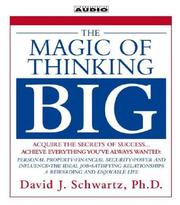
The Magic of Thinking Big

The Magic of Thinking Big

David Schwartz
1959
270 pages · about 4h 30m to read Open Librarygoodreads

Summary

Schwartz, a marketing professor, published this in 1959 as a self-improvement manual arguing that the size of a person's thinking determines the size of their results, and that most limits people encounter are self-imposed rather than external.

The practical content covers a set of habits. Belief is treated as a mechanism rather than a sentiment, on the argument that a person who believes something is achievable generates the methods for achieving it while a person who does not stops looking. He attacks what he calls excusitis, meaning the habit of explaining current position through health, intelligence, age or luck, and gives a treatment for each. He argues for building confidence through action rather than waiting for it, using specific behaviours including sitting at the front, walking faster, speaking up first and making eye contact.

Other material covers thinking in terms of what can be added rather than what cannot be done, the argument that people are judged on the size of their thinking rather than on their qualifications, managing the environment including the people a person spends time with, and treating setbacks as information. The book has sold enormously and has influenced most subsequent self-improvement writing, including material that does not credit it.

It contains no research and the claims are asserted. Schwartz's examples are from 1950s American corporate life and the gender assumptions are of their period. Some of the advice, particularly on projecting confidence, will read as superficial. The observation that most constraints people cite are self-generated, and the treatment of belief as something that changes what a person notices and attempts, is the durable content.

Key takeaways 8

  1. The size of a person's thinking determines the size of their results more than their ability does.
  2. Belief functions as a mechanism rather than a sentiment, since a person who believes something is possible generates methods while one who does not stops looking.
  3. Most explanations people give for their current position, including health, intelligence, age and luck, are excuses that survive because they are unexamined.
  4. Confidence follows action rather than preceding it, which means the behaviours should be adopted before the feeling arrives.
  5. People are judged on the scale of their thinking rather than on their qualifications, which is why the same credentials produce different outcomes.
  6. The people a person spends time with determine the scale of what they consider possible, which makes environment a deliberate choice.
  7. Setbacks should be treated as information about method rather than as verdicts about capability.
  8. The book asserts its claims without evidence and its examples reflect 1950s American corporate life.

Who should read it

Readers who want the foundational text of modern self-improvement writing, treated as assertion rather than as evidence.

Who recommended it 5 · 3 direct

Tim Ferrissreported

Similar books 6

Chosen by shared topics, the entries that hold them, and the people who recommended both.

Tim Ferriss · 2016

Routines, tools and advice from over 200 podcast guests on health, wealth and wisdom.

James Clear · 2016

Build habits by making them obvious, attractive, easy and satisfying.

Anthony Robbins · 1991

Change behaviour by changing what you link with pain and pleasure.

Where it sits in the reference 0

No entry holds this book yet. It reached the reference because someone recommended it.

Topics

Productivity and HabitsPsychology and BehaviourHabits, motivation and self-improvementMotivation and success mindset