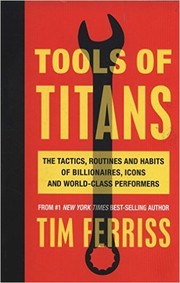
Tools of Titans
Summary
Ferriss compiled this from more than two hundred podcast interviews, organised into three sections covering health, wealth and wisdom. Each entry profiles a subject with their routines, tools, recommended books, and answers to questions Ferriss asks repeatedly across interviews.
The recurring questions produce the book's comparative value, since the same questions asked of many high performers reveal both convergence and disagreement. They include what purchase under one hundred dollars has most improved your life, what advice would you give your younger self, what do you believe that most people would disagree with, and what does the first hour of your day look like.
The health section covers training protocols, fasting, cold exposure, sleep, and a range of supplement regimens, much of it from people with commercial interests in what they recommend. The wealth section covers investing, negotiation, marketing and business building. The wisdom section covers Stoicism, meditation, psychedelics, failure and habit. The format is deliberately non-linear and Ferriss instructs readers to skip.
The main problem is evidential. The subjects are selected for success and asked what they do, which produces survivorship bias throughout, and the health protocols in particular are anecdote rather than evidence. Several recommendations, especially in supplements and in fasting, are stated with more confidence than the research supports. The book is long and much of it is transcription. Its value is as a reference of practices to test individually rather than as a set of validated methods, and Ferriss says as much in the introduction.
Key takeaways 8
- Asking the same questions of many high performers reveals which practices converge and which are idiosyncratic, which is more informative than any single profile.
- Most of the subjects follow a structured morning routine, though the specific content varies enormously and the consistency matters more than the components.
- Nearly all of them treat physical training and sleep as inputs to cognitive performance rather than as separate concerns.
- Many describe deliberately defining their fears in writing as a decision tool, which Ferriss calls fear-setting and treats as more useful than goal-setting.
- Several subjects state that the ability to decline opportunities is the constraint on performance rather than the ability to find them.
- The subjects disagree substantially on diet, training and productivity method, which undermines any claim that a single protocol produces the results.
- The health protocols in the book are anecdotal, and several are stated with more confidence than the underlying research supports.
- The subjects are selected for success, which means the practices described cannot be distinguished from practices that unsuccessful people also follow.
Who should read it
Readers who want a reference of practices to test individually, treating the whole as anecdote rather than as evidence.
Who recommended it 7 · 2 direct
Similar books 6
Chosen by shared topics, the entries that hold them, and the people who recommended both.
The size of your thinking sets the size of your results, and how to think bigger.
Recommended by: Ali Abdaal, Mohnish Pabrai, Nat Eliason and 2 others

Change behaviour by changing what you link with pain and pleasure.
Recommended by: Guy Spier, Nat Eliason, Brian Koppelman and 2 others
Thirteen principles of getting rich, claimed to come from studying 500 wealthy men.
“I've always been a big fan of books and teaching seminars specializing in the area of self-improvement. Think And Grow Rich by Napoleon Hill is one book I'd recommend to everyone.” — Jim Clayton
Source: Clayton on the one book he would recommend to everyone
Recommended by: Jim Clayton, Mohnish Pabrai and 8 others
Where it sits in the reference 0
No entry holds this book yet. It reached the reference because someone recommended it.
Topics