Updates

  1. Person pages list letters, writing, profiles and links as sortable tables with filters, and show each person's companies as links; Fund letters show each letter's description in its own column.
  2. Experts show a checked job title and a short description of each person; 30 more people have photographs.
  3. Every company, fund, university and publication the experts work for has a page listing the people there.
  4. Fund letters show each letter's thesis and filter by it; 225 person pages list the essays, columns and newsletter issues the person wrote.
  5. Person pages list every essay and newsletter issue a person wrote, and their own books as a table in List view.
  6. Recommends shows the five largest kinds of book and the rest under More; browse pictures load sooner.
  7. Podcasts and talks link the original episode, filter by Audio and video or Press, and list each publisher once.
  8. Pages are wider, Recommends has List and Grid, and a filter clicked again turns off.
  9. Book cards sit in a ruled grid with Open Library and Goodreads links and each book's one-line note.
  10. Funds is now Investors; each investor's styles are buttons that filter the table.
  11. Podcasts and talks on a person's page filter by year and publisher and show as a list or a grid of pictures.
  12. Quotes show only people's own words: 472 summaries written by list sites are gone.
  13. Country pages open from Browse again, and every link on the shelf lands on a page.
  14. Subject and person pages show their sections as tabs, and each book appears once on a person's page.
  15. Book cards show the quote, who said it and the source; grids show five cards to a row.
  16. On a phone, a menu holds the sections, search, Updates, Feedback and dark mode.
  17. Feedback takes a screenshot of the page with no browser prompt, opens a screenshot full size when you click it, and clears itself once sent.
  18. Book cards are centred, search names the topic each book sits in, and any text cut short shows whole on hover.
  19. Search groups its results by kind: people, companies, geographies, subjects, topics, books, funds, fund letters and papers.
  20. The Books table lists who recommended each book by name, and the browser tab names the section you are in.
  21. Feedback can take a screenshot of the page, or one you paste or choose, and opens in the corner beside Updates.
  22. Each rail button reopens its section where you left it, and Browse, Table and People show on every book and subject page.
  23. Filters grey out choices that hold nothing instead of hiding them, and Books › People filters by authors or recommenders.
  24. Feedback takes a subject line and up to three screenshots.
  25. Biographies are grouped by the person they are about: 41 new pages, from Abraham Lincoln to Lee Kuan Yew.
  26. Sport splits into 23 sports, and Religion into one topic per faith.
  27. Book lists show as cards: the cover, one recommendation quote and every recommender by name.
  28. Seventeen subjects that had two or three pages under different names now have one page each.
  29. Every page lists its Experts as authors and recommenders, with a link to them on the Experts tab.
  30. Economics, Financial history, Financial panics and Accounting are subjects of their own, with one page per financial crisis.
  31. Book, person and subject pages open inside the app, so the tabs stay in view.
  32. 996 more book covers, and photographs or logos for 227 more people and companies.
  33. Books › Browse shows every subject as cards, and the rail holds Fund letters, Papers, Experts, Books and Funds.
  34. Every topic over 150 books splits into narrower topics, each with a page of its own.

Send feedback

What is it?
Screenshots, up to 3 (optional)
or paste one with Ctrl+V

We use your email only to reply to you.

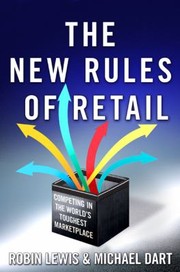
The New Rules of Retail

The New Rules of Retail

Robin Lewis, Michael Dart
2010
T3 256 pages · about 4h 16m to read Open Librarygoodreads

Preemptive distribution and control of the value chain.

Summary

The reference has not verified this book in detail; the summary states only what the title, author and subject establish.

Lewis and Dart argue that retail power has shifted decisively from producers to consumers, and that survival now requires three capabilities they call preemptive distribution, neurological connection and value chain control.

The reference has not verified the book's detailed contents. The argument as the authors state it runs as follows. Consumers have more choice, more information and more channels than at any previous point, so they can obtain any product at any price from any source. This eliminates the advantages that came from shelf space, from information asymmetry and from geographic convenience. What remains defensible is being present wherever the consumer is before competitors are, which they call preemptive distribution; establishing an emotional attachment strong enough that the consumer does not comparison shop, which they call neurological connection; and controlling enough of the chain from design through manufacture to sale that the experience can be delivered consistently, which they call value chain control.

They use vertically integrated specialty retailers and brands with strong emotional positioning as their positive cases, and argue that undifferentiated mid-market retailers holding none of the three capabilities will not survive.

The general prediction, that mid-market retail without differentiation would be destroyed, has been substantially borne out over the following decade. The specific companies held up as examples have had varied outcomes, which is the usual fate of business book cases. Readers should verify the specific evidence and cases the authors present.

Key takeaways 7

  1. Consumer access to information and channels eliminated the advantages retailers held from shelf space and geographic convenience.
  2. Being present wherever the consumer shops, before competitors arrive, replaced distribution scale as the positional advantage.
  3. Emotional attachment strong enough to prevent comparison shopping is what protects margin when price information is universal.
  4. Controlling the chain from design to sale is what allows a consistent experience to be delivered rather than promised.
  5. Retailers holding none of these capabilities compete on price alone and cannot sustain the margin their cost structure requires.
  6. Undifferentiated mid-market retail was predicted to be destroyed, and this has substantially happened.
  7. Product quality alone provides no defence when consumers can find equivalent products instantly at lower prices.

Who should read it

Retail and consumer brand operators assessing which of their advantages survive universal price transparency, who should verify the book's specific evidence.

Similar books 6

Chosen by shared topics, the entries that hold them, and the people who recommended both.
Anita Elberse · 2013

Hit economics that explain Netflix's later spending strategy.

Hermann Simon · 2015

Price is the strongest profit lever and the least managed; how to set it well.

Recommended by: Michael Mauboussin

Mark Jeffery · 2010

Fifteen metrics that show which marketing spending works and which does not.

Recommended by: Mohnish Pabrai, Jeff Bezos

Madhavan Ramanujam, Georg Tacke · 2016

Set the price before you design the product, since most failures are pricing ones.

Tien Tzuo · 2018

Why firms are moving from selling units to selling ongoing subscriptions, and how.

Where it sits in the reference 4

Business models
Business models
Business themes
Business themes

Topics

Sales and MarketingBusiness and ManagementGrowth, pricing and channels