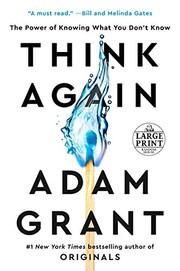
Think Again
Summary
Grant argues that the ability to reconsider what you believe is a distinct skill from intelligence, that it is not correlated with intelligence and may be negatively correlated with it, and that individuals and organisations can be trained in it.
His framework contrasts four modes: the preacher who defends a position, the prosecutor who attacks another's, the politician who seeks approval, and the scientist who holds beliefs as hypotheses and looks for disconfirming evidence. He argues most people default to the first three and that the scientific mode must be deliberately adopted. He draws on the confidence and competence literature, on Philip Tetlock's forecasting research, on his own studies of negotiation and of entrepreneurs trained in scientific method, and on cases including the Iridium satellite venture and firefighters who died holding their equipment.
The practical material covers how to change other people's minds, where he argues that motivational interviewing, asking questions and finding the small number of points of agreement work while argument and evidence generally do not; how to build organisational cultures of psychological safety where challenge is expected; and how to hold career and identity loosely enough to update. He introduces the practice of rethinking cycles and the recommendation to define yourself by values rather than by opinions.
The book is readable and the practical advice is usable. Its weakness is the usual one for this genre: it assembles studies selected to support the thesis, several of the cited effects are modest or contested, and the entrepreneurial training study it leans on is a single trial. Grant is also more confident that rethinking can be taught than the evidence establishes.
Key takeaways 7
- The ability to reconsider a belief is a separate skill from intelligence and is not improved by being smarter, since intelligence supplies better arguments for existing positions.
- People default to preaching, prosecuting or politicking, and holding beliefs as testable hypotheses must be deliberately adopted.
- Confident humility, meaning belief in one's capability combined with doubt about one's current answer, is the state that produces learning.
- Arguing with evidence rarely changes a mind, while asking questions that let a person examine their own reasoning sometimes does.
- Presenting fewer and stronger reasons persuades better than presenting many, because weak reasons dilute strong ones and invite counterargument.
- Identifying yourself with your values rather than your opinions makes it possible to change an opinion without experiencing it as a loss of self.
- Organisations should build cultures where challenging a superior is expected, since psychological safety without accountability produces comfort rather than learning.
Who should read it
Operators and investors who want practical methods for updating their own views and for changing others', with the usual caveats about popular behavioural science.
About Adam Grant
Organisational psychologist and professor of management at the Wharton School, University of Pennsylvania.
Give and Take presents evidence that people who default to helping others cluster at both the bottom and the top of performance distributions, and identifies what separates the two groups - directly useful for anyone designing incentives or picking partners. Think Again and Originals cover how people revise beliefs against new evidence and how unfamiliar ideas get championed inside established organisations.
Who recommended it 2
Similar books 6
Chosen by shared topics, the entries that hold them, and the people who recommended both.

Bevelin distilling observation and inference habits from Sherlock Holmes
Recommended by: Mohnish Pabrai, Patrick O'Shaughnessy and 1 other
Dialogue form; Munger's inversion habit worked through systematically.
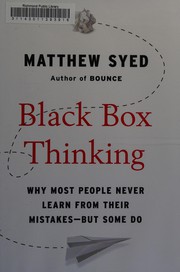
Why aviation learns from every failure while fields like medicine hide theirs.
Recommended by: Richard Branson, Daniel Ek
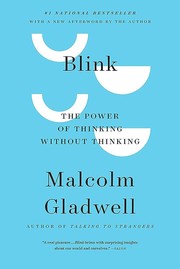
How snap judgments work, when to trust them and when they mislead.
Recommended by: Mohnish Pabrai, Ev Williams, Packy McCormick
Papers on how people choose under risk, from prospect theory to framing.
Where it sits in the reference 2
Topics