
Charlie Munger
Vice-chairman, Berkshire Hathaway 1978-2023; chairman, Wesco Financial and Daily Journal Corporation
His latticework-of-mental-models talks reframed investing as applied multidisciplinary psychology and are quoted as a primary source across fields.
1 books of their own · 8 biographies about them · 33 letters · 53 articles · 57 books they recommend
Books they wrote 1

Biographies about them 8
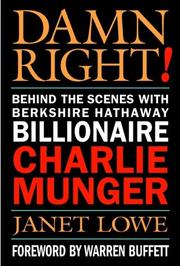
One authorised biography and one compiled speech collection carry almost the whole literature.


Letters 33
worldlypartners.com/charlie-munger-archive/
Berkshire's own site hosts only Munger's Wesco Financial chairman's letters for 1997-2009 (berkshirehathaway.com/wesco/WescoHome.html, files cm1997.pdf ... cm2009.pdf). The earlier Wesco letters 1983-1996 and the Blue Chip Stamps letters to shareholders 1977-1982, which Munger also wrote, are not on berkshirehathaway.com; the complete set of individual PDFs is in the Charlie Munger Archive at worldlypartners.com/charlie-munger-archive/. Several of those PDFs are page scans with no text layer, so they will not search. Munger's Daily Journal Corporation annual-meeting remarks and his Wesco annual-meeting remarks 1999-2011 exist only as third-party transcripts and are recorded under articles.
- Wesco Financial Corporation letter to shareholders 20092009
- Wesco Financial Corporation letter to shareholders 20082008
- Wesco Financial Corporation letter to shareholders 20072007
- Wesco Financial Corporation letter to shareholders 20062006
- Wesco Financial Corporation letter to shareholders 20052005
- Wesco Financial Corporation letter to shareholders 20042004
- Wesco Financial Corporation letter to shareholders 20032003
- Wesco Financial Corporation letter to shareholders 20022002
- Wesco Financial Corporation letter to shareholders 20012001
- Wesco Financial Corporation letter to shareholders 20002000
- Wesco Financial Corporation letter to shareholders 19991999
- Wesco Financial Corporation letter to shareholders 19981998
- Wesco Financial Corporation letter to shareholders 19971997
- Wesco Financial Corporation letter to shareholders 19961996 · Not on berkshirehathaway.com; hosted in the Worldly Partners Munger archive
- Wesco Financial Corporation letter to shareholders 19951995 · Not on berkshirehathaway.com; hosted in the Worldly Partners Munger archive
- Wesco Financial Corporation letter to shareholders 19941994 · Not on berkshirehathaway.com; hosted in the Worldly Partners Munger archive
- Wesco Financial Corporation letter to shareholders 19931993 · Not on berkshirehathaway.com; hosted in the Worldly Partners Munger archive
- Wesco Financial Corporation letter to shareholders 19921992 · Not on berkshirehathaway.com; hosted in the Worldly Partners Munger archive
- Wesco Financial Corporation letter to shareholders 19911991 · Not on berkshirehathaway.com; hosted in the Worldly Partners Munger archive
- Wesco Financial Corporation letter to shareholders 19901990 · Not on berkshirehathaway.com; hosted in the Worldly Partners Munger archive
- Wesco Financial Corporation letter to shareholders 19891989 · Not on berkshirehathaway.com; hosted in the Worldly Partners Munger archive
- Wesco Financial Corporation letter to shareholders 19881988 · Not on berkshirehathaway.com; hosted in the Worldly Partners Munger archive
- Wesco Financial Corporation letter to shareholders 19871987 · Not on berkshirehathaway.com; hosted in the Worldly Partners Munger archive
- Wesco Financial Corporation letter to shareholders 19861986 · Not on berkshirehathaway.com; hosted in the Worldly Partners Munger archive
- Wesco Financial Corporation letter to shareholders 19851985 · Not on berkshirehathaway.com; hosted in the Worldly Partners Munger archive
- Wesco Financial Corporation letter to shareholders 19841984 · Not on berkshirehathaway.com; hosted in the Worldly Partners Munger archive
- Wesco Financial Corporation letter to shareholders 19831983 · Not on berkshirehathaway.com; hosted in the Worldly Partners Munger archive
- Blue Chip Stamps letter to shareholders 19821982 · Blue Chip Stamps chairman’s letter, written by Munger
- Blue Chip Stamps letter to shareholders 19811981 · Blue Chip Stamps chairman’s letter, written by Munger
- Blue Chip Stamps letter to shareholders 19801980 · Blue Chip Stamps chairman’s letter, written by Munger
- Blue Chip Stamps letter to shareholders 19791979 · Blue Chip Stamps chairman’s letter, written by Munger
- Blue Chip Stamps letter to shareholders 19781978 · Blue Chip Stamps chairman’s letter, written by Munger
- Blue Chip Stamps letter to shareholders 19771977 · Blue Chip Stamps chairman’s letter, written by Munger
Articles and essays 53
- Why America Should Ban CryptoOp-ed, 2023
- Poor Charlie’s Almanack: The Essential Wit and Wisdom of Charles T. Munger (full text of the talks)Stripe Press, 2023
- Daily Journal Corporation 2023 annual meeting — transcript of Charlie Munger’s remarksThird-party transcript, 2023
- Charlie Munger in conversation with Todd Combs, Singleton Prize for CEO ExcellenceSingleton Prize, 2022
- Daily Journal Corporation 2022 annual meeting — transcript of Charlie Munger’s remarksThird-party transcript, 2022
- Daily Journal Corporation 2021 annual meeting — transcript of Charlie Munger’s remarksThird-party transcript, 2021
- Daily Journal Corporation 2020 annual meeting — transcript of Charlie Munger’s remarksThird-party transcript, 2020
- Charlie Munger Unplugged (interview)The Wall Street Journal, 2019
- Daily Journal Corporation 2019 annual meeting — transcript of Charlie Munger’s remarksThird-party transcript, 2019
- Daily Journal Corporation 2018 annual meeting — transcript of Charlie Munger’s remarksThird-party transcript, 2018
- A conversation with Charlie Munger at the University of Michigan Ross SchoolUniversity of Michigan Ross, 2017
- Daily Journal Corporation 2017 annual meeting — transcript of Charlie Munger’s remarksThird-party transcript, 2017
- Daily Journal Corporation 2017 annual meeting — transcript of Charlie Munger’s remarksThird-party transcript, 2017
- Daily Journal Corporation 2016 annual meeting — transcript of Charlie Munger’s remarksThird-party transcript, 2016
- Daily Journal Corporation 2015 annual meeting — transcript of Charlie Munger’s remarksThird-party transcript, 2015
- Vice Chairman’s Thoughts — Past and FutureBerkshire Hathaway 50th anniversary letter, 2014
- Daily Journal Corporation 2014 annual meeting — transcript of Charlie Munger’s remarksThird-party transcript, 2014
- Daily Journal Corporation 2013 annual meeting — transcript of Charlie Munger’s remarksThird-party transcript, 2013
- A parody about the Great RecessionEssay, 2011
- Wesco Financial 2011 annual meeting — notes of Charlie Munger’s remarksThird-party transcript, 2011
- Basically, It’s Over: A parable about how one nation came to financial ruinSlate, 2010
- Wesco Financial 2010 annual meeting — notes of Charlie Munger’s remarksThird-party transcript, 2010
- Sacrificing to Restore Market ConfidenceOp-ed, 2009
- Wesco Financial 2009 annual meeting — notes of Charlie Munger’s remarksThird-party transcript, 2009
- Wesco Financial 2008 annual meeting — notes of Charlie Munger’s remarksThird-party transcript, 2008
- 2007 USC Law School Commencement AddressUSC Gould School of Law (transcript), 2007
- USC Gould School of Law commencement addressUSC Gould School of Law, 2007
- Wesco Financial 2007 annual meeting — notes of Charlie Munger’s remarksThird-party transcript, 2007
- Wesco Financial 2006 annual meeting — notes of Charlie Munger’s remarksThird-party transcript, 2006
- Wesco Financial 2005 annual meeting — notes of Charlie Munger’s remarksThird-party transcript, 2005
- Wesco Financial 2004 annual meeting — notes of Charlie Munger’s remarksThird-party transcript, 2004
- Academic Economics: Strengths and Faults After Considering Interdisciplinary NeedsUC Santa Barbara address, 2003
- Wesco Financial 2003 annual meeting — notes of Charlie Munger’s remarksThird-party transcript, 2003
- Optimism Has No Place in AccountingEssay, 2002
- Wesco Financial 2002 annual meeting — notes of Charlie Munger’s remarksThird-party transcript, 2002
- The Great Financial Scandal of 2003Essay, 2001
- Wesco Financial 2001 annual meeting — notes of Charlie Munger’s remarksThird-party transcript, 2001
- Talk to a breakfast meeting of the Philanthropy Round TablePhilanthropy Round Table, 2000
- A Perverse Use of Antitrust LawEssay, 2000
- Wesco Financial 2000 annual meeting — notes of Charlie Munger’s remarksThird-party transcript, 2000
- Wesco Financial 2000 annual meeting — notes of Charlie Munger’s remarksThird-party transcript, 2000
- Wesco Financial 1999 annual meeting — notes of Charlie Munger’s remarksThird-party transcript, 1999
- Investment Practices of Leading Charitable FoundationsFoundation Financial Officers Group address, 1998
- Worldly Wisdom Revisited: Business — What Lawyers Should KnowStanford Law School lecture, 1996
- Practical Thought About Practical ThoughtEssay, 1996
- The Psychology of Human MisjudgmentHarvard University address (revised transcript), 1995
- The Psychology of Human MisjudgmentHarvard University address, 1995
- A Lesson on Elementary, Worldly Wisdom As It Relates to Investment Management and BusinessUSC Business School address (transcript), 1994
- A Lesson on Elementary, Worldly Wisdom As It Relates to Investment Management and BusinessUSC Marshall School of Business lecture, 1994
- Resignation of Mutual Savings from the U.S. League of Savings InstitutionsLetter, 1989
- 1986 commencement speech at Harvard SchoolHarvard School (now Harvard-Westlake) commencement, 1986
- 1984 testimony to the U.S. House of RepresentativesU.S. House of Representatives, 1984
- Opinion piece on the stock marketOp-ed, 1984
Books they recommend 57
Munger organized his intellectual life around what he called 'big ideas' — the handful of core concepts from each major discipline that, taken together, explain most of what matters. A cluster of biology and evolutionary thinking comes first; from there the list moves into psychology, where Poor Charlie's Almanack catalogues 25 tendencies toward misjudgment drawing heavily on Cialdini and Kahneman. Biography forms the third pillar: Munger read biographies obsessively, believing you could 'absorb the lifetime learning of extraordinary people' without paying the tuition. The investing titles aren't separate — he treated investing as applied psychology, applied math, and applied history simultaneously.
Poor Charlie's Almanack recommended reading 22
Science 7
Biography and Memoir 5

General History 3
Psychology and Behaviour 1
Negotiation and Persuasion 1
Business and Management 1

Investing 1

Environment and Energy 1
Economics 1
Financial History 1

Book recommendations listed on their Good Books profile 13
Science 4
Business and Management 2

Company Histories 2
Financial History 2

Psychology and Behaviour 1
Decision Making 1
Investing 1
Superbook reading list 12
Science 3
Investing 3
Psychology and Behaviour 2
Biography and Memoir 1
Biography of Scientists 1
Economics 1
General History 1
1996 Berkshire annual meeting 1
Science 1
1994 Berkshire annual meeting 1
Biography and Memoir 1
1995 Berkshire annual meeting 1
Decision Making 1
2011 Berkshire annual meeting 1
Company Histories 1
2015 Berkshire annual meeting 1
Economics 1
2008 Berkshire annual meeting 1
Negotiation and Persuasion 1
Munger's fond memories of Phil Fisher 1
Investing 1
Notes from the 2004 Berkshire Hathaway Annual Meeting, by Whitney Tilson, p. 35 1
Biography and Memoir 1
Munger on what a reader gets from assimilating the book 1
Investing 1
Poor Charlie's Almanack, Talk Two: A Lesson on Elementary, Worldly Wisdom 1
Science 1
Where they publish 10
- Poor Charlie's Almanack, Recommended Reading (Stripe Press edition)
- Books Munger recommended at Berkshire annual meetings
- Poor Charlie's Almanack (Stripe Press full text)
- Investment Masters Class book recommendations
- Good Books — Charlie Munger profile
- Superbook reading list
- Poor Charlie's Almanack (book, 2005)
- Wesco Financial Annual Meeting transcripts (various years)
- USC Law School Commencement speech, 'Elementary, Worldly Wisdom' (1994)
- Daily Journal Annual Meeting transcripts (DJCO)