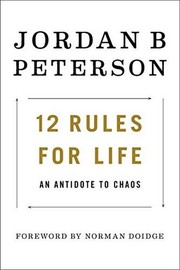
12 Rules for Life
Summary
Peterson, a clinical psychologist and former University of Toronto professor, organises the book as twelve rules, each with an essay drawing on clinical practice, evolutionary biology, mythology, religious texts and literature, particularly Dostoevsky, Nietzsche, Jung and Solzhenitsyn.
The rules include standing up straight with shoulders back, treating yourself like someone you are responsible for helping, making friends with people who want the best for you, comparing yourself to who you were yesterday rather than to someone else today, not letting children do things that make you dislike them, setting your own house in order before criticising the world, pursuing what is meaningful rather than what is expedient, telling the truth, assuming the person you are listening to knows something you do not, being precise in speech, not bothering children when they are skateboarding, and petting a cat when you encounter one.
The underlying argument is that life involves unavoidable suffering, that meaning comes from voluntarily accepting responsibility, and that order and chaos must be balanced rather than one eliminated. Peterson's opening argument about lobster serotonin and dominance hierarchies is used to claim that hierarchy is biologically ancient rather than a recent social construction, and it is the most disputed passage in the book.
The criticisms are substantial. Biologists dispute the lobster argument as a misapplication of a distant evolutionary comparison. The interpretation of myth is idiosyncratic and not accepted by scholars in those fields. The prose is dense and digressive, and the connection between the stated rule and the essay is often loose. Peterson's political prominence means readers frequently evaluate the book by his public positions. The material on responsibility, on truthfulness in speech and on comparing yourself to your own past is the part with clinical grounding.
Key takeaways 8
- Meaning comes from voluntarily accepting responsibility for suffering rather than from pursuing happiness or avoiding difficulty.
- A person should compare their current position to their own past rather than to other people's present, because the second comparison is always available and always defeating.
- Set your own life in order before attempting to criticise or reform larger systems, because the smaller task is verifiable and the larger one is not.
- Telling the truth, or at minimum not lying, is a practical requirement rather than a moral luxury, because accumulated small falsehoods produce a life built on a false structure.
- Dominance hierarchies are evolutionarily ancient rather than recent social constructions, which Peterson argues from a comparison to lobster neurochemistry that biologists dispute.
- Parents should not permit behaviour in children that makes the parents dislike them, because resentment damages the relationship more than the discipline would.
- Listening properly requires assuming the other person knows something you do not, which is the condition for learning anything from a conversation.
- Order and chaos both have necessary functions, and the objective is standing at the boundary rather than eliminating either.
Who should read it
Readers who want an argument for personal responsibility grounded in clinical practice, prepared for digressive prose and for the disputed evolutionary claims.
Who recommended it 10 · 1 direct
Similar books 6
Chosen by shared topics, the entries that hold them, and the people who recommended both.
Recommended by: Nat Eliason, Naval Ravikant, Garry Tan and 1 other
Life in Nazi concentration camps, and logotherapy: finding meaning to survive.
“I have been deeply influenced by the existentialist and eminent psychiatrist Viktor Frankl, who wrote the perennial best seller Man's Search for Meaning, one of the most influential books I've ever…” — Frank Martin
Source: Martin on one of the most influential books he has read and reread
Recommended by: Frank Martin, Mohnish Pabrai, Nat Eliason and 24 others
Recommended by: Naval Ravikant
Recommended by: Andrew Wilkinson, Nat Eliason and 1 other
“Derek is one of my favorite writers, and his latest book is focused on a simple idea: our beliefs are often not necessarily true, but simply useful to us. That beliefs are tools, not truths.” — Andrew Wilkinson
Source: Newsletter
Recommended by: Andrew Wilkinson
Recommended by: Andrew Wilkinson, David Cancel, Nat Eliason and 4 others
Where it sits in the reference 0
No entry holds this book yet. It reached the reference because someone recommended it.
Topics