Updates

  1. Person pages list letters, writing, profiles and links as sortable tables with filters, and show each person's companies as links; Fund letters show each letter's description in its own column.
  2. Experts show a checked job title and a short description of each person; 30 more people have photographs.
  3. Every company, fund, university and publication the experts work for has a page listing the people there.
  4. Fund letters show each letter's thesis and filter by it; 225 person pages list the essays, columns and newsletter issues the person wrote.
  5. Person pages list every essay and newsletter issue a person wrote, and their own books as a table in List view.
  6. Recommends shows the five largest kinds of book and the rest under More; browse pictures load sooner.
  7. Podcasts and talks link the original episode, filter by Audio and video or Press, and list each publisher once.
  8. Pages are wider, Recommends has List and Grid, and a filter clicked again turns off.
  9. Book cards sit in a ruled grid with Open Library and Goodreads links and each book's one-line note.
  10. Funds is now Investors; each investor's styles are buttons that filter the table.
  11. Podcasts and talks on a person's page filter by year and publisher and show as a list or a grid of pictures.
  12. Quotes show only people's own words: 472 summaries written by list sites are gone.
  13. Country pages open from Browse again, and every link on the shelf lands on a page.
  14. Subject and person pages show their sections as tabs, and each book appears once on a person's page.
  15. Book cards show the quote, who said it and the source; grids show five cards to a row.
  16. On a phone, a menu holds the sections, search, Updates, Feedback and dark mode.
  17. Feedback takes a screenshot of the page with no browser prompt, opens a screenshot full size when you click it, and clears itself once sent.
  18. Book cards are centred, search names the topic each book sits in, and any text cut short shows whole on hover.
  19. Search groups its results by kind: people, companies, geographies, subjects, topics, books, funds, fund letters and papers.
  20. The Books table lists who recommended each book by name, and the browser tab names the section you are in.
  21. Feedback can take a screenshot of the page, or one you paste or choose, and opens in the corner beside Updates.
  22. Each rail button reopens its section where you left it, and Browse, Table and People show on every book and subject page.
  23. Filters grey out choices that hold nothing instead of hiding them, and Books › People filters by authors or recommenders.
  24. Feedback takes a subject line and up to three screenshots.
  25. Biographies are grouped by the person they are about: 41 new pages, from Abraham Lincoln to Lee Kuan Yew.
  26. Sport splits into 23 sports, and Religion into one topic per faith.
  27. Book lists show as cards: the cover, one recommendation quote and every recommender by name.
  28. Seventeen subjects that had two or three pages under different names now have one page each.
  29. Every page lists its Experts as authors and recommenders, with a link to them on the Experts tab.
  30. Economics, Financial history, Financial panics and Accounting are subjects of their own, with one page per financial crisis.
  31. Book, person and subject pages open inside the app, so the tabs stay in view.
  32. 996 more book covers, and photographs or logos for 227 more people and companies.
  33. Books › Browse shows every subject as cards, and the rail holds Fund letters, Papers, Experts, Books and Funds.
  34. Every topic over 150 books splits into narrower topics, each with a page of its own.

Send feedback

What is it?
Screenshots, up to 3 (optional)
or paste one with Ctrl+V

We use your email only to reply to you.

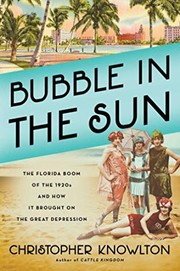
Bubble in the Sun

Bubble in the Sun

Christopher Knowlton
2020
T3 411 pages · about 6h 51m to read Open Librarygoodreads

The 1920s Florida land boom and its collapse.

Summary

Knowlton covers the Florida land boom of the 1920s and its collapse, arguing that it was a significant contributor to the conditions that produced the Depression rather than a regional curiosity. He follows the developers who built the state: Carl Fisher at Miami Beach, George Merrick at Coral Gables, Addison Mizner at Boca Raton, and Henry Flagler's earlier railroad that made the peninsula reachable.

The mechanics of the boom are the substance. Land was sold on binders, meaning a small deposit gave the buyer the right to resell before the balance was due, which meant a purchaser could control property with almost no capital and flip it repeatedly within weeks. Prices were quoted on subdivisions that had not been surveyed and lots that were underwater. Northern buyers purchased sight unseen from newspaper advertisements. Banks lent against the inflated valuations and Florida banks were heavily concentrated in the same collateral.

The collapse came from several directions at once: the railroads embargoed freight because the lines could not handle the volume, a ship sank in the Miami harbour channel and blocked it, buyers stopped arriving, and then the 1926 Miami hurricane and the 1928 Okeechobee hurricane destroyed property and killed thousands. Florida banks failed in waves from 1926, three years before the national crash.

Knowlton also covers the environmental consequences of draining the Everglades. The book is popular history and its macroeconomic claim, that Florida contributed materially to the national banking collapse, is asserted more than demonstrated. The boom mechanics and the developer biographies are well reported.

Key takeaways 7

  1. Florida land was sold on binders that let a buyer control property with a small deposit and resell before payment was due, which allowed speculation with almost no capital.
  2. Lots were sold sight unseen to northern buyers from newspaper advertisements, on subdivisions that in many cases had not been surveyed or drained.
  3. Florida banks concentrated their lending in the same inflated land collateral, so the collapse took the banking system with it.
  4. Florida bank failures began in 1926, three years before the national crash, and the state's contraction preceded the national one.
  5. The boom ended from several simultaneous causes including a rail freight embargo, a blocked harbour, and two catastrophic hurricanes.
  6. Developers financed infrastructure from lot sales, which meant a slowdown in sales immediately stopped construction and destroyed the value of unsold inventory.
  7. Draining the Everglades to create sellable land caused environmental damage whose costs were borne publicly long after the developers had gone.

Who should read it

Investors interested in the mechanics of a land speculation cycle and in a regional bust that preceded the national one.

Who recommended it 1

Similar books 6

Chosen by shared topics, the entries that hold them, and the people who recommended both.

Charles V. Bagli · 2013

The Stuyvesant Town deal and the largest real estate loss on record.

Recommended by: Vinod Khosla

Michael Cannon · 1966

The Melbourne property mania and bank collapses of the 1890s.

Robert F. Bruner, Sean D. Carr · 2007

The 1907 panic day by day, from a failed copper corner to J.P. Morgan's rescue.

Recommended by: Mohnish Pabrai and 1 other
William L. Silber · 2007

The 1914 closure of the exchange, and how the dollar took over.

Robert A. Caro · 1974

How an unelected official amassed power and used it to rebuild New York.

Where it sits in the reference 3

Assets
Industries
Financial panics

Topics

Financial HistoryGeneral HistoryFinancial History