Updates

  1. Person pages list letters, writing, profiles and links as sortable tables with filters, and show each person's companies as links; Fund letters show each letter's description in its own column.
  2. Experts show a checked job title and a short description of each person; 30 more people have photographs.
  3. Every company, fund, university and publication the experts work for has a page listing the people there.
  4. Fund letters show each letter's thesis and filter by it; 225 person pages list the essays, columns and newsletter issues the person wrote.
  5. Person pages list every essay and newsletter issue a person wrote, and their own books as a table in List view.
  6. Recommends shows the five largest kinds of book and the rest under More; browse pictures load sooner.
  7. Podcasts and talks link the original episode, filter by Audio and video or Press, and list each publisher once.
  8. Pages are wider, Recommends has List and Grid, and a filter clicked again turns off.
  9. Book cards sit in a ruled grid with Open Library and Goodreads links and each book's one-line note.
  10. Funds is now Investors; each investor's styles are buttons that filter the table.
  11. Podcasts and talks on a person's page filter by year and publisher and show as a list or a grid of pictures.
  12. Quotes show only people's own words: 472 summaries written by list sites are gone.
  13. Country pages open from Browse again, and every link on the shelf lands on a page.
  14. Subject and person pages show their sections as tabs, and each book appears once on a person's page.
  15. Book cards show the quote, who said it and the source; grids show five cards to a row.
  16. On a phone, a menu holds the sections, search, Updates, Feedback and dark mode.
  17. Feedback takes a screenshot of the page with no browser prompt, opens a screenshot full size when you click it, and clears itself once sent.
  18. Book cards are centred, search names the topic each book sits in, and any text cut short shows whole on hover.
  19. Search groups its results by kind: people, companies, geographies, subjects, topics, books, funds, fund letters and papers.
  20. The Books table lists who recommended each book by name, and the browser tab names the section you are in.
  21. Feedback can take a screenshot of the page, or one you paste or choose, and opens in the corner beside Updates.
  22. Each rail button reopens its section where you left it, and Browse, Table and People show on every book and subject page.
  23. Filters grey out choices that hold nothing instead of hiding them, and Books › People filters by authors or recommenders.
  24. Feedback takes a subject line and up to three screenshots.
  25. Biographies are grouped by the person they are about: 41 new pages, from Abraham Lincoln to Lee Kuan Yew.
  26. Sport splits into 23 sports, and Religion into one topic per faith.
  27. Book lists show as cards: the cover, one recommendation quote and every recommender by name.
  28. Seventeen subjects that had two or three pages under different names now have one page each.
  29. Every page lists its Experts as authors and recommenders, with a link to them on the Experts tab.
  30. Economics, Financial history, Financial panics and Accounting are subjects of their own, with one page per financial crisis.
  31. Book, person and subject pages open inside the app, so the tabs stay in view.
  32. 996 more book covers, and photographs or logos for 227 more people and companies.
  33. Books › Browse shows every subject as cards, and the rail holds Fund letters, Papers, Experts, Books and Funds.
  34. Every topic over 150 books splits into narrower topics, each with a page of its own.

Send feedback

What is it?
Screenshots, up to 3 (optional)
or paste one with Ctrl+V

We use your email only to reply to you.

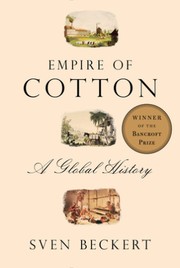
Empire of Cotton

Empire of Cotton

Sven Beckert
2014
T2 622 pages · about 10h 22m to read Open Librarygoodreads

One commodity chain as the whole story of industrial capitalism.

Summary

Beckert, a Harvard historian, wrote a global history of cotton from the ancient world to the present, using the commodity to trace the development of capitalism itself.

His central analytical contribution is the concept of war capitalism, which he distinguishes from industrial capitalism. War capitalism preceded and enabled industrialisation, and it operated through violence rather than through markets: the seizure of land from indigenous peoples in the Americas, the enslavement of Africans to work it, the armed domination of trade routes, and the destruction of competing production, particularly the Indian cotton textile industry which was the world's largest before British policy dismantled it. Beckert argues that European industrialisation depended on this: cheap slave-grown raw cotton, captive markets created by force, and capital accumulated through the trade.

The industrial narrative traces the mechanisation of spinning and weaving in Britain, the concentration of production in Lancashire, the American South's emergence as the dominant supplier, the disruption of the American Civil War and the global scramble for alternative supply in India, Egypt and Brazil that followed, and the subsequent reorganisation of production.

The later sections cover the movement of manufacturing from Britain to continental Europe, to the American South, to Japan, and eventually to China, India, Bangladesh and Vietnam, and argue that the industry has repeatedly relocated to wherever labour is cheapest and most controllable, which is the pattern rather than an exception.

Beckert also documents the state's role throughout: tariffs, colonial policy, infrastructure and the coercion of labour were state actions without which the industry would not have developed as it did.

The book is long and its central claim, that slavery and coercion were constitutive of capitalism rather than incidental to it, is contested by economic historians who dispute the quantitative significance. The global scope and the documentation are widely admired.

Key takeaways 7

  1. European industrialisation depended on cheap slave-grown raw cotton, on captive markets created by force, and on capital accumulated through that trade.
  2. War capitalism operating through land seizure, slavery and armed trade domination preceded and enabled industrial capitalism.
  3. India had the world's largest cotton textile industry before British policy dismantled it in favour of Lancashire production.
  4. The American Civil War's disruption of cotton supply triggered a global scramble that reorganised production across India, Egypt and Brazil.
  5. Cotton manufacturing has repeatedly relocated to wherever labour is cheapest and most controllable, which is the industry's persistent pattern.
  6. State action through tariffs, colonial policy, infrastructure and labour coercion was constitutive of the industry rather than incidental.
  7. The claim that coercion was constitutive of capitalism rather than incidental is contested by economic historians on quantitative grounds.

Who should read it

Readers who want a global commodity history that connects supply chains, state power and labour coercion across four centuries.

Similar books 6

Chosen by shared topics, the entries that hold them, and the people who recommended both.
Thomas K. McCraw · 1997

How Britain, Germany, Japan and the US each built their own form of capitalism.

Recommended by: Mohnish Pabrai

Alan Greenspan, Adrian Wooldridge · 2018

American economic growth from colonial times to now, driven by creative destruction.
Arthur Herman · 2001

Scottish Enlightenment as the source of modern commercial and economic thinking

Where it sits in the reference 2

Business themes
Economics

Topics

General HistoryEconomicsSociology and CultureEconomic and Business HistoryGlobalisation and national societies