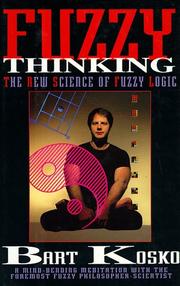
Fuzzy Thinking
How fuzzy logic works and how it changes everyday life.
Summary
Bart Kosko, a leading exponent of fuzzy logic, wrote what the publisher calls the first popular book to explain how fuzzy logic is changing everyday life. The fuzzy principle is that everything is a matter of degree and nothing is absolute. Kosko argues that for centuries the West has been locked into thinking in black and white, right and wrong, all or nothing, so Western scientists resisted fuzzy logic, while Eastern philosophy, with its yin and yang and its habit of seeing the universe from several perspectives at once, made Asia more open to it. To compete, he says, the West must open itself to fuzzy ways of thinking.
Fuzzy logic mimics the working of the human brain and is used to make machines think more like people. Japanese and Korean companies were applying it to products worth billions of dollars a year: air conditioners that adjust continuously to the room's temperature instead of blasting cold air, cameras, car engines, brakes and transmissions, washing machines, elevators and televisions, and palmtop computers that read handwriting. Kosko applies it even to ethics: on the question of when life begins, fuzzy thinking says it begins at fertilisation, at six months and at birth, each to a degree.
Key takeaways 4
- Fuzzy logic treats truth as a matter of degree rather than true or false.
- Kosko argues that Western all-or-nothing thinking slowed acceptance of fuzzy logic.
- Asian manufacturers built fuzzy control into everyday products from air conditioners to cameras.
- Fuzzy thinking can reframe ethical questions that have no sharp boundaries.
Who should read it
Readers interested in logic, artificial intelligence and the philosophy of uncertainty.
Who recommended it 1
Similar books 6
Chosen by shared topics, the entries that hold them, and the people who recommended both.
How very simple programs produce complexity, and what that explains in nature.
Recommended by: Mohnish Pabrai, Steve Jurvetson
How scientists found order in chaos, from nonlinearity to the butterfly effect.
Recommended by: Jim Collins, Naval Ravikant, Stewart Brand
Control and communication in animals and machines run on the same principles.
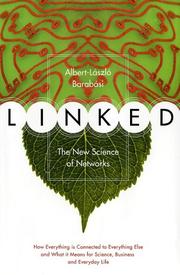
The science of networks, and why social networks, companies and organisms are alike.
“Barabasi, Albert-Laszlo, Linked: How Everything is Connected to Everything Else and What It Means (New York: Perseus Books, 2002)” — Michael Mauboussin
Source: Exploring Network Economics, page 15
Recommended by: Michael Mauboussin, Mohnish Pabrai
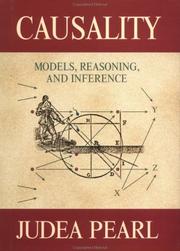
A mathematical theory of causation for statistics, AI, economics and science.

A graduate text on power laws, fractals and critical points in complex systems.
Recommended by: Nassim Nicholas Taleb