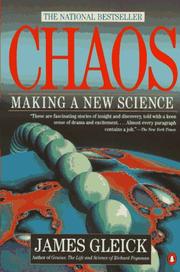
Chaos
How scientists found order in chaos, from nonlinearity to the butterfly effect.
Summary
Gleick tells how scientists studying the growth of complexity in nature found order and pattern in chaos. He explains the concepts of the new science: nonlinearity, sensitivity to initial conditions known as the butterfly effect, universal constants, fractals and strange attractors.
The book is organised around the scientists who built the field, among them Edward Lorenz, Mitchell Feigenbaum and Benoit Mandelbrot, and it follows their work across disciplines. It was published in 1987. The source read in this pass, a catalogue description, gives the concepts and people but not the chapter-by-chapter structure.
Key takeaways 3
- Simple deterministic systems can behave unpredictably because small differences in starting conditions grow.
- Chaotic systems still show order, in fractal shapes, strange attractors and universal constants.
- The science of chaos grew from work in weather, physics and mathematics that crossed disciplinary lines.
Who should read it
Readers who want a narrative introduction to chaos theory and the scientists who developed it.
Who recommended it 3 · 1 direct
Similar books 6
Chosen by shared topics, the entries that hold them, and the people who recommended both.

How very simple programs produce complexity, and what that explains in nature.
Recommended by: Mohnish Pabrai, Steve Jurvetson

Control and communication in animals and machines run on the same principles.
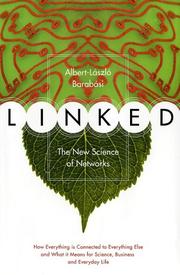
The science of networks, and why social networks, companies and organisms are alike.
“Barabasi, Albert-Laszlo, Linked: How Everything is Connected to Everything Else and What It Means (New York: Perseus Books, 2002)” — Michael Mauboussin
Source: Exploring Network Economics, page 15
Recommended by: Michael Mauboussin, Mohnish Pabrai
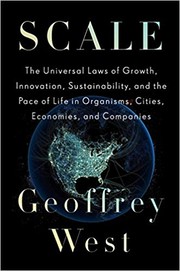
Why organisms, cities and companies follow power laws set by their supply networks.
“Geoffrey West, Scale: The Universal Laws of Growth, Innovation, Sustainability, and the Pace of Life in Organisms, Cities, Economies, and Companies (New York: Penguin Press, 2017), 26” — Michael Mauboussin
Source: Underestimating the Red Queen: Measuring Growth and Maintenance Investments, page 18
Recommended by: Michael Mauboussin, Nat Eliason and 4 others

How people have understood nothing, from zero in India to the vacuum in physics.
Recommended by: Naval Ravikant
Where it sits in the reference 4
As an Amazon Associate I earn from qualifying purchases.