Updates

  1. Person pages list letters, writing, profiles and links as sortable tables with filters, and show each person's companies as links; Fund letters show each letter's description in its own column.
  2. Experts show a checked job title and a short description of each person; 30 more people have photographs.
  3. Every company, fund, university and publication the experts work for has a page listing the people there.
  4. Fund letters show each letter's thesis and filter by it; 225 person pages list the essays, columns and newsletter issues the person wrote.
  5. Person pages list every essay and newsletter issue a person wrote, and their own books as a table in List view.
  6. Recommends shows the five largest kinds of book and the rest under More; browse pictures load sooner.
  7. Podcasts and talks link the original episode, filter by Audio and video or Press, and list each publisher once.
  8. Pages are wider, Recommends has List and Grid, and a filter clicked again turns off.
  9. Book cards sit in a ruled grid with Open Library and Goodreads links and each book's one-line note.
  10. Funds is now Investors; each investor's styles are buttons that filter the table.
  11. Podcasts and talks on a person's page filter by year and publisher and show as a list or a grid of pictures.
  12. Quotes show only people's own words: 472 summaries written by list sites are gone.
  13. Country pages open from Browse again, and every link on the shelf lands on a page.
  14. Subject and person pages show their sections as tabs, and each book appears once on a person's page.
  15. Book cards show the quote, who said it and the source; grids show five cards to a row.
  16. On a phone, a menu holds the sections, search, Updates, Feedback and dark mode.
  17. Feedback takes a screenshot of the page with no browser prompt, opens a screenshot full size when you click it, and clears itself once sent.
  18. Book cards are centred, search names the topic each book sits in, and any text cut short shows whole on hover.
  19. Search groups its results by kind: people, companies, geographies, subjects, topics, books, funds, fund letters and papers.
  20. The Books table lists who recommended each book by name, and the browser tab names the section you are in.
  21. Feedback can take a screenshot of the page, or one you paste or choose, and opens in the corner beside Updates.
  22. Each rail button reopens its section where you left it, and Browse, Table and People show on every book and subject page.
  23. Filters grey out choices that hold nothing instead of hiding them, and Books › People filters by authors or recommenders.
  24. Feedback takes a subject line and up to three screenshots.
  25. Biographies are grouped by the person they are about: 41 new pages, from Abraham Lincoln to Lee Kuan Yew.
  26. Sport splits into 23 sports, and Religion into one topic per faith.
  27. Book lists show as cards: the cover, one recommendation quote and every recommender by name.
  28. Seventeen subjects that had two or three pages under different names now have one page each.
  29. Every page lists its Experts as authors and recommenders, with a link to them on the Experts tab.
  30. Economics, Financial history, Financial panics and Accounting are subjects of their own, with one page per financial crisis.
  31. Book, person and subject pages open inside the app, so the tabs stay in view.
  32. 996 more book covers, and photographs or logos for 227 more people and companies.
  33. Books › Browse shows every subject as cards, and the rail holds Fund letters, Papers, Experts, Books and Funds.
  34. Every topic over 150 books splits into narrower topics, each with a page of its own.

Send feedback

What is it?
Screenshots, up to 3 (optional)
or paste one with Ctrl+V

We use your email only to reply to you.

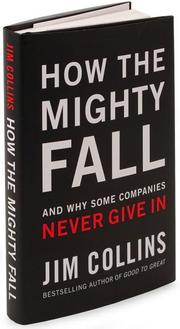
How the Mighty Fall

How the Mighty Fall

Jim Collins
2009
T4 222 pages · about 3h 42m to read Open Librarygoodreads

Summary

Collins examines company decline as a process with identifiable stages, written after the financial crisis and drawing on the same research base as his earlier books. His argument is that decline is detectable and reversible in its early stages and that the difficulty is that the early stages look like success.

He identifies five stages. Hubris born of success, in which the organisation stops asking why it succeeded and treats its position as deserved. Undisciplined pursuit of more, in which growth is pursued beyond what the organisation can staff or execute, frequently through acquisition into areas where it has no advantage. Denial of risk and peril, in which internal data shows deterioration and is explained away, external factors are blamed, and the leadership continues to project confidence. Grasping for salvation, in which the company seeks a single dramatic rescue, typically a charismatic outside chief executive, a transformational acquisition, an untested strategy or a cultural revolution. And capitulation to irrelevance or death.

His key practical claim is that the recovery move is the opposite of the intuition at stage four: companies that recovered did so through incremental disciplined action consistent with what they already understood, while companies that sought the dramatic rescue accelerated their decline.

The research method is the same as Good to Great, matching declining companies to comparison cases, and it carries the same criticism that the pattern is identified after the fact from a selected sample. The stage model is nonetheless usable as a diagnostic, and the warning about grasping for salvation is the most valuable part.

Key takeaways 7

  1. Company decline proceeds through five identifiable stages and is detectable and reversible in the early ones, which look like success from inside.
  2. The first stage is losing sight of why the company succeeded, which converts an understood advantage into an assumed entitlement.
  3. Growth pursued beyond what an organisation can staff and execute is the second stage, and it usually takes the form of acquisitions outside the core.
  4. Denial appears as explaining away internal data showing deterioration while attributing problems to external factors.
  5. Grasping for a single dramatic rescue, whether a charismatic outsider, a transformational acquisition or an untested strategy, accelerates decline rather than reversing it.
  6. Companies that recovered did so through incremental disciplined action consistent with what they already understood, which is the opposite of the intuition at that point.
  7. Decline is largely self-inflicted, and the point of no return comes later than most participants believe.

Who should read it

Executives and directors who want a diagnostic for organisational decline and a warning about the recovery moves that make it worse.

About Jim Collins

Management researcher; Stanford Graduate School of Business faculty 1988-1995, since then an independent researcher running a management laboratory in Boulder, Colorado

Built to Last and Good to Great are the primary research sources the enduring-company literature builds on and argues with.

Stanford Graduate School of Business

Who recommended it 1

Alfred Linreported

Similar books 6

Chosen by shared topics, the entries that hold them, and the people who recommended both.
Jim Collins · 2001

What eleven companies did to turn fifteen ordinary years into fifteen great ones.

Jim Collins, Morten T. Hansen · 2011

What companies that beat their industries tenfold in turbulent times did differently.

Jim Collins · 2005

Good to Great's principles applied to non-profits and the public sector.

Recommended by: Mohnish Pabrai
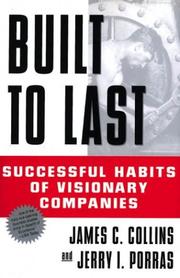
Jim Collins, Jerry I. Porras · 1994

What eighteen long-lived companies did differently from close rivals in their fields.

Jim Collins · 2019

Monograph companion to Good to Great

Where it sits in the reference 3

Strategists
Business themes
Business themes

Topics

Business and ManagementLeadership