Updates

  1. Person pages list letters, writing, profiles and links as sortable tables with filters, and show each person's companies as links; Fund letters show each letter's description in its own column.
  2. Experts show a checked job title and a short description of each person; 30 more people have photographs.
  3. Every company, fund, university and publication the experts work for has a page listing the people there.
  4. Fund letters show each letter's thesis and filter by it; 225 person pages list the essays, columns and newsletter issues the person wrote.
  5. Person pages list every essay and newsletter issue a person wrote, and their own books as a table in List view.
  6. Recommends shows the five largest kinds of book and the rest under More; browse pictures load sooner.
  7. Podcasts and talks link the original episode, filter by Audio and video or Press, and list each publisher once.
  8. Pages are wider, Recommends has List and Grid, and a filter clicked again turns off.
  9. Book cards sit in a ruled grid with Open Library and Goodreads links and each book's one-line note.
  10. Funds is now Investors; each investor's styles are buttons that filter the table.
  11. Podcasts and talks on a person's page filter by year and publisher and show as a list or a grid of pictures.
  12. Quotes show only people's own words: 472 summaries written by list sites are gone.
  13. Country pages open from Browse again, and every link on the shelf lands on a page.
  14. Subject and person pages show their sections as tabs, and each book appears once on a person's page.
  15. Book cards show the quote, who said it and the source; grids show five cards to a row.
  16. On a phone, a menu holds the sections, search, Updates, Feedback and dark mode.
  17. Feedback takes a screenshot of the page with no browser prompt, opens a screenshot full size when you click it, and clears itself once sent.
  18. Book cards are centred, search names the topic each book sits in, and any text cut short shows whole on hover.
  19. Search groups its results by kind: people, companies, geographies, subjects, topics, books, funds, fund letters and papers.
  20. The Books table lists who recommended each book by name, and the browser tab names the section you are in.
  21. Feedback can take a screenshot of the page, or one you paste or choose, and opens in the corner beside Updates.
  22. Each rail button reopens its section where you left it, and Browse, Table and People show on every book and subject page.
  23. Filters grey out choices that hold nothing instead of hiding them, and Books › People filters by authors or recommenders.
  24. Feedback takes a subject line and up to three screenshots.
  25. Biographies are grouped by the person they are about: 41 new pages, from Abraham Lincoln to Lee Kuan Yew.
  26. Sport splits into 23 sports, and Religion into one topic per faith.
  27. Book lists show as cards: the cover, one recommendation quote and every recommender by name.
  28. Seventeen subjects that had two or three pages under different names now have one page each.
  29. Every page lists its Experts as authors and recommenders, with a link to them on the Experts tab.
  30. Economics, Financial history, Financial panics and Accounting are subjects of their own, with one page per financial crisis.
  31. Book, person and subject pages open inside the app, so the tabs stay in view.
  32. 996 more book covers, and photographs or logos for 227 more people and companies.
  33. Books › Browse shows every subject as cards, and the rail holds Fund letters, Papers, Experts, Books and Funds.
  34. Every topic over 150 books splits into narrower topics, each with a page of its own.

Send feedback

What is it?
Screenshots, up to 3 (optional)
or paste one with Ctrl+V

We use your email only to reply to you.

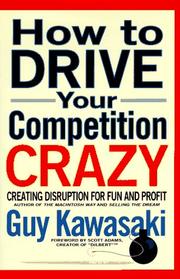
How to Drive Your Competition Crazy

How to Drive Your Competition Crazy

Guy Kawasaki
1995
T3 245 pages · about 4h 5m to read Open Librarygoodreads

Kawasaki on competing through service, speed and irritating incumbents

Summary

Kawasaki, then recently of Apple, wrote this as a tactical guide to competing against larger or established rivals. It is organised around specific manoeuvres rather than around strategy, and its premise is that a small company beats a large one through speed, focus and attention to what customers actually experience.

The tactics include: know your competitor better than they know themselves, including buying their products and using their support; define the competitive dimension yourself rather than accepting the incumbent's; serve the customers the incumbent finds unprofitable or annoying; make yourself easy to buy from, which he treats as a competitive weapon because large companies make themselves hard to deal with; turn customers into evangelists by giving them something worth telling others about; and use publicity rather than advertising because it is cheaper and more credible.

He also covers a set of practices about competing honourably, arguing that attacking competitors directly usually raises their profile and damages your own credibility, and that the better use of energy is making the competitor irrelevant to your customers.

The book is from 1995 and its examples are from that period, so the specific cases are dated. It is tactical rather than analytical, and it has no framework connecting the tactics. Readers wanting competitive strategy should go to Porter or Brandenburger and Nalebuff. Its value is as a checklist of practical moves for a small company that needs to act rather than analyse, and Kawasaki's arguments about evangelism and ease of purchase anticipated a great deal of later practice.

Key takeaways 7

  1. A small company should define the dimension of competition itself rather than accept the one the incumbent has established.
  2. Serving customers the incumbent finds unprofitable or annoying is the reliable entry point, because the incumbent will not defend them.
  3. Making your company easy to buy from is a competitive weapon, since large organisations reliably make themselves difficult to transact with.
  4. Buying and using a competitor's product and support is the cheapest and most underused source of competitive information.
  5. Publicity is cheaper and more credible than advertising, and a small company should invest in being newsworthy rather than in media purchase.
  6. Attacking a competitor directly raises their profile and damages your credibility, so the better move is making them irrelevant to your customers.
  7. Customers who tell other customers are worth more than any marketing expenditure, and earning that requires giving them something specific worth repeating.

Who should read it

Founders competing against larger established rivals who want tactical moves rather than a strategic framework.

About Guy Kawasaki

Chief evangelist at Canva; earlier Apple's Macintosh evangelist and a co-founder of Garage Technology Ventures.

The Art of the Start breaks early-company work into concrete tasks - pitching, positioning, recruiting, bootstrapping, partnering - for founders with no prior company behind them. The Macintosh Way and Selling the Dream document how Apple built developer and customer evangelism into a product launch, which is where the modern practice of developer relations comes from.

Canva, Apple, Garage Technology Ventures

Who recommended it 1 · 1 direct

“Awesome book. On my Top Ten List. CEO of garage.com and a friend.”

Similar books 6

Chosen by shared topics, the entries that hold them, and the people who recommended both.
David A. Aaker · 1996

How to build and manage a brand, using the four parts of brand equity.

Adam Morgan · 1999

Challenger-brand economics against a dominant incumbent.

Recommended by: Vinod Khosla

Mark Jeffery · 2010

Fifteen metrics that show which marketing spending works and which does not.

Recommended by: Mohnish Pabrai, Jeff Bezos

Clayton Christensen, Taddy Hall, Karen Dillon, David S. Duncan · 2016

Customers hire products to do a job; innovate by finding the job, not the buyer type.

Bharat Anand · 2016

Media firms fail by fixating on content when value lies in the connections around it.

Where it sits in the reference 4

Founders
Business models
Business themes
Business themes

Topics

Sales and MarketingBusiness and ManagementBrands, positioning and luxury