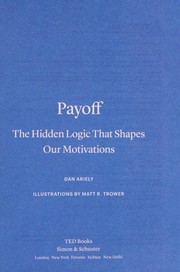
Payoff
Summary
Ariely's short book examines what actually motivates people at work, arguing that the standard model in which people trade effort for money describes almost nothing about human motivation.
His evidence comes from his own experiments. In one, workers at a semiconductor plant were offered a cash bonus, a pizza voucher or a compliment from a manager for meeting a target; the pizza and the compliment produced better results than the cash, and the cash group performed worse than the control group over the week. In another, participants built Lego models; when the models were disassembled in front of them as they built the next one, output fell sharply compared with a group whose models were stored, even though payment was identical. In another, participants wrote a document; those whose work was shredded without being read produced far less than those whose work was acknowledged, and acknowledgement required only that a supervisor glance at it.
His conclusion is that meaning, defined minimally as evidence that the work matters to someone, is a more powerful motivator than money, and that organisations destroy meaning without noticing through cancelled projects, unread reports and work that never reaches a user.
The book is short and readable, based on Ariely's own studies. Several of Ariely's published findings have been questioned and one of his papers was retracted over data problems in the underlying dataset, which is a reason to treat specific results here with caution while the general direction is supported by other researchers' work.
Key takeaways 7
- Offering a cash bonus for performance produced worse results than a pizza voucher or a manager's compliment, and worse than no incentive at all over a week.
- Work whose output is destroyed in front of the worker produces sharply lower effort than identical work whose output is retained, at identical pay.
- Acknowledgement of work requires only that someone visibly look at it, and its absence reduces output substantially.
- Meaning at work is minimally defined as evidence that the output matters to someone, and it motivates more strongly than money does.
- Organisations destroy meaning without noticing through cancelled projects, unread reports and work that never reaches a user.
- People value what they built themselves more than an identical object they did not build, which affects how ownership of work should be assigned.
- Some of Ariely's published findings have been questioned and one paper was retracted over data problems, so specific results here need caution.
Who should read it
Managers designing incentives and work structures, treating the specific experimental results with caution given the author's replication issues.
About Dan Ariely
Professor of psychology and behavioral economics at Duke University who runs experiments on how people misjudge value.
Predictably Irrational reports controlled experiments showing that valuation errors are systematic and repeatable: relative comparison, the pull of free, the effect of price on expected quality. The findings bear directly on pricing, bundling, incentive design and any forecast that assumes rational buyers.
Who recommended it 2 · 1 direct
Similar books 6
Chosen by shared topics, the entries that hold them, and the people who recommended both.
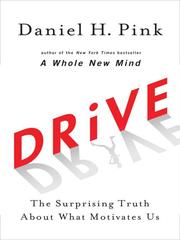
Rewards work for routine tasks; creative work runs on autonomy, mastery and purpose.
“In his excellent book, Drive, Dan Pink distinguishes between algorithmic tasks and heuristic tasks.” — Michael Mauboussin
Source: Blaming the Rat: Incentives, Motivation, and How They Interact (Legg Mason Capital Management)
Recommended by: Michael Mauboussin, Mohnish Pabrai and 3 others
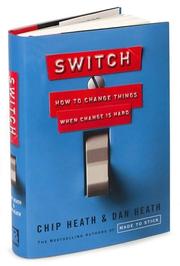
Change made easier: direct the rational rider, motivate the emotional elephant.
Recommended by: Andrew Wilkinson, Mohnish Pabrai, Nir Eyal and 1 other
What organisational culture is, how it forms, and how it bears on leadership.
Decision rules from building Bridgewater: radical truth and radical transparency.
Recommended by: Alfred Lin, Nat Eliason, Andrew Lokenauth and 28 others
Recommended by: Mohnish Pabrai
Where it sits in the reference 3
Topics