Updates

  1. Person pages list letters, writing, profiles and links as sortable tables with filters, and show each person's companies as links; Fund letters show each letter's description in its own column.
  2. Experts show a checked job title and a short description of each person; 30 more people have photographs.
  3. Every company, fund, university and publication the experts work for has a page listing the people there.
  4. Fund letters show each letter's thesis and filter by it; 225 person pages list the essays, columns and newsletter issues the person wrote.
  5. Person pages list every essay and newsletter issue a person wrote, and their own books as a table in List view.
  6. Recommends shows the five largest kinds of book and the rest under More; browse pictures load sooner.
  7. Podcasts and talks link the original episode, filter by Audio and video or Press, and list each publisher once.
  8. Pages are wider, Recommends has List and Grid, and a filter clicked again turns off.
  9. Book cards sit in a ruled grid with Open Library and Goodreads links and each book's one-line note.
  10. Funds is now Investors; each investor's styles are buttons that filter the table.
  11. Podcasts and talks on a person's page filter by year and publisher and show as a list or a grid of pictures.
  12. Quotes show only people's own words: 472 summaries written by list sites are gone.
  13. Country pages open from Browse again, and every link on the shelf lands on a page.
  14. Subject and person pages show their sections as tabs, and each book appears once on a person's page.
  15. Book cards show the quote, who said it and the source; grids show five cards to a row.
  16. On a phone, a menu holds the sections, search, Updates, Feedback and dark mode.
  17. Feedback takes a screenshot of the page with no browser prompt, opens a screenshot full size when you click it, and clears itself once sent.
  18. Book cards are centred, search names the topic each book sits in, and any text cut short shows whole on hover.
  19. Search groups its results by kind: people, companies, geographies, subjects, topics, books, funds, fund letters and papers.
  20. The Books table lists who recommended each book by name, and the browser tab names the section you are in.
  21. Feedback can take a screenshot of the page, or one you paste or choose, and opens in the corner beside Updates.
  22. Each rail button reopens its section where you left it, and Browse, Table and People show on every book and subject page.
  23. Filters grey out choices that hold nothing instead of hiding them, and Books › People filters by authors or recommenders.
  24. Feedback takes a subject line and up to three screenshots.
  25. Biographies are grouped by the person they are about: 41 new pages, from Abraham Lincoln to Lee Kuan Yew.
  26. Sport splits into 23 sports, and Religion into one topic per faith.
  27. Book lists show as cards: the cover, one recommendation quote and every recommender by name.
  28. Seventeen subjects that had two or three pages under different names now have one page each.
  29. Every page lists its Experts as authors and recommenders, with a link to them on the Experts tab.
  30. Economics, Financial history, Financial panics and Accounting are subjects of their own, with one page per financial crisis.
  31. Book, person and subject pages open inside the app, so the tabs stay in view.
  32. 996 more book covers, and photographs or logos for 227 more people and companies.
  33. Books › Browse shows every subject as cards, and the rail holds Fund letters, Papers, Experts, Books and Funds.
  34. Every topic over 150 books splits into narrower topics, each with a page of its own.

Send feedback

What is it?
Screenshots, up to 3 (optional)
or paste one with Ctrl+V

We use your email only to reply to you.

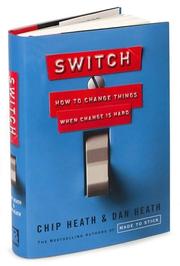
Switch: How to Change Things When Change Is

Switch: How to Change Things When Change Is Hard

Chip Heath
2010
T4 305 pages · about 5h 5m to read Open Librarygoodreads

Summary

The Heath brothers build a framework for change from Jonathan Haidt's image of a rider on an elephant, in which the rider represents deliberate rational thought and the elephant represents emotion and habit, and the path represents the surrounding environment. Their argument is that failed change efforts usually address only one of the three.

Directing the rider means providing clarity, because what looks like resistance is frequently lack of direction. Their techniques include finding the bright spots, meaning identifying where the desired behaviour already occurs and replicating it rather than analysing the problem; scripting the critical moves, meaning giving specific behavioural instructions rather than general goals; and pointing to the destination. Motivating the elephant means addressing emotion, because knowing something is not sufficient to change behaviour. Their techniques include finding the feeling, shrinking the change so it appears achievable, and growing your people by building an identity consistent with the new behaviour.

Shaping the path means changing the environment, because what looks like a people problem is frequently a situation problem. Their techniques include tweaking the environment, building habits through action triggers and checklists, and rallying the herd through visible social proof. The cases include the Vietnamese child nutrition programme by Jerry Sternin, the Brazilian railway turnaround, and public health interventions.

The research is synthesised rather than original, and several cited studies have replicated poorly, particularly around ego depletion which underpins their treatment of self-control. The bright spots technique and the argument to look for situation problems before people problems are the two most usable elements.

Key takeaways 8

  1. Change requires addressing rational direction, emotional motivation and the surrounding environment, and efforts that address only one of the three fail.
  2. What looks like resistance is frequently a lack of clarity about what specifically to do.
  3. Finding where the desired behaviour already occurs and replicating it works better than analysing why the problem exists.
  4. Specific behavioural instructions produce change where general goals do not, because ambiguity exhausts the deliberate mind.
  5. Knowing something is insufficient to change behaviour, which is why analysis and evidence alone do not produce action.
  6. Shrinking a change until it appears achievable overcomes the resistance produced by the size of the objective.
  7. What looks like a people problem is frequently a situation problem, so the environment should be examined before the individuals.
  8. Making the desired behaviour visible to others recruits social proof, which does more than persuasion aimed at individuals.

Who should read it

Operators leading change programmes who want a diagnostic for which of the three components their effort is missing.

Who recommended it 4 · 2 direct

Nir Eyalreported
Tony Hsiehreported

Similar books 6

Chosen by shared topics, the entries that hold them, and the people who recommended both.
Daniel H. Pink · 2009

Rewards work for routine tasks; creative work runs on autonomy, mastery and purpose.

“In his excellent book, Drive, Dan Pink distinguishes between algorithmic tasks and heuristic tasks.” — Michael Mauboussin

Source: Blaming the Rat: Incentives, Motivation, and How They Interact (Legg Mason Capital Management)

Recommended by: Michael Mauboussin, Mohnish Pabrai and 3 others
T4 Peak
Chip Conley · 2007

Recommended by: Tony Hsieh

Dan Ariely · 2016

Experiments showing people work for meaning and recognition, not just money.

Recommended by: Tim Ferriss, Alfred Lin

T4 Fish
Stephen C. Lundin et al. · 2011
Edgar H. Schein · 1985

What organisational culture is, how it forms, and how it bears on leadership.

Where it sits in the reference 2

Business themes
Business themes

Topics

Psychology and BehaviourBusiness and ManagementHabits, motivation and self-improvement