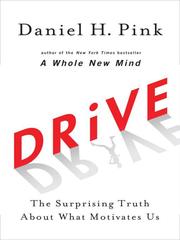
Drive
Autonomy, mastery and purpose against pay-for-performance assumptions
Summary
Pink argues that the reward-and-punishment model of motivation works for routine algorithmic tasks and fails for work requiring judgment, creativity or complex problem-solving. He organises the argument around three elements of intrinsic motivation: autonomy, meaning control over task, time, technique and team; mastery, meaning the pursuit of getting better at something that matters; and purpose, meaning connection to an objective beyond the self.
The research he draws on includes Deci and Ryan's self-determination theory, Harlow's early primate work showing that monkeys solved puzzles without reward, Deci's finding that paying people for a task they already enjoyed reduced their subsequent voluntary engagement, and Ariely and others' finding that very large incentives degraded performance on tasks requiring cognitive effort. He also cites the candle problem, where a functional fixedness task is solved more slowly by people offered payment.
His practical recommendations include results-only work environments, allocating unstructured time as Atlassian and 3M did, paying people enough to take money off the table, and shifting from if-then rewards to unexpected recognition after the fact.
The evidence is more contested than the book presents. The undermining effect of extrinsic rewards on intrinsic motivation has a mixed meta-analytic record, effect sizes are modest, and the finding depends heavily on task type and on whether the reward is controlling or informational. Many of the corporate examples have been discontinued, including Google's twenty percent time in its original form. The autonomy, mastery and purpose framing is useful as a design vocabulary regardless of the strength of the underlying studies.
Key takeaways 8
- Reward-and-punishment motivation works for routine algorithmic tasks and degrades performance on tasks requiring judgment or creativity.
- Paying people for an activity they already find intrinsically interesting reduces their voluntary engagement with it afterwards.
- Larger financial incentives improve performance on mechanical tasks and worsen it on tasks requiring cognitive effort.
- Autonomy over task, time, technique and team is the strongest single lever for motivation in knowledge work.
- Mastery requires work at the edge of current ability and never completes, which is what makes it a durable source of motivation.
- Purpose connected to something beyond the individual sustains effort where personal reward does not.
- People should be paid enough that compensation stops being a live issue, after which additional pay does not increase motivation.
- Unexpected recognition given after the work is completed avoids the damage that promised conditional rewards cause.
Who should read it
Managers designing incentive systems for knowledge work who want a vocabulary for autonomy and purpose, treating the effect sizes with caution.
Who recommended it 5 · 2 direct
“In his excellent book, Drive, Dan Pink distinguishes between algorithmic tasks and heuristic tasks.”
Similar books 6
Chosen by shared topics, the entries that hold them, and the people who recommended both.
Change made easier: direct the rational rider, motivate the emotional elephant.
Recommended by: Andrew Wilkinson, Mohnish Pabrai, Nir Eyal and 1 other
Experiments showing people work for meaning and recognition, not just money.
Recommended by: Tim Ferriss, Alfred Lin

Eight CEOs who beat the market by allocating capital, not by running operations.
“…books I've recommended, highlighted to death, or forced on friends.” — Andrew Wilkinson
Source: Andrew Wilkinson's Bookshelf, neverenough.com
Recommended by: Andrew Wilkinson, Dan Loeb, Francois Rochon and 12 others

Recommended by: Mohnish Pabrai

How Pixar kept a creative company working after success, and the habits it used.
Recommended by: Jim Collins, Alexis Ohanian, Allen Gannett and 11 others
Where it sits in the reference 3
Topics