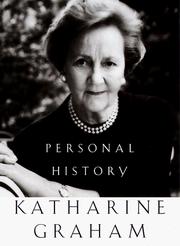
Personal History
Washington Post publisher's Pulitzer-winning memoir of running a company
Summary
Graham won the Pulitzer Prize for this autobiography, which covers her wealthy but emotionally distant childhood as the daughter of Eugene Meyer, who bought the Washington Post at a bankruptcy auction in 1933; her marriage to Philip Graham, who ran the paper and whose bipolar illness produced years of abuse before his suicide in 1963; and her assumption of control at forty-six with no management experience and no confidence.
The business material is substantial. She describes learning the business under conditions where every executive and every peer assumed she was a placeholder, the decision to take the company public in 1971, the choice to publish the Pentagon Papers while the public offering was pending and while government lawyers warned that criminal prosecution could void the company's broadcast licences, the Watergate coverage and the pressure from the Nixon administration, and the 1975 pressmen's strike in which she kept the paper publishing after sabotage of the presses.
The relationship with Warren Buffett, who bought a large stake in 1973 and joined the board, is documented in detail. She credits him with teaching her to read financial statements and to think about capital allocation, and the Post's subsequent share repurchases and returns reflect that.
The book is unusually honest about her own limitations, her fear, and her acceptance of her husband's treatment of her. The tone is measured and she is generous about people who treated her badly. It is long. She writes little about the newspaper's editorial decisions outside the major cases and does not examine the paper's institutional position critically. It remains one of the best accounts of learning to run a company under public scrutiny with no preparation.
Key takeaways 8
- Graham took control of the company at forty-six with no management experience and describes the process of learning the business in public.
- She authorised publication of the Pentagon Papers while the company's public offering was pending and while lawyers warned that prosecution could void its broadcast licences.
- Institutional and personal assumptions that a woman could not run the company were near-universal, and she documents how they shaped every interaction.
- Warren Buffett taught her to read financial statements and to think about capital allocation, which changed how the company deployed its cash.
- The company's share repurchases at low valuations produced returns that the newspaper operations alone would not have achieved.
- She kept the paper publishing through the 1975 pressmen's strike after the presses were sabotaged, which required accepting a prolonged confrontation.
- Political pressure on a news organisation operates through its regulated businesses rather than through the newsroom, which is what made the broadcast licences the point of leverage.
- Confidence followed competence rather than preceding it, and she describes years of performing a role she did not believe she could fill.
Who should read it
Executives who inherited or were handed a company without preparation, and anyone interested in decisions made under simultaneous legal, political and financial pressure.
Who recommended it 6 · 2 direct
“Highly Recommended.”
Similar books 6
Chosen by shared topics, the entries that hold them, and the people who recommended both.
Running Disney and buying Pixar, Marvel, Lucasfilm and Fox to add creative talent.
Recommended by: Bill Gates, Alexis Ohanian, Ali Abdaal and 8 others
Founder's account of building Firestone; business sense from the tyre trade
Recommended by: Andrew Wilkinson, Charlie Munger and 1 other
Media executive's memoir spanning Paramount, Fox and IAC
Recommended by: Bill Gates

A printer's rise in colonial America and his chart for practising thirteen virtues.
Recommended by: Charlie Munger, Mohnish Pabrai, Nat Eliason and 4 others

Samuel Zemurray rose from selling ripe bananas to taking over United Fruit.
Recommended by: Nat Eliason, Ryan Holiday, Andrew Wilkinson and 3 others

Entrepreneur's memoir of building and selling successive companies
Recommended by: Mohnish Pabrai
Where it sits in the reference 2
Topics