Updates

  1. Person pages list letters, writing, profiles and links as sortable tables with filters, and show each person's companies as links; Fund letters show each letter's description in its own column.
  2. Experts show a checked job title and a short description of each person; 30 more people have photographs.
  3. Every company, fund, university and publication the experts work for has a page listing the people there.
  4. Fund letters show each letter's thesis and filter by it; 225 person pages list the essays, columns and newsletter issues the person wrote.
  5. Person pages list every essay and newsletter issue a person wrote, and their own books as a table in List view.
  6. Recommends shows the five largest kinds of book and the rest under More; browse pictures load sooner.
  7. Podcasts and talks link the original episode, filter by Audio and video or Press, and list each publisher once.
  8. Pages are wider, Recommends has List and Grid, and a filter clicked again turns off.
  9. Book cards sit in a ruled grid with Open Library and Goodreads links and each book's one-line note.
  10. Funds is now Investors; each investor's styles are buttons that filter the table.
  11. Podcasts and talks on a person's page filter by year and publisher and show as a list or a grid of pictures.
  12. Quotes show only people's own words: 472 summaries written by list sites are gone.
  13. Country pages open from Browse again, and every link on the shelf lands on a page.
  14. Subject and person pages show their sections as tabs, and each book appears once on a person's page.
  15. Book cards show the quote, who said it and the source; grids show five cards to a row.
  16. On a phone, a menu holds the sections, search, Updates, Feedback and dark mode.
  17. Feedback takes a screenshot of the page with no browser prompt, opens a screenshot full size when you click it, and clears itself once sent.
  18. Book cards are centred, search names the topic each book sits in, and any text cut short shows whole on hover.
  19. Search groups its results by kind: people, companies, geographies, subjects, topics, books, funds, fund letters and papers.
  20. The Books table lists who recommended each book by name, and the browser tab names the section you are in.
  21. Feedback can take a screenshot of the page, or one you paste or choose, and opens in the corner beside Updates.
  22. Each rail button reopens its section where you left it, and Browse, Table and People show on every book and subject page.
  23. Filters grey out choices that hold nothing instead of hiding them, and Books › People filters by authors or recommenders.
  24. Feedback takes a subject line and up to three screenshots.
  25. Biographies are grouped by the person they are about: 41 new pages, from Abraham Lincoln to Lee Kuan Yew.
  26. Sport splits into 23 sports, and Religion into one topic per faith.
  27. Book lists show as cards: the cover, one recommendation quote and every recommender by name.
  28. Seventeen subjects that had two or three pages under different names now have one page each.
  29. Every page lists its Experts as authors and recommenders, with a link to them on the Experts tab.
  30. Economics, Financial history, Financial panics and Accounting are subjects of their own, with one page per financial crisis.
  31. Book, person and subject pages open inside the app, so the tabs stay in view.
  32. 996 more book covers, and photographs or logos for 227 more people and companies.
  33. Books › Browse shows every subject as cards, and the rail holds Fund letters, Papers, Experts, Books and Funds.
  34. Every topic over 150 books splits into narrower topics, each with a page of its own.

Send feedback

What is it?
Screenshots, up to 3 (optional)
or paste one with Ctrl+V

We use your email only to reply to you.

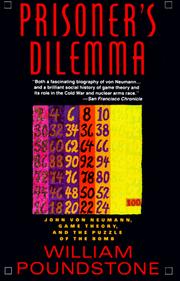
Prisoner's Dilemma

Prisoner's Dilemma

William Poundstone
1992
T2 290 pages · about 4h 50m to read Open Librarygoodreads

Summary

Poundstone combines a biography of John von Neumann with a history of game theory and an examination of the prisoner's dilemma and its application to nuclear strategy.

The von Neumann material covers his mathematics, his work on quantum mechanics, his role in the Manhattan Project, his invention of the stored-program computer architecture, and his advocacy of a preventive nuclear strike against the Soviet Union while the United States held a monopoly, which he argued followed from the game's logic.

The game theory content covers the minimax theorem, zero-sum and non-zero-sum games, the invention of the prisoner's dilemma at RAND by Flood and Dresher and its formulation by Tucker, and the related games of chicken, stag hunt and deadlock. Poundstone is clear about what each captures and about the fact that the dilemma's defining feature is that individually rational choices produce a collectively worse outcome that both parties can see coming and cannot avoid.

He covers the experimental record, including the original RAND experiment where the subjects cooperated far more than the theory predicted, and Axelrod's tournaments where tit-for-tat won a repeated version.

The application to nuclear strategy is the book's spine, and Poundstone shows how the framework shaped American thinking about deterrence, arms races and disarmament, while being clear that the model's fit to the actual situation was always contested. The book is well written and requires no mathematics.

Key takeaways 7

  1. The prisoner's dilemma describes a situation in which individually rational choices produce an outcome both parties know is worse for both.
  2. Repeated interaction changes the game entirely, and tit-for-tat, meaning cooperate first then copy the other party's last move, won Axelrod's tournaments.
  3. Experimental subjects cooperate substantially more than the theory predicts, which was evident in the original RAND experiment.
  4. Von Neumann advocated a preventive nuclear strike on the reasoning that the game's logic required acting while the United States held a monopoly.
  5. Chicken, stag hunt and deadlock describe different strategic structures, and misidentifying which one applies produces confident and wrong policy.
  6. Arms races have the structure of a prisoner's dilemma, which explains why both parties build weapons neither wants.
  7. A model that captures a situation's structure can shape decisions for decades even when its fit to the actual situation was never established.

Who should read it

Readers who want an accessible history of game theory and the nuclear strategy it shaped, together with von Neumann's life.

About William Poundstone

American science and business writer covering game theory, probability, pricing psychology and decision-making.

Fortune's Formula traces the Kelly criterion from Bell Labs information theory to Ed Thorp's blackjack and hedge-fund bet sizing, and it remains the standard entry point to position sizing under an edge. Priceless collects the experimental work on how buyers anchor and compare prices, which transfers straight into pricing decisions.

Similar books 6

Chosen by shared topics, the entries that hold them, and the people who recommended both.
Avinash K. Dixit, Barry J. Nalebuff · 2008

Game theory without maths, with new examples: commitment, signals, bargaining.
Avinash K. Dixit, Barry J. Nalebuff · 1991

Game theory without maths: look forward, reason back, and make threats credible.
Thomas C. Schelling · 1960

Conflict as bargaining: commitment, credible threats and focal points.

Recommended by: Naval Ravikant
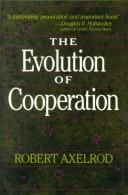
Robert Axelrod · 1984

Computer tournaments of the prisoner's dilemma show why tit-for-tat wins.

Ken Binmore · 2008

Binmore on when Bayesian decision theory applies and when it does not

Recommended by: Nassim Nicholas Taleb
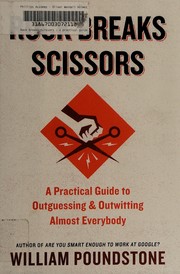
William Poundstone · 2014

People can't act randomly, and how to exploit that in games, tests and markets.

Recommended by: Mohnish Pabrai

Where it sits in the reference 4

Journalists
Investment philosophy
Mental models
Mental models

Topics

Mathematics and StatisticsDecision MakingBiography of ScientistsGames, gambling and quantitative finance