Updates

  1. Person pages list letters, writing, profiles and links as sortable tables with filters, and show each person's companies as links; Fund letters show each letter's description in its own column.
  2. Experts show a checked job title and a short description of each person; 30 more people have photographs.
  3. Every company, fund, university and publication the experts work for has a page listing the people there.
  4. Fund letters show each letter's thesis and filter by it; 225 person pages list the essays, columns and newsletter issues the person wrote.
  5. Person pages list every essay and newsletter issue a person wrote, and their own books as a table in List view.
  6. Recommends shows the five largest kinds of book and the rest under More; browse pictures load sooner.
  7. Podcasts and talks link the original episode, filter by Audio and video or Press, and list each publisher once.
  8. Pages are wider, Recommends has List and Grid, and a filter clicked again turns off.
  9. Book cards sit in a ruled grid with Open Library and Goodreads links and each book's one-line note.
  10. Funds is now Investors; each investor's styles are buttons that filter the table.
  11. Podcasts and talks on a person's page filter by year and publisher and show as a list or a grid of pictures.
  12. Quotes show only people's own words: 472 summaries written by list sites are gone.
  13. Country pages open from Browse again, and every link on the shelf lands on a page.
  14. Subject and person pages show their sections as tabs, and each book appears once on a person's page.
  15. Book cards show the quote, who said it and the source; grids show five cards to a row.
  16. On a phone, a menu holds the sections, search, Updates, Feedback and dark mode.
  17. Feedback takes a screenshot of the page with no browser prompt, opens a screenshot full size when you click it, and clears itself once sent.
  18. Book cards are centred, search names the topic each book sits in, and any text cut short shows whole on hover.
  19. Search groups its results by kind: people, companies, geographies, subjects, topics, books, funds, fund letters and papers.
  20. The Books table lists who recommended each book by name, and the browser tab names the section you are in.
  21. Feedback can take a screenshot of the page, or one you paste or choose, and opens in the corner beside Updates.
  22. Each rail button reopens its section where you left it, and Browse, Table and People show on every book and subject page.
  23. Filters grey out choices that hold nothing instead of hiding them, and Books › People filters by authors or recommenders.
  24. Feedback takes a subject line and up to three screenshots.
  25. Biographies are grouped by the person they are about: 41 new pages, from Abraham Lincoln to Lee Kuan Yew.
  26. Sport splits into 23 sports, and Religion into one topic per faith.
  27. Book lists show as cards: the cover, one recommendation quote and every recommender by name.
  28. Seventeen subjects that had two or three pages under different names now have one page each.
  29. Every page lists its Experts as authors and recommenders, with a link to them on the Experts tab.
  30. Economics, Financial history, Financial panics and Accounting are subjects of their own, with one page per financial crisis.
  31. Book, person and subject pages open inside the app, so the tabs stay in view.
  32. 996 more book covers, and photographs or logos for 227 more people and companies.
  33. Books › Browse shows every subject as cards, and the rail holds Fund letters, Papers, Experts, Books and Funds.
  34. Every topic over 150 books splits into narrower topics, each with a page of its own.

Send feedback

What is it?
Screenshots, up to 3 (optional)
or paste one with Ctrl+V

We use your email only to reply to you.

The Evolution of Cooperation

The Evolution of Cooperation

Robert Axelrod
1984
T1 241 pages · about 4h 1m to read Open Librarygoodreads

Summary

Axelrod ran computer tournaments in which submitted strategies played the iterated prisoner's dilemma against each other, and this book reports what won and why.

The winner in both tournaments was tit-for-tat, submitted by Anatol Rapoport, which cooperates on the first move and then copies the opponent's previous move. It was the shortest programme submitted. Axelrod identifies four properties that characterised successful strategies: being nice, meaning never defecting first; being retaliatory, meaning responding to defection immediately; being forgiving, meaning returning to cooperation as soon as the opponent does; and being clear, meaning simple enough that the opponent can recognise the pattern and adapt to it.

His theoretical result is that cooperation can emerge among self-interested agents without central authority or trust, provided the interaction is repeated and the shadow of the future is long enough, meaning the participants weight future encounters sufficiently relative to present gains.

The empirical applications include the live and let live system that developed in First World War trench warfare, where units facing each other across static lines developed tacit restraint that commands had to break up by rotating troops, and biological examples of reciprocal altruism.

The work has been enormously influential across biology, political science and economics. Later research has qualified it: tit-for-tat performs poorly with noise, since a single misperception produces endless mutual retaliation, and variants including generous tit-for-tat and win-stay-lose-shift do better in noisy environments.

Key takeaways 7

  1. Tit-for-tat, which cooperates first and then copies the opponent's last move, won both tournaments and was the shortest programme submitted.
  2. Successful strategies were nice, meaning they never defected first, retaliatory, forgiving and clear enough that opponents could recognise the pattern.
  3. Cooperation emerges among self-interested agents without authority or trust provided the interaction repeats and future encounters are weighted sufficiently.
  4. Extending the shadow of the future, by making interactions more frequent or more durable, promotes cooperation more reliably than any appeal to values.
  5. Being clear enough that an opponent can understand your strategy is an advantage, since a strategy that cannot be recognised cannot be reciprocated.
  6. Trench warfare units facing each other across static lines developed tacit restraint that commands had to break up by rotating troops.
  7. Tit-for-tat performs poorly with noise, since one misperception produces endless mutual retaliation, and forgiving variants do better in noisy environments.

Who should read it

Anyone designing repeated interactions, including negotiators, platform operators and partnership managers, who needs the conditions under which cooperation emerges.

Who recommended it 2 · 1 direct

Similar books 6

Chosen by shared topics, the entries that hold them, and the people who recommended both.
William Poundstone · 1992

Von Neumann, game theory and the prisoner's dilemma in nuclear strategy.
Avinash K. Dixit, Barry J. Nalebuff · 2008

Game theory without maths, with new examples: commitment, signals, bargaining.
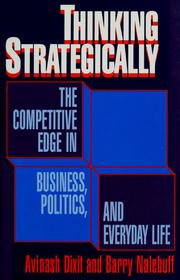
Avinash K. Dixit, Barry J. Nalebuff · 1991

Game theory without maths: look forward, reason back, and make threats credible.

Robert Wright · 2000

History read as an expanding series of non-zero-sum games

Thomas C. Schelling · 1960

Conflict as bargaining: commitment, credible threats and focal points.

Recommended by: Naval Ravikant

Michael Suk-Young Chwe · 2001

Common knowledge and coordination; why rituals and advertising work

Recommended by: Mark Zuckerberg

Where it sits in the reference 2

Mental models
Mental models

Topics

Mathematics and StatisticsSociology and CultureSocial behaviour and collective actionGames, gambling and quantitative finance