
Stubborn Attachments
Summary
Cowen makes a philosophical argument with a practical conclusion: that societies should prioritise sustainable long-run economic growth almost above everything else, because the compounding effect of growth over long horizons dominates almost every other consideration in terms of human welfare.
The argument proceeds in steps. He argues that we should not discount the welfare of future people simply because they are distant in time, and that once the discount rate on future welfare goes to zero, the value of a small increase in the growth rate becomes enormous. He introduces Wealth Plus, a measure that includes leisure, environmental quality and household production alongside conventional output, to head off the objection that growth means only measured GDP. He argues that we should hold to some absolute human rights as constraints on what may be done in pursuit of growth, and that radical uncertainty about long-run consequences means we should follow general rules rather than calculate case by case.
The conclusion he draws is that most redistributive and present-focused policy debate is misdirected, because the sums involved are small relative to the compounding effect of a sustained growth rate difference. The book is short and written as philosophy rather than as economics, with almost no data. The objections are substantial: the argument depends on growth being sustainable indefinitely, it treats the growth rate as something policy can reliably move, and the move from a zero discount rate to growth maximisation has been challenged by philosophers who think it proves too much. Cowen states the objections and does not fully answer several of them.
Key takeaways 7
- Small differences in a sustained economic growth rate dominate almost every other policy consideration once the horizon is long enough.
- The welfare of future people should not be discounted merely because they are distant in time, and accepting this reorders policy priorities substantially.
- Growth should be measured as Wealth Plus, including leisure, environmental quality and household production, rather than as conventional output alone.
- A small set of absolute human rights should constrain what may be done in pursuit of growth, which prevents the argument from licensing anything.
- Radical uncertainty about long-run consequences means decision-makers should follow general rules rather than calculate each case.
- Most present-focused redistributive debate concerns amounts that are small relative to the compounding effect of a growth rate difference.
- Individuals should treat the aggregate consequences of their choices as morally relevant even when those consequences are diffuse and distant.
Who should read it
Readers who want a compact philosophical case for prioritising long-run growth, and investors interested in how compounding arguments apply to public choices.
About Tyler Cowen
Professor of economics at George Mason University, director of the Mercatus Center and co-author of the Marginal Revolution blog.
The books apply price theory to questions operators actually face: which skills complement machines, how large firms really behave, why long-run growth should outrank near-term redistribution. Talent sets out a practical interviewing method for finding underrated people, drawn from his own grant-making at Emergent Ventures.
George Mason University, Mercatus Center, Marginal Revolution
Who recommended it 2
Similar books 6
Chosen by shared topics, the entries that hold them, and the people who recommended both.

How communities manage shared resources without either the state or the market.
Recommended by: Patrick Collison, Stewart Brand
Recommended by: Mohnish Pabrai, Patrick Collison
Voters hold systematic biases about economics, so democracies choose bad policies.
“The median American is a moderate national socialist – statist to the core on both economic and social policy.” — Marc Andreessen
Source: @pmarca, 'Thread: Books I've recently read and recommend'
Recommended by: Marc Andreessen, Patrick Collison
Twenty-three free-market claims, each set against counter-evidence.
Recommended by: Morgan Housel
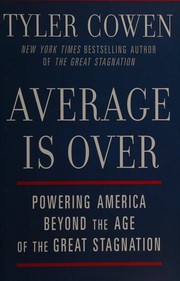
Work is splitting between those who work well with smart machines and the rest.
“Tyler Cowen... dedicates a chapter to freestyle chess in his terrific book, Average Is Over.” — Michael Mauboussin
Source: Lessons from Freestyle Chess: Merging Fundamental and Quantitative Analysis (Credit Suisse)
Recommended by: Michael Mauboussin, Ryan Holiday
Where it sits in the reference 2
Topics