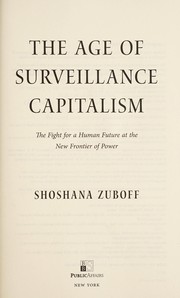
The Age of Surveillance Capitalism
Behavioural data as the raw material of the ad model.
Summary
Zuboff argues that a new economic logic emerged at Google around 2001 and then spread, in which human experience is claimed as free raw material, converted into behavioural data, and used not primarily to improve services but to predict and ultimately to shape future behaviour, with the predictions sold in what she calls behavioural futures markets.
Her key analytical move is the concept of behavioural surplus. She argues that Google discovered, under financial pressure after the dot-com crash, that the data exhaust from searches contained far more information than was needed to improve search, and that the surplus could predict click behaviour. That discovery produced targeted advertising and a business model that requires ever more data from ever more contexts. She traces the extension into mobile, into the home through voice assistants and connected devices, into the car, and into what she calls the instrumentarian project of behaviour modification at scale, using Pokemon Go and Facebook's contagion experiments as evidence.
The book is long, written in a heavily theoretical register, and argues by analogy to Arendt, Skinner and industrial capitalism. Its central contribution is naming a mechanism and insisting it is a specific economic logic rather than a technology's inevitable consequence. Critics, including some who share its politics, argue that Zuboff overstates the predictive and behavioural power of the technology, that treating this as a distinct form of capitalism obscures continuities with ordinary advertising and market research, and that the prose repeats itself at great length. For investors the useful part is the account of how data collection becomes a business requirement rather than a byproduct.
Key takeaways 7
- Google discovered that data left over from serving search queries could predict click behaviour, and that behavioural surplus became the raw material of a new business model.
- Under this model user behaviour is not the product being improved but the raw input, and the product sold is a prediction about future behaviour.
- The business logic requires continuous expansion into new contexts, which is why the same companies move into mobile, the home, the car and the body.
- Prediction products become more valuable as they move from forecasting behaviour to intervening in it, which creates commercial pressure toward behaviour modification.
- Users cannot meaningfully consent because the terms are unreadable, the alternative is exclusion, and the extraction occurs in contexts the user does not perceive as transactions.
- This economic logic was invented at a specific time under specific financial pressure and is not an inevitable consequence of digital technology.
- Existing privacy law fails because it regulates the disclosure of data rather than the inference of new data from behaviour.
Who should read it
Founders and investors in data-driven businesses who need the strongest statement of the case against behavioural data extraction, read with its overstatements in mind.
Who recommended it 2
Similar books 6
Chosen by shared topics, the entries that hold them, and the people who recommended both.
How machine learning and robots will displace work faster than institutions adapt.
Recommended by: Antonio García Martínez, Brian Armstrong
AI as a fall in the cost of prediction, and what that does to decisions and jobs.
Recommended by: Daniel Petre, Patrick O'Shaughnessy
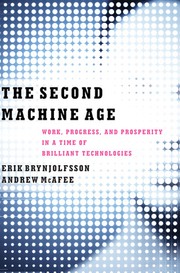
Brynjolfsson and McAfee provide the economic context: AI as a general-purpose technology that decouples productivity from employment. The alignment problem doesn't exist in a vacuum — it plays out in economies where AI is already restructuring labor markets in ways that are hard to reverse.
Recommended by: Mohnish Pabrai, Patrick Collison and 4 others

The textbook on deep learning: how machines learn layered concepts from data.
Recommended by: Vinod Khosla, Elon Musk, Satya Nadella

Harari's concern — that humans may cede decision-making to opaque systems through preference rather than coercion — reframes the alignment problem as a cultural and political challenge, not only a technical one. Less rigorous than Bostrom or Russell, but more widely read, making it a useful lens for understanding public discourse.
Recommended by: Andrew Wilkinson, Bill Gates, Nat Eliason and 7 others
Where it sits in the reference 3
Topics