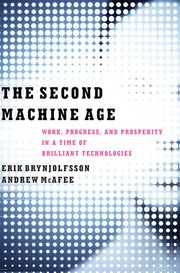
The Second Machine Age
Brynjolfsson and McAfee provide the economic context: AI as a general-purpose technology that decouples productivity from employment. The alignment problem doesn't exist in a vacuum — it plays out in economies where AI is already restructuring labor markets in ways that are hard to reverse.
Summary
Brynjolfsson and McAfee, both at MIT, argue that digital technologies are producing a transformation comparable to the Industrial Revolution, with the difference that the first machine age augmented physical power and the second augments cognitive capability. They organise the argument around exponential improvement in computing, the digitisation of information which makes it non-rival and near-free to reproduce, and recombinant innovation, in which new ideas are combinations of existing ones and therefore accelerate as the stock grows.
The book divides into bounty and spread. Bounty means the increase in total output, variety and quality, which they argue is understated by GDP because free digital goods produce consumer surplus that national accounts do not capture. Spread means the distribution of that output, and here they document the divergence between productivity growth and median wages since roughly the mid-1980s, the falling labour share of income, and the growth in returns to capital and to superstars.
They explain the spread through skill-biased technical change, capital-biased technical change and winner-take-all market structures produced by digital goods with near-zero marginal cost. Their policy recommendations include education reform, infrastructure investment, immigration reform and a negative income tax, and they treat a full basic income more cautiously than later writers.
The book was published in 2014 and predates the current generation of machine learning entirely, so its examples of what machines cannot do have been overtaken. Critics argue that measured productivity growth has not risen as their thesis predicts, which remains the strongest objection. The bounty and spread framing and the argument about non-rival digital goods have held up better than the specific technological claims.
Key takeaways 8
- Digital technologies augment cognitive capability in the way industrial machines augmented physical power, which changes which human contributions retain value.
- Digital goods are non-rival and can be reproduced at near-zero cost, which produces winner-take-all market structures and enormous consumer surplus.
- Innovation is recombinant, so the rate of new ideas accelerates as the stock of existing building blocks grows rather than exhausting itself.
- Economic output and its distribution are separate questions, and technology has increased the first while worsening the second.
- Median wages have diverged from productivity growth since the mid-1980s, and the labour share of income has fallen across developed economies.
- National accounts understate the gains because free digital goods produce consumer value that GDP does not measure.
- Returns concentrate on capital and on a small number of top performers in each field, because digital distribution removes the local limits that once protected the merely good.
- The book's examples of tasks machines could not perform have been overtaken by subsequent developments, which strengthens rather than weakens its main argument.
Who should read it
Investors and operators thinking about the economic effects of automation, with the technological examples read as dated and the distributional analysis as current.
Who recommended it 6 · 2 direct
Similar books 6
Chosen by shared topics, the entries that hold them, and the people who recommended both.

How machine learning and robots will displace work faster than institutions adapt.
Recommended by: Antonio García Martínez, Brian Armstrong

AI as a fall in the cost of prediction, and what that does to decisions and jobs.
Recommended by: Daniel Petre, Patrick O'Shaughnessy
How Google and others turn behaviour into data to predict and steer what people do.
Recommended by: Benedict Evans, Vinod Khosla
Recommended by: Patrick Collison

How a game designer built artificial life from simple rules of biology.
Recommended by: Mohnish Pabrai, Jeff Bezos
Where it sits in the reference 2
Topics