Updates

  1. Person pages list letters, writing, profiles and links as sortable tables with filters, and show each person's companies as links; Fund letters show each letter's description in its own column.
  2. Experts show a checked job title and a short description of each person; 30 more people have photographs.
  3. Every company, fund, university and publication the experts work for has a page listing the people there.
  4. Fund letters show each letter's thesis and filter by it; 225 person pages list the essays, columns and newsletter issues the person wrote.
  5. Person pages list every essay and newsletter issue a person wrote, and their own books as a table in List view.
  6. Recommends shows the five largest kinds of book and the rest under More; browse pictures load sooner.
  7. Podcasts and talks link the original episode, filter by Audio and video or Press, and list each publisher once.
  8. Pages are wider, Recommends has List and Grid, and a filter clicked again turns off.
  9. Book cards sit in a ruled grid with Open Library and Goodreads links and each book's one-line note.
  10. Funds is now Investors; each investor's styles are buttons that filter the table.
  11. Podcasts and talks on a person's page filter by year and publisher and show as a list or a grid of pictures.
  12. Quotes show only people's own words: 472 summaries written by list sites are gone.
  13. Country pages open from Browse again, and every link on the shelf lands on a page.
  14. Subject and person pages show their sections as tabs, and each book appears once on a person's page.
  15. Book cards show the quote, who said it and the source; grids show five cards to a row.
  16. On a phone, a menu holds the sections, search, Updates, Feedback and dark mode.
  17. Feedback takes a screenshot of the page with no browser prompt, opens a screenshot full size when you click it, and clears itself once sent.
  18. Book cards are centred, search names the topic each book sits in, and any text cut short shows whole on hover.
  19. Search groups its results by kind: people, companies, geographies, subjects, topics, books, funds, fund letters and papers.
  20. The Books table lists who recommended each book by name, and the browser tab names the section you are in.
  21. Feedback can take a screenshot of the page, or one you paste or choose, and opens in the corner beside Updates.
  22. Each rail button reopens its section where you left it, and Browse, Table and People show on every book and subject page.
  23. Filters grey out choices that hold nothing instead of hiding them, and Books › People filters by authors or recommenders.
  24. Feedback takes a subject line and up to three screenshots.
  25. Biographies are grouped by the person they are about: 41 new pages, from Abraham Lincoln to Lee Kuan Yew.
  26. Sport splits into 23 sports, and Religion into one topic per faith.
  27. Book lists show as cards: the cover, one recommendation quote and every recommender by name.
  28. Seventeen subjects that had two or three pages under different names now have one page each.
  29. Every page lists its Experts as authors and recommenders, with a link to them on the Experts tab.
  30. Economics, Financial history, Financial panics and Accounting are subjects of their own, with one page per financial crisis.
  31. Book, person and subject pages open inside the app, so the tabs stay in view.
  32. 996 more book covers, and photographs or logos for 227 more people and companies.
  33. Books › Browse shows every subject as cards, and the rail holds Fund letters, Papers, Experts, Books and Funds.
  34. Every topic over 150 books splits into narrower topics, each with a page of its own.

Send feedback

What is it?
Screenshots, up to 3 (optional)
or paste one with Ctrl+V

We use your email only to reply to you.

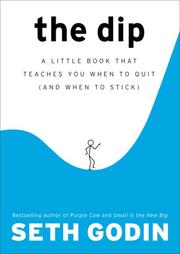
The Dip

The Dip

Seth Godin
2007
T2 96 pages · about 1h 36m to read Open Librarygoodreads

Summary

Godin argues that quitting is usually the correct decision and that the failure is quitting the wrong things at the wrong time. His central distinction is between a dip and a cul-de-sac. A dip is a period of difficulty that separates people who will reach mastery from those who will not, and the difficulty is what makes the reward on the other side worth having. A cul-de-sac is a situation that does not get better regardless of effort.

His argument is that the reward for getting through a dip is disproportionate, because being the best in a defined market captures most of the value while being merely good captures very little, and the dip is what keeps most competitors out.

His prescription is to quit cul-de-sacs immediately and to quit them early, freeing resources for a dip worth entering, and to decide in advance what conditions would cause you to quit a dip, before you are inside it and reasoning under pressure. He argues that most people do the opposite: they quit dips because the difficulty is uncomfortable, and they persist in cul-de-sacs because quitting feels like failure and because the situation is not painful enough to force a decision.

The book is very short, roughly eighty pages, and states its argument without evidence. The distinction between a dip and a cul-de-sac is difficult to apply in practice, since the two look identical from inside, and Godin offers no test. The instruction to decide quitting conditions in advance is the practical content and it does not require the rest of the framework.

Key takeaways 8

  1. Quitting is usually correct, and the failure is quitting the wrong things at the wrong time rather than quitting at all.
  2. A dip is difficulty that separates those who will reach mastery from those who will not, and the difficulty is what makes the reward available.
  3. A cul-de-sac does not improve regardless of effort, and persisting in one consumes the resources a worthwhile dip would require.
  4. Being the best in a defined market captures most of the available value while being merely good captures very little.
  5. The scarcity produced by the dip is what makes the position on the other side of it valuable.
  6. Quitting conditions should be decided before entering a dip, since the decision cannot be made well from inside it.
  7. Most people quit dips because the difficulty is uncomfortable and persist in cul-de-sacs because quitting feels like failure.
  8. A dip and a cul-de-sac look identical from inside, and the book provides no test for distinguishing them.

Who should read it

Founders and operators deciding whether to persist with something difficult, wanting a short direct argument for deliberate quitting.

About Seth Godin

American marketing writer, founder of Yoyodyne and Squidoo, who has published a daily marketing blog for two decades.

Permission Marketing argued for earning attention through opt-in years before that became the default of email and content marketing, and Purple Cow made remarkability the product's job rather than the advertising budget's. The Dip supplies a decision rule for when to quit a market and when the difficulty itself is the barrier worth pushing through.

Yoyodyne, Squidoo

Who recommended it 4 · 2 direct

Ev Williamsreported
Nick Huberreported

Similar books 6

Chosen by shared topics, the entries that hold them, and the people who recommended both.
Seth Godin · 1960

Valuable work now needs people who do what can't be written into a job description.

Reid Hoffman, Ben Casnocha · 2012

Run your career the way an entrepreneur runs a startup.

Where it sits in the reference 3

Strategists
Business themes
Business themes

Topics

Business and ManagementProductivity and HabitsCareers, learning, creative work and simple living