Updates

  1. Person pages list letters, writing, profiles and links as sortable tables with filters, and show each person's companies as links; Fund letters show each letter's description in its own column.
  2. Experts show a checked job title and a short description of each person; 30 more people have photographs.
  3. Every company, fund, university and publication the experts work for has a page listing the people there.
  4. Fund letters show each letter's thesis and filter by it; 225 person pages list the essays, columns and newsletter issues the person wrote.
  5. Person pages list every essay and newsletter issue a person wrote, and their own books as a table in List view.
  6. Recommends shows the five largest kinds of book and the rest under More; browse pictures load sooner.
  7. Podcasts and talks link the original episode, filter by Audio and video or Press, and list each publisher once.
  8. Pages are wider, Recommends has List and Grid, and a filter clicked again turns off.
  9. Book cards sit in a ruled grid with Open Library and Goodreads links and each book's one-line note.
  10. Funds is now Investors; each investor's styles are buttons that filter the table.
  11. Podcasts and talks on a person's page filter by year and publisher and show as a list or a grid of pictures.
  12. Quotes show only people's own words: 472 summaries written by list sites are gone.
  13. Country pages open from Browse again, and every link on the shelf lands on a page.
  14. Subject and person pages show their sections as tabs, and each book appears once on a person's page.
  15. Book cards show the quote, who said it and the source; grids show five cards to a row.
  16. On a phone, a menu holds the sections, search, Updates, Feedback and dark mode.
  17. Feedback takes a screenshot of the page with no browser prompt, opens a screenshot full size when you click it, and clears itself once sent.
  18. Book cards are centred, search names the topic each book sits in, and any text cut short shows whole on hover.
  19. Search groups its results by kind: people, companies, geographies, subjects, topics, books, funds, fund letters and papers.
  20. The Books table lists who recommended each book by name, and the browser tab names the section you are in.
  21. Feedback can take a screenshot of the page, or one you paste or choose, and opens in the corner beside Updates.
  22. Each rail button reopens its section where you left it, and Browse, Table and People show on every book and subject page.
  23. Filters grey out choices that hold nothing instead of hiding them, and Books › People filters by authors or recommenders.
  24. Feedback takes a subject line and up to three screenshots.
  25. Biographies are grouped by the person they are about: 41 new pages, from Abraham Lincoln to Lee Kuan Yew.
  26. Sport splits into 23 sports, and Religion into one topic per faith.
  27. Book lists show as cards: the cover, one recommendation quote and every recommender by name.
  28. Seventeen subjects that had two or three pages under different names now have one page each.
  29. Every page lists its Experts as authors and recommenders, with a link to them on the Experts tab.
  30. Economics, Financial history, Financial panics and Accounting are subjects of their own, with one page per financial crisis.
  31. Book, person and subject pages open inside the app, so the tabs stay in view.
  32. 996 more book covers, and photographs or logos for 227 more people and companies.
  33. Books › Browse shows every subject as cards, and the rail holds Fund letters, Papers, Experts, Books and Funds.
  34. Every topic over 150 books splits into narrower topics, each with a page of its own.

Send feedback

What is it?
Screenshots, up to 3 (optional)
or paste one with Ctrl+V

We use your email only to reply to you.

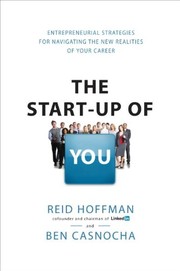
The Start-up of You

The Start-up of You

Reid Hoffman, Ben Casnocha
2012
T4 272 pages · about 4h 32m to read Open Librarygoodreads

Summary

Hoffman and Casnocha argue that the career model built on stable employment and defined ladders no longer exists, and that individuals should manage their careers using the methods entrepreneurs use for startups. The book was written after LinkedIn's growth and draws on Hoffman's investing and operating experience. The framework has several components. Competitive advantage comes from the intersection of three elements: assets, meaning what you have including skills, cash and relationships; aspirations, meaning what you want; and market realities, meaning what people will pay for. They argue that people plan around the first two and ignore the third.

The ABZ planning method holds that a person should have plan A, the current course; plan B, an adjacent alternative that can be pivoted to using the same assets; and plan Z, a fallback that is survivable and that removes catastrophic risk from the other two. They argue that having a defined plan Z is what permits risk-taking in plan A.

On networks they distinguish strong ties from weak ties and argue that weak ties provide most new information and opportunities because they connect to different circles. They advocate building relationships before they are needed and giving before asking. On risk they argue that most people overestimate career risk and underestimate the risk of stability, and they advocate intelligent risk-taking with defined downside limits and small experiments.

The book is short and the ideas are not original individually. It reads partly as an argument for LinkedIn as a tool. The advice presumes a knowledge-work career in a developed economy. The ABZ framing and the distinction between weak and strong ties are the parts readers use.

Key takeaways 8

  1. Career advantage comes from the intersection of your assets, your aspirations and what the market will actually pay for, and most people ignore the third.
  2. A person should hold a current plan, an adjacent alternative reachable with the same assets, and a survivable fallback that removes catastrophic risk.
  3. Having a defined fallback is what makes taking risk in the primary plan rational rather than reckless.
  4. Weak ties provide most new opportunities and information because they connect to circles that your close relationships do not reach.
  5. Relationships must be built before they are needed, because a network approached only at the moment of need does not respond.
  6. Careers should be treated as permanent beta, with continuous investment in skills rather than periodic retraining after a disruption.
  7. Stability carries risk that is invisible because it accumulates slowly, while the risks of change are visible and therefore overweighted.
  8. Small reversible experiments generate better career information than analysis or planning does.

Who should read it

Professionals managing their own careers who want a structured alternative to the ladder model, particularly the fallback-enabled risk framing.

About Reid Hoffman

Co-founder and former executive chairman of LinkedIn; partner at Greylock Partners; co-founder of Inflection AI

Blitzscaling and The Start-up of You outlived their news cycles and gave the industry durable vocabulary, on top of a first-rate operating and investing record.

Greylock Partners, Inflection AI, LinkedIn

Who recommended it 6 · 1 direct

Jack Dorseyreported
Reid Hoffmanreported

Similar books 6

Chosen by shared topics, the entries that hold them, and the people who recommended both.

Seth Godin · 1960

Valuable work now needs people who do what can't be written into a job description.

Seth Godin · 2007

When to push through a hard stretch and when to quit a dead end.

Where it sits in the reference 3

Founders
Business themes
Business themes

Topics

Productivity and HabitsBusiness and ManagementCareers, learning, creative work and simple living