
The Four Obsessions of an Extraordinary Executive
Summary
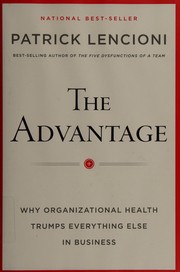
Lencioni presents his argument as a business fable following two chief executives running competing consulting firms, one focused on organisational health and one on strategy and market position, followed by a short section stating the model. His central claim is that organisational health is a greater competitive advantage than strategy, technology or finance, because it is harder to copy and because it determines whether any strategy can be executed. He defines health as minimal politics, minimal confusion, high morale, high productivity and low turnover.
The four disciplines are: build and maintain a cohesive leadership team, which requires that the team trust each other, engage in unfiltered conflict, commit to decisions and hold each other accountable; create organisational clarity, which requires the leadership team to agree on the answers to six specific questions covering why the organisation exists, what its values are, what its business is, what defines success, what the priorities are and who is responsible for what; overcommunicate that clarity, which he argues requires repetition to a degree that leaders find excessive and embarrassing; and reinforce the clarity through human systems including hiring, performance management, compensation and firing.
His specific argument about communication is that leaders stop repeating a message at the point when they are bored with it, which is roughly the point at which the organisation begins to hear it.
The fable is thin and the model is stated in the last thirty pages. There is no research base beyond consulting practice. The six questions for organisational clarity are the most immediately usable element, since they can be answered in a single leadership session and the disagreements they reveal are the point.
Key takeaways 8
- Organisational health is a greater competitive advantage than strategy or technology because it cannot be copied and determines whether any strategy can be executed.
- A cohesive leadership team requires trust, unfiltered conflict, genuine commitment and mutual accountability in that order.
- Six specific questions covering purpose, values, business, success, priorities and responsibilities must be answered identically by every member of the leadership team.
- The disagreements revealed when leaders answer these questions separately are the substance of the exercise rather than an obstacle to it.
- Leaders stop repeating a message when they become bored with it, which is approximately when the organisation begins to hear it.
- Clarity must be reinforced through hiring, performance management, compensation and firing, or it decays into a statement nobody acts on.
- Human systems that contradict the stated priorities teach the organisation what actually matters.
- There is no research base beyond consulting practice, and the model is asserted rather than tested.
Who should read it
Leadership teams that agree in the room and diverge afterwards, wanting six questions that expose the disagreement quickly.
About Patrick Lencioni
American management consultant and founder of The Table Group; writes business fables about executive teams and organisational health.
The Five Dysfunctions of a Team names a sequence - absence of trust, fear of conflict, lack of commitment, avoidance of accountability, inattention to results - and gives managers a diagnostic order for working through them. The Advantage sets out organisational health as a measurable executive discipline covering clarity, meeting design and internal communication.
Who recommended it 3 · 1 direct
Similar books 6
Chosen by shared topics, the entries that hold them, and the people who recommended both.
Organisational health, clarity and cohesion, matters more than strategy or smarts.
Recommended by: Changpeng Zhao, David Cancel

A fable of a failing executive team and a five-level model of what goes wrong.
Recommended by: Alfred Lin, Chris Powers, Sarah Pritula and 1 other

Recommended by: Mohnish Pabrai

Recommended by: Mohnish Pabrai
Recommended by: Mohnish Pabrai

Where it sits in the reference 3
Topics