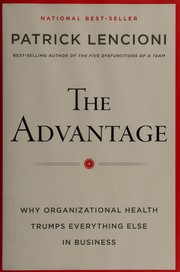
The Advantage
Summary
Lencioni argues that organisational health, meaning the absence of politics and confusion and the presence of clarity and cohesion, matters more to performance than intelligence, strategy or technology, and that executives ignore it because it seems soft and cannot be reduced to a metric.
He sets out four disciplines. Build a cohesive leadership team, which requires the vulnerability-based trust, productive conflict and commitment from his earlier work. Create clarity by answering six questions as a team: why we exist, how we behave, what we do, how we will succeed, what is most important right now, and who must do what. Overcommunicate that clarity, on the argument that leaders stop repeating a message long before employees have internalised it, and that seven repetitions is a reasonable floor. Reinforce clarity through human systems, meaning hiring, performance management, compensation and firing must all encode the same answers.
The most practical elements are the six questions and the thematic goal concept, which is a single rallying objective with a defined time horizon that the whole leadership team shares regardless of function. Lencioni also argues for a specific meeting structure separating daily check-ins, weekly tactical, monthly strategic and quarterly offsite, with a rule that tactical and strategic matters must never be mixed in one meeting.
The book has no empirical base. Lencioni works from consulting experience and the evidence is assertion and illustrative example. The arguments about repetition and about meeting structure are useful and testable; the claim that health beats strategy is stated rather than demonstrated. The writing is repetitive by design and readers who know his earlier books will find substantial overlap.
Key takeaways 7
- Organisational health, meaning minimal politics and confusion combined with high clarity and morale, produces more performance advantage than strategy or technology do.
- A leadership team must answer six specific questions together, including why the organisation exists and what is most important right now, and disagreement among them on any one guarantees confusion below.
- Leaders stop communicating a message long before employees have absorbed it, and the required number of repetitions is far higher than executives believe.
- Hiring, performance review, compensation and dismissal must all encode the same stated answers, or the systems will overwrite the message.
- A single shared thematic goal with a defined time horizon, owned by the whole leadership team regardless of function, prevents departmental optimisation.
- Meetings should be separated by type, with tactical and strategic matters never combined, because mixing them means the urgent always displaces the important.
- Executives avoid working on organisational health because it cannot be measured and offers no analytical sophistication, not because they doubt it matters.
Who should read it
Chief executives and leadership teams who want a practical structure for clarity, communication cadence and meeting design.
About Patrick Lencioni
American management consultant and founder of The Table Group; writes business fables about executive teams and organisational health.
The Five Dysfunctions of a Team names a sequence - absence of trust, fear of conflict, lack of commitment, avoidance of accountability, inattention to results - and gives managers a diagnostic order for working through them. The Advantage sets out organisational health as a measurable executive discipline covering clarity, meeting design and internal communication.
Who recommended it 2
Similar books 6
Chosen by shared topics, the entries that hold them, and the people who recommended both.
A fable of a failing executive team and a five-level model of what goes wrong.
Recommended by: Alfred Lin, Chris Powers, Sarah Pritula and 1 other
A fable of two rival firms showing why organisational health beats clever strategy.
Recommended by: Mohnish Pabrai, Ali Abdaal, Brian Armstrong
Insider account of Google's people operations by its SVP of HR.
Recommended by: Mohnish Pabrai, Changpeng Zhao, David Cancel and 2 others
Decision rules from building Bridgewater: radical truth and radical transparency.
Recommended by: Alfred Lin, Nat Eliason, Andrew Lokenauth and 28 others
Leaderless organisations, from Alcoholics Anonymous to file sharing, and their power.
Recommended by: Mohnish Pabrai, Changpeng Zhao, Simon Sinek
Recommended by: Mohnish Pabrai
Where it sits in the reference 3
Topics