
The Money Game
The classic on markets as a game of psychology and identity
Summary
Adam Smith is the pen name of George Goodman, who wrote this in 1968 about the Wall Street of the 1960s go-go years. The book argues that markets are a game whose outcome depends on the psychology of the participants, and that the first requirement is knowing who you are, because an investor's identity determines what they will actually do when prices move.
The central argument is that people who do not know their own objectives and temperament will discover them expensively. Goodman writes that if you do not know who you are, the stock market is an expensive place to find out, which is the line the book is remembered for. He treats the identification of a security with a person's self-image as the source of most errors, and notes that the stock does not know you own it.
The material covers the professional money managers of the period, described through characters including the Gnome of Zurich and Poor Grenville, the performance culture that rewarded quarterly results, the mutual fund sales machine, and the technical analysts. Goodman is sceptical of the academic random walk work that was new at the time while taking it seriously, and he treats charting with the same scepticism.
The book is written as a series of essays with invented characters and a comic tone, which some readers enjoy and others find dated. The specific market conditions belong entirely to the 1960s, and the institutions described do not exist. Its durability comes from the psychological observations, which describe behaviour that has not changed, and from being the first book to treat market participation as primarily a problem of self-knowledge rather than of analysis.
Key takeaways 8
- An investor's temperament and objectives determine their results more than their analysis does, and most people have never identified either.
- The stock does not know you own it, so any emotional attachment to a position is entirely one-sided and entirely costly.
- Professional managers behave according to how they are measured, and quarterly performance measurement produces behaviour that harms long-run returns.
- Identity gets attached to positions, which is why investors defend losing holdings rather than reassess them.
- Markets are driven by what participants believe other participants will believe, which makes them a game about anticipation rather than about value alone.
- Groups of professional investors converge on the same holdings and then discover that the exit is narrower than the entrance.
- A person who cannot state why they bought a security cannot know when to sell it.
- The market is an expensive place to discover who you are, and self-knowledge acquired before participation is far cheaper.
Who should read it
Investors who want the first and still one of the sharpest treatments of market participation as a problem of self-knowledge rather than of technique.
About Adam Smith
Scottish moral philosopher at the University of Glasgow who founded modern economics with The Wealth of Nations in 1776.
The Wealth of Nations set out how division of labour, self-interest and competitive prices coordinate production without central direction, and it supplies the vocabulary economics still argues in: specialisation, capital accumulation, natural and market price. The Theory of Moral Sentiments supplies the other half, placing exchange inside a system of sympathy and judgement.
Who recommended it 8 · 5 direct
“One of the great books about investing is Adam Smith's 'The Money Game' which was published in 1967.”
“One of the great investment books of the 1960s was The Money Game by the pseudonymous Adam Smith.”
“For a magnificent account of the current financial scene, you should hurry out and get a copy of 'The Money Game' by Adam Smith. It is loaded with insights and supreme wit.”
Similar books 6
Chosen by shared topics, the entries that hold them, and the people who recommended both.

Why Wall Street grows rich on fees while its clients' results stay ordinary.
“recommended reading for those with a healthy disdain for Wall Street and its practices as well as an interest in post-boom psychology” — Nick Sleep
Source: Nomad Investment Partnership, Interim Report for the period ended June 30th, 2002, p. 10
Recommended by: Mohnish Pabrai, Nick Sleep, Warren Buffett and 4 others

Wall Street from the late-1960s boom to the 1970 to 1973 collapse.
Recommended by: Mohnish Pabrai, Warren Buffett
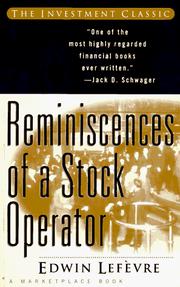
A speculator modelled on Jesse Livermore learns to read and trade the market.
“The finest trading book ever written is Reminiscences of a Stock Operator by Edwin LeFevre. It is colloquial reminiscences by a legendary speculator of the mistakes and lessons he learned over a…” — Barton Biggs
Source: Biggs calling it the finest trading book ever written
Recommended by: Barton Biggs, Bill Miller, Colm O'Shea and 5 others

A value investor's memoir from the 1950s to the dot-com crash, on market psychology.
“Personal biographies, the histories, are the most interesting. I have Benjamin Graham's personal biography, also the biography of Leon Levy, The Mind of Wall Street. These are all great.” — Chris Mittleman
Source: Mittleman on why investor biographies are the most useful reading
Recommended by: Chris Mittleman
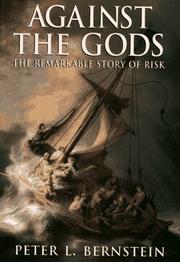
How people learned to measure risk, from early probability to portfolio theory.
“I think some of the books that are a must would be Peter Bernstein's book about risk, Against the Gods: The Remarkable Story of Risk.” — Charles de Vaulx
Source: De Vaulx naming Bernstein's book a must-read on risk
Recommended by: Charles de Vaulx, Jim Collins and 8 others
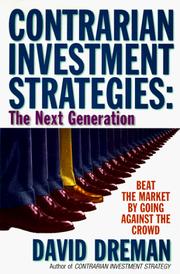
Data showing that low-expectation stocks beat popular ones over the long run.
“all these people really were helpful in forming and getting me involved in investing” — Joel Greenblatt
Source: Masters in Business transcript: Joel Greenblatt (2018)
Recommended by: Joel Greenblatt, Mohnish Pabrai and 1 other
Where it sits in the reference 3
Topics