Updates

  1. Person pages list letters, writing, profiles and links as sortable tables with filters, and show each person's companies as links; Fund letters show each letter's description in its own column.
  2. Experts show a checked job title and a short description of each person; 30 more people have photographs.
  3. Every company, fund, university and publication the experts work for has a page listing the people there.
  4. Fund letters show each letter's thesis and filter by it; 225 person pages list the essays, columns and newsletter issues the person wrote.
  5. Person pages list every essay and newsletter issue a person wrote, and their own books as a table in List view.
  6. Recommends shows the five largest kinds of book and the rest under More; browse pictures load sooner.
  7. Podcasts and talks link the original episode, filter by Audio and video or Press, and list each publisher once.
  8. Pages are wider, Recommends has List and Grid, and a filter clicked again turns off.
  9. Book cards sit in a ruled grid with Open Library and Goodreads links and each book's one-line note.
  10. Funds is now Investors; each investor's styles are buttons that filter the table.
  11. Podcasts and talks on a person's page filter by year and publisher and show as a list or a grid of pictures.
  12. Quotes show only people's own words: 472 summaries written by list sites are gone.
  13. Country pages open from Browse again, and every link on the shelf lands on a page.
  14. Subject and person pages show their sections as tabs, and each book appears once on a person's page.
  15. Book cards show the quote, who said it and the source; grids show five cards to a row.
  16. On a phone, a menu holds the sections, search, Updates, Feedback and dark mode.
  17. Feedback takes a screenshot of the page with no browser prompt, opens a screenshot full size when you click it, and clears itself once sent.
  18. Book cards are centred, search names the topic each book sits in, and any text cut short shows whole on hover.
  19. Search groups its results by kind: people, companies, geographies, subjects, topics, books, funds, fund letters and papers.
  20. The Books table lists who recommended each book by name, and the browser tab names the section you are in.
  21. Feedback can take a screenshot of the page, or one you paste or choose, and opens in the corner beside Updates.
  22. Each rail button reopens its section where you left it, and Browse, Table and People show on every book and subject page.
  23. Filters grey out choices that hold nothing instead of hiding them, and Books › People filters by authors or recommenders.
  24. Feedback takes a subject line and up to three screenshots.
  25. Biographies are grouped by the person they are about: 41 new pages, from Abraham Lincoln to Lee Kuan Yew.
  26. Sport splits into 23 sports, and Religion into one topic per faith.
  27. Book lists show as cards: the cover, one recommendation quote and every recommender by name.
  28. Seventeen subjects that had two or three pages under different names now have one page each.
  29. Every page lists its Experts as authors and recommenders, with a link to them on the Experts tab.
  30. Economics, Financial history, Financial panics and Accounting are subjects of their own, with one page per financial crisis.
  31. Book, person and subject pages open inside the app, so the tabs stay in view.
  32. 996 more book covers, and photographs or logos for 227 more people and companies.
  33. Books › Browse shows every subject as cards, and the rail holds Fund letters, Papers, Experts, Books and Funds.
  34. Every topic over 150 books splits into narrower topics, each with a page of its own.

Send feedback

What is it?
Screenshots, up to 3 (optional)
or paste one with Ctrl+V

We use your email only to reply to you.

The Score Takes Care of Itself

The Score Takes Care of Itself

Bill Walsh, Steve Jamison
2009
T2 251 pages · about 4h 11m to read Open Librarygoodreads

Bill Walsh's standard of performance as an organisational system

Summary

Walsh took the San Francisco 49ers from a two and fourteen record in 1979 to Super Bowl victories in 1981, 1984 and 1988. The book was assembled after his death in 2007 by Steve Jamison and Walsh's son Craig, from his writing and talks, so it is a compilation rather than a single composed work.

The central concept is the Standard of Performance, a defined set of behavioural expectations Walsh installed before results were possible. It covered how players dressed, how coaches spoke, how the locker room was kept, punctuality, and the specific technique standards for every position. His argument is that a leader controls the standard of execution and cannot control the score, and that installing the first eventually produces the second. He was explicit that he did not talk about winning at all in the first two seasons.

The operational material includes his scripting of the first twenty-five offensive plays before each game, which removed in-game emotional decision-making, his detailed contingency planning for every game situation, and his teaching-based approach in which coaching meant instruction in specific technique rather than motivation. He also writes about succession, describing how he built a coaching tree by teaching assistants his whole system.

Walsh is candid about the costs, including his own exhaustion, his difficulty with the emotional demands of the job, and his departure after the 1988 season. The failures are covered, including the 1982 season after the first championship. The book is repetitive because of how it was assembled, and the business applications are asserted rather than tested. Sports leadership books generalise poorly. The standard of performance concept and the pre-scripting of decisions transfer directly.

Key takeaways 8

  1. A leader controls the standard of execution and does not control the outcome, so effort should go entirely into the first.
  2. Behavioural standards should be installed and enforced before results are possible, covering details that appear unrelated to performance.
  3. Walsh deliberately avoided discussing winning during the rebuilding period because it directed attention away from the actions that produce it.
  4. Decisions should be scripted in advance where possible, because decisions made under emotional pressure during an event are worse.
  5. Coaching means teaching specific technique rather than providing motivation, and a leader who relies on inspiration has nothing to teach.
  6. Contingency plans for every foreseeable situation remove hesitation at the moment it would be most costly.
  7. Success produces complacency and internal politics quickly, and the leader must attack both immediately after a win.
  8. Teaching subordinates the entire system rather than their part of it produces successors and multiplies the leader's effect beyond their own tenure.

Who should read it

Leaders rebuilding a failing organisation who want a concrete account of installing standards before any results are available.

Who recommended it 11 · 2 direct

David Cancelreported
Drew Houstonreported
Jack Dorseyreported
Justin Kanreported
Keith Raboisreported
Noah Kaganreported
Ron Conwayreported
Sam Altmanreported

Similar books 6

Chosen by shared topics, the entries that hold them, and the people who recommended both.

Phil Jackson · 2013

Recommended by: Tom Bilyeu

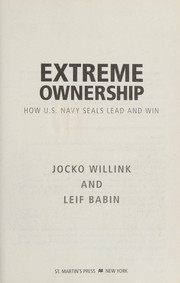
Jocko Willink, Leif Babin · 2015

Navy SEAL leadership doctrine adapted to running teams and firms

Alex Ferguson · 2015

Recommended by: Daniel Ek

Where it sits in the reference 2

Business themes
Business themes

Topics

LeadershipSportAmerican football