Updates

  1. Person pages list letters, writing, profiles and links as sortable tables with filters, and show each person's companies as links; Fund letters show each letter's description in its own column.
  2. Experts show a checked job title and a short description of each person; 30 more people have photographs.
  3. Every company, fund, university and publication the experts work for has a page listing the people there.
  4. Fund letters show each letter's thesis and filter by it; 225 person pages list the essays, columns and newsletter issues the person wrote.
  5. Person pages list every essay and newsletter issue a person wrote, and their own books as a table in List view.
  6. Recommends shows the five largest kinds of book and the rest under More; browse pictures load sooner.
  7. Podcasts and talks link the original episode, filter by Audio and video or Press, and list each publisher once.
  8. Pages are wider, Recommends has List and Grid, and a filter clicked again turns off.
  9. Book cards sit in a ruled grid with Open Library and Goodreads links and each book's one-line note.
  10. Funds is now Investors; each investor's styles are buttons that filter the table.
  11. Podcasts and talks on a person's page filter by year and publisher and show as a list or a grid of pictures.
  12. Quotes show only people's own words: 472 summaries written by list sites are gone.
  13. Country pages open from Browse again, and every link on the shelf lands on a page.
  14. Subject and person pages show their sections as tabs, and each book appears once on a person's page.
  15. Book cards show the quote, who said it and the source; grids show five cards to a row.
  16. On a phone, a menu holds the sections, search, Updates, Feedback and dark mode.
  17. Feedback takes a screenshot of the page with no browser prompt, opens a screenshot full size when you click it, and clears itself once sent.
  18. Book cards are centred, search names the topic each book sits in, and any text cut short shows whole on hover.
  19. Search groups its results by kind: people, companies, geographies, subjects, topics, books, funds, fund letters and papers.
  20. The Books table lists who recommended each book by name, and the browser tab names the section you are in.
  21. Feedback can take a screenshot of the page, or one you paste or choose, and opens in the corner beside Updates.
  22. Each rail button reopens its section where you left it, and Browse, Table and People show on every book and subject page.
  23. Filters grey out choices that hold nothing instead of hiding them, and Books › People filters by authors or recommenders.
  24. Feedback takes a subject line and up to three screenshots.
  25. Biographies are grouped by the person they are about: 41 new pages, from Abraham Lincoln to Lee Kuan Yew.
  26. Sport splits into 23 sports, and Religion into one topic per faith.
  27. Book lists show as cards: the cover, one recommendation quote and every recommender by name.
  28. Seventeen subjects that had two or three pages under different names now have one page each.
  29. Every page lists its Experts as authors and recommenders, with a link to them on the Experts tab.
  30. Economics, Financial history, Financial panics and Accounting are subjects of their own, with one page per financial crisis.
  31. Book, person and subject pages open inside the app, so the tabs stay in view.
  32. 996 more book covers, and photographs or logos for 227 more people and companies.
  33. Books › Browse shows every subject as cards, and the rail holds Fund letters, Papers, Experts, Books and Funds.
  34. Every topic over 150 books splits into narrower topics, each with a page of its own.

Send feedback

What is it?
Screenshots, up to 3 (optional)
or paste one with Ctrl+V

We use your email only to reply to you.

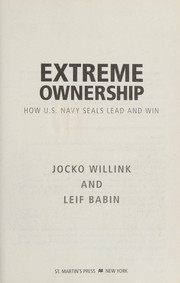
Extreme Ownership

Extreme Ownership

Jocko Willink, Leif Babin
2015
T3 325 pages · about 5h 25m to read Open Librarygoodreads

Navy SEAL leadership doctrine adapted to running teams and firms

Summary

Willink and Babin were Navy SEAL officers in Task Unit Bruiser during the 2006 battle of Ramadi, and they translate combat leadership lessons into business practice. Each chapter follows the same structure: a combat account, the principle extracted from it, and an application to a corporate client from their consulting firm.

The title principle states that a leader owns every outcome in their area of responsibility, including failures caused by subordinates, by inadequate resources or by unclear orders from above. Willink opens with a blue-on-blue incident in Ramadi where friendly forces fired on each other, and describes taking full responsibility in the investigation despite multiple contributing failures by others.

The other principles include no bad teams only bad leaders, believing in the mission well enough to explain why to the team, checking the ego, covering and moving between units, keeping plans simple, prioritising and executing one problem at a time, decentralised command with clearly stated commander's intent, and the argument that discipline produces freedom.

The main weakness is the translation. The business applications are brief, drawn from unnamed consulting clients and generally show the principle working, which makes them unfalsifiable. Combat and commercial organisations differ in ways the book acknowledges only in passing, particularly in that soldiers cannot resign. The extreme ownership principle can be applied in ways that excuse organisational failure by loading it onto individuals. The material on decentralised command and commander's intent transfers best, because it addresses a real problem of scale.

Key takeaways 8

  1. A leader owns every outcome in their area of responsibility, including failures they did not cause and could not have prevented directly.
  2. There are no bad teams, only bad leaders, and the same team under different leadership produces different results.
  3. A team executes only when every member understands why the mission matters, which requires the leader to have understood it themselves first.
  4. Plans must be simple enough that the most junior person can state the objective and their part in it.
  5. When multiple problems arrive at once, the leader must name the highest priority, direct effort there, and then move to the next.
  6. Decentralised command requires teams of six to ten with leaders who know the commander's intent and can act without asking.
  7. Leaders must manage upward as well as downward, and a leader who complains that senior management does not support them has failed to communicate.
  8. Discipline in standard procedures creates the freedom to improvise, because the routine parts require no attention.

Who should read it

Managers who need a direct account of responsibility and decentralised execution, prepared for military framing and thin business evidence.

Who recommended it 12 · 1 direct

Alfred Linreported
Austin Riefreported
Brant Cooperreported
Chris Powersreported
David Cancelreported
Tim Ferrissreported
Tobi Lütkereported
Tom Bilyeureported

Similar books 6

Chosen by shared topics, the entries that hold them, and the people who recommended both.
Andrew S. Grove · 1983

Management as production: a manager's output is the output of the team they lead.

L. David Marquet · 2001

Marquet's account of transforming the USS Santa Fe from the worst-performing submarine in the Navy to the best. The specific mechanism — moving from leader-follower to leader-leader by pushing control down while moving competence and clarity up — is one of the most rigorously documented leadership case studies in print.

Jim Collins · 2001

What eleven companies did to turn fifteen ordinary years into fifteen great ones.

Peter F. Drucker · 1967

Effectiveness is learned practice: manage time, pick priorities, decide well.

Where it sits in the reference 3

Business themes
Business themes
Business themes

Topics

LeadershipWar and Strategy