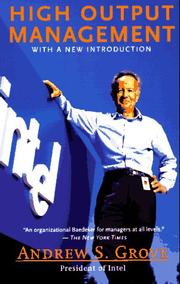
High Output Management
Insider: Grove's management system built at Intel; source of OKRs.
Summary
Grove defines a manager's output as the output of the organisation under their supervision plus the output of neighbouring organisations under their influence. Everything in the book follows from that definition. He treats management as a production process, opening with a breakfast factory to establish concepts of limiting step, batch size, work in progress and process, assembly and test operations.
The managerial leverage chapters give the highest-value material. Grove argues that a manager should spend time on activities that affect many people or affect them for a long time, and he ranks activities by that measure. He treats one-on-ones as a high-return activity, recommending that the subordinate sets the agenda and that the meeting lasts at least an hour. He analyses meetings as either process-oriented or mission-oriented and gives rules for both. He argues for dual reporting and hybrid organisations, which he says are unavoidable in any company that needs both functional depth and business focus.
The performance sections cover task-relevant maturity, which determines whether a manager should be structured or delegative with a given person on a given task, and they cover performance review as the single most important form of task-relevant feedback. Grove also describes objectives and key results, which Intel used and which John Doerr later carried to Google.
The book comes from Intel in the 1970s and early 1980s, and some of the examples show it. Manufacturing metaphors run throughout, and the treatment of knowledge work assumes more measurable output than many teams have. Grove's approach to performance ranking has aged less well than his approach to meetings and one-on-ones. The core definitions still hold, and the book remains the most concrete management manual written by a practising CEO.
Key takeaways 8
- A manager's output equals the output of their organisation plus the output of neighbouring organisations they influence.
- Managerial leverage is the measure that should govern how a manager allocates time, calculated as output produced per hour of managerial activity.
- Training your subordinates is among the highest-leverage activities available, and the manager must do it personally rather than delegate it.
- One-on-ones should be scheduled regularly, run for at least an hour and have their agenda set by the subordinate rather than the manager.
- Meetings are the medium of managerial work and should not be treated as an obstacle to it.
- The right management style depends on the subordinate's task-relevant maturity for that particular task, not on their seniority or the manager's preference.
- Indicators should come in pairs, because measuring only quantity or only speed will degrade the other dimension.
- Dual reporting and hybrid organisations are necessary in any company that needs both functional expertise and business-unit accountability.
Who should read it
Managers at any level who want a concrete operating manual rather than leadership philosophy, particularly those setting up meeting and review structures for the first time.
About Andrew S. Grove
Intel's third employee, later its chief executive and chairman, who ran the company through the shift from memory to microprocessors.
High Output Management defines a manager's output as the output of the organisation beneath and beside them, then supplies the mechanics for raising it: meetings, one-on-ones, indicators, task-relevant maturity, training. Only the Paranoid Survive names the strategic inflection point and shows, through Intel's exit from memory, how a company recognises one and moves.
Who recommended it 27 · 2 direct
Similar books 6
Chosen by shared topics, the entries that hold them, and the people who recommended both.

How to spot a strategic inflection point, when a tenfold force changes a business.
“On my Top Ten List. Great Book. Grove was CEO of Intel.” — Mohnish Pabrai
Source: Mohnish's Bookshelf — Books on Entrepreneurship, Management and Leadership, entry 174
Recommended by: Charlie Munger, Mohnish Pabrai and 11 others
What eleven companies did to turn fifteen ordinary years into fifteen great ones.
Recommended by: Brian Armstrong, Mohnish Pabrai, Nat Eliason and 16 others
Effectiveness is learned practice: manage time, pick priorities, decide well.
Recommended by: Ev Williams, Nat Eliason, David Cancel and 5 others
Subtitled 'Building a Business When There Are No Easy Answers'
“…books I've recommended, highlighted to death, or forced on friends.” — Andrew Wilkinson
Source: Andrew Wilkinson's Bookshelf, neverenough.com
Recommended by: Andrew Wilkinson, Balaji S. Srinivasan and 34 others

Full-scale biography by a Harvard business historian.
Recommended by: Patrick Collison, Keith Rabois
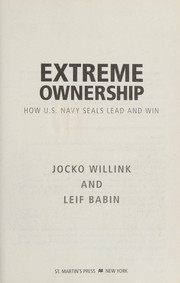
Navy SEAL leadership doctrine adapted to running teams and firms
Recommended by: Nat Eliason, Alfred Lin, Austin Rief and 9 others
Where it sits in the reference 5
Topics