Updates

  1. Person pages list letters, writing, profiles and links as sortable tables with filters, and show each person's companies as links; Fund letters show each letter's description in its own column.
  2. Experts show a checked job title and a short description of each person; 30 more people have photographs.
  3. Every company, fund, university and publication the experts work for has a page listing the people there.
  4. Fund letters show each letter's thesis and filter by it; 225 person pages list the essays, columns and newsletter issues the person wrote.
  5. Person pages list every essay and newsletter issue a person wrote, and their own books as a table in List view.
  6. Recommends shows the five largest kinds of book and the rest under More; browse pictures load sooner.
  7. Podcasts and talks link the original episode, filter by Audio and video or Press, and list each publisher once.
  8. Pages are wider, Recommends has List and Grid, and a filter clicked again turns off.
  9. Book cards sit in a ruled grid with Open Library and Goodreads links and each book's one-line note.
  10. Funds is now Investors; each investor's styles are buttons that filter the table.
  11. Podcasts and talks on a person's page filter by year and publisher and show as a list or a grid of pictures.
  12. Quotes show only people's own words: 472 summaries written by list sites are gone.
  13. Country pages open from Browse again, and every link on the shelf lands on a page.
  14. Subject and person pages show their sections as tabs, and each book appears once on a person's page.
  15. Book cards show the quote, who said it and the source; grids show five cards to a row.
  16. On a phone, a menu holds the sections, search, Updates, Feedback and dark mode.
  17. Feedback takes a screenshot of the page with no browser prompt, opens a screenshot full size when you click it, and clears itself once sent.
  18. Book cards are centred, search names the topic each book sits in, and any text cut short shows whole on hover.
  19. Search groups its results by kind: people, companies, geographies, subjects, topics, books, funds, fund letters and papers.
  20. The Books table lists who recommended each book by name, and the browser tab names the section you are in.
  21. Feedback can take a screenshot of the page, or one you paste or choose, and opens in the corner beside Updates.
  22. Each rail button reopens its section where you left it, and Browse, Table and People show on every book and subject page.
  23. Filters grey out choices that hold nothing instead of hiding them, and Books › People filters by authors or recommenders.
  24. Feedback takes a subject line and up to three screenshots.
  25. Biographies are grouped by the person they are about: 41 new pages, from Abraham Lincoln to Lee Kuan Yew.
  26. Sport splits into 23 sports, and Religion into one topic per faith.
  27. Book lists show as cards: the cover, one recommendation quote and every recommender by name.
  28. Seventeen subjects that had two or three pages under different names now have one page each.
  29. Every page lists its Experts as authors and recommenders, with a link to them on the Experts tab.
  30. Economics, Financial history, Financial panics and Accounting are subjects of their own, with one page per financial crisis.
  31. Book, person and subject pages open inside the app, so the tabs stay in view.
  32. 996 more book covers, and photographs or logos for 227 more people and companies.
  33. Books › Browse shows every subject as cards, and the rail holds Fund letters, Papers, Experts, Books and Funds.
  34. Every topic over 150 books splits into narrower topics, each with a page of its own.

Send feedback

What is it?
Screenshots, up to 3 (optional)
or paste one with Ctrl+V

We use your email only to reply to you.

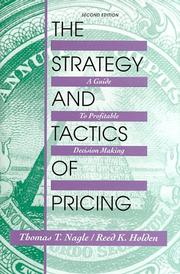
The Strategy and Tactics of Pricing

The Strategy and Tactics of Pricing

Thomas T. Nagle, Reed K. Holden
1987
T1 368 pages · about 6h 8m to read Open Librarygoodreads

The standard text on value-based pricing.

Summary

Nagle and Holden wrote the standard practitioner textbook on pricing, now in multiple editions. Its central instruction is that price should be set from customer value rather than from cost or from competitors' prices, and it works out what that requires in practice.

The method starts with economic value estimation: identify the customer's next best alternative, calculate its price, then quantify the differentiation value of your offering relative to it in monetary terms. That produces a ceiling. The book then covers price structure, meaning how to charge rather than how much, including metrics, tiers, bundling and two-part tariffs; price and value communication, since differentiation value must be perceived to be paid for; pricing policy, which governs discounting and negotiation behaviour over time; and price level.

The strategic chapters cover segmented pricing, competitive response and when not to respond to a competitor's price cut, the analysis of whether a price change is profitable given the required volume change at the relevant contribution margin, and price wars. The breakeven sales change analysis is the most immediately usable tool: it shows how much additional volume a price cut requires to be worthwhile, and the answer is almost always more than managers assume.

The book is a textbook, dry and thorough, and it assumes an industrial or business-to-business context more readily than a consumer subscription one. Later editions add software and subscription material but the framework predates modern usage-based and platform pricing. It remains the most complete treatment of the fundamentals.

Key takeaways 7

  1. Price should be set from the customer's economic value relative to their next best alternative, not from cost or from competitors' prices.
  2. Economic value equals the reference price of the customer's best alternative plus the monetary value of the differentiation, and both parts must be quantified.
  3. A price cut requires far more additional volume to be profitable than managers assume, and the required amount is determined by contribution margin.
  4. How you charge, meaning the pricing metric and structure, frequently matters more to profitability than how much you charge.
  5. Differentiation value must be communicated and believed before a customer will pay for it, so value communication is part of pricing rather than of marketing.
  6. Responding to a competitor's price cut is usually the wrong move, and the decision should turn on whether the competitor can sustain it and whether the cut is visible to your customers.
  7. Discounting policy should be set as a rule in advance, because discounts negotiated case by case teach customers to negotiate.

Who should read it

Operators and founders setting prices who need a complete method for value-based pricing, structure and discount policy.

Similar books 6

Chosen by shared topics, the entries that hold them, and the people who recommended both.

Hermann Simon · 2015

Price is the strongest profit lever and the least managed; how to set it well.

Recommended by: Michael Mauboussin
Jean-Noël Kapferer, Vincent Bastien · 2008

The standard analytical text on the LVMH-style brand model.

Tien Tzuo · 2018

Why firms are moving from selling units to selling ongoing subscriptions, and how.

Hamilton Helmer · 2016

Seven sources of lasting advantage, each a benefit plus a barrier to rivals.

Anita Elberse · 2013

Hit economics that explain Netflix's later spending strategy.

Mark Jeffery · 2010

Fifteen metrics that show which marketing spending works and which does not.

Recommended by: Mohnish Pabrai, Jeff Bezos

Where it sits in the reference 6

Business models
Business models
Business models
Business themes
Business themes
Business themes

Topics

Sales and MarketingBusiness and ManagementGrowth, pricing and channels